The Edit · Founder Insights
52 Running Events in Singapore for 2026, From Family Fun Runs to the BYD Marathon
Fifty-two running events in Singapore for 2026: 26 coached races, from the new Decathlon KipRun half marathon and AIA HYROX Singapore to the Singapore Half Marathon and the BYD Marathon, plus every major family fun run, charity walk and character run. Dates, distances, who each race suits, and how long to train for it. Curated by a Singapore studio that coaches runners year-round.

Singapore's 2026 running calendar is one of the deepest in the region, with nearly 40 organised events across road, trail, vertical, charity, kids, and competitive formats. The headline races sit across the year: AIA HYROX Singapore, whose marquee edition is at Singapore Expo from 26 to 29 November, the Great Eastern Women's Run at The Kallang on 1 November, and the year-end BYD Singapore International Marathon (previously the Standard Chartered Singapore Marathon) at the F1 Pit Building from 4 to 6 December. Between them sits a calendar of family fun runs, kids dashes, half marathons, character-themed runs, and charity walks that gives every Singapore runner a reason to put a race on the calendar. This is the curated list we use with our coached runners at Catalyst, ranked by training time-frame, who each race suits, and the race-prep block we would write against the date. For HYROX specifically, our guide to training for HYROX in Singapore covers the engine-first method and a 12-week plan.
TL;DR
- AIA HYROX Singapore's next edition runs 26 to 29 November 2026 at Singapore Expo, after a record weekend at the National Stadium in April. Eight stations of run-plus-workout; train 10 to 16 weeks.
- The BYD Singapore International Marathon (4 to 6 December 2026) is Southeast Asia's only World Athletics Gold Label road race; 16-week build for the half, 18 to 22 weeks for the full.
- Two big names sat 2026 out: Sundown Marathon and the SAFRA Bay Run and Army Half Marathon have published no edition since 2023, and the Lazada Run skipped the year entirely; each entry below carries its current status.
- Family-and-charity options through May to July (Diaper Dash, Run for Light, Great Green Run, Disney Run) make 2026 an easy year to get a first race on the calendar without a training block.
- Twelve weeks of structured strength plus mileage is the threshold below which most Singapore runners under-perform on race day; the Catalyst Healthspan Assessment shows you where your aerobic and movement baseline actually sits.
- The full calendar runs to 52 events: 26 coached races, from the new Decathlon KipRun half marathon (27 September) to the Singapore Half Marathon Powered by JomRun (11 October) and a GU Forest Force trail series, plus a family, charity and character fun-run table covering every Disney, Sanrio and cause run on the 2026 schedule, plus the SG61 Run For Singapore virtual national challenge.
Planning past December? The running events in Singapore for 2027 calendar tracks confirmed dates and registration windows as organisers announce them. If you want the dates on their own, The Catalyst Feed keeps a plain Singapore race calendar for 2026 and 2027 with a downloadable ICS file for the confirmed events.
Still deciding on 2026? A dozen of the races below still have confirmed dates ahead of them, and the biggest are all in the back half of the year: the Pocari Sweat Run on 5 September, the Garmin Run on 25 October, the Great Eastern Women's Run on 1 November and the BYD Singapore International Marathon from 4 to 6 December. The SAFRA Army Half Marathon and Sundown Marathon are still to be dated. For the training side rather than the dates, each major race has its own race profile and training guide.
Quick-reference table
| # | Event | Distances | Date | Difficulty | Best for | Entry fee |
|---|---|---|---|---|---|---|
| 1 | SAFRA Diaper Dash | 4 baby categories | 23 to 24 May 2026 | Beginner family | Parents with babies 6 to 23 months | SGD 60 member / 100 public |
| 2 | Run for Light | 1km / 5km / 10km | 23 May 2026 | Casual to moderate | Charity runners; first-time 10K | From SGD 55 |
| 3 | National Vertical Marathon | Multi-category climb | 24 May 2026 | Moderate to advanced | Vertical-format athletes; HYROX cross-train | From SGD 24 |
| 4 | Great Green Run | 800m / 5km / 10km | 14 June 2026 | Beginner to moderate | First-time runners; eco-aware families | 5km SGD 48 / 10km SGD 58 |
| 5 | Disney Run Singapore | 1km / 3km / 5km | 5 July 2026 | Beginner family | Kids and casual adult runners | From SGD 50 |
| 6 | Lazada Run | 5km / 10km / 21.1km | No 2026 edition (last ran 2025) | Beginner to advanced | Reclaiming the Singapore half marathon mid-year slot | TBC |
| 7 | Pocari Sweat Run | 5km / 10km | 5 September 2026 | Moderate | Heat-acclimatised competitive runners | From SGD 48 |
| 8 | Garmin Run Singapore | 10km / 21.1km | 25 October 2026 | Moderate to advanced | First-time half marathoners on the year-end build | 10km from SGD 85 / 21.1km from SGD 105 |
| 9 | Great Eastern Women's Run | 100m / 2km / 5km / 10km / 21.1km | 1 November 2026 | All levels | Women across every age and ability | From SGD 22 |
| 10 | AIA HYROX Singapore | 8-station HYROX | 26 to 29 November 2026 | Moderate to elite | HYROX-format athletes, Singles, Doubles, Relay | Singles SGD 196 / Doubles SGD 180pp |
| 11 | Sundown Marathon | 5km / 10km / 21.1km / 42.2km | No 2026 edition (last ran 2023) | Moderate to advanced | Night-race specialists; mid-year marathon target | TBC |
| 12 | BYD Singapore International Marathon | 5km / 10km / 21.1km / 42.2km | 4 to 6 December 2026 | All levels | Year-end target race; SG's flagship marathon | 5km SGD 98 / 21.1km SGD 168 / 42.2km SGD 188 |
| 13 | 2XU Compression Run | 5km / 10km / 21.1km | 5 April 2026 | Moderate | A flat, fast early-year half marathon | 5km SGD 80 / 10km SGD 90 / 21.1km SGD 105 |
| 14 | Income Eco Run | 3km / 5km / 10km / 15km / 21.1km | 19 April 2026 | Beginner to moderate | A beginner-friendly distance ladder | From SGD 40 |
| 15 | Unlabelled Run | 5km / 10km | 6 June 2026 | Moderate | 10K runners; an unbranded mid-year tune-up | 5km from SGD 45 / 10km from SGD 60 |
| 16 | GU Forest Force Run Series | 21km / 30km trail | 5 Jul & 13 Sep 2026 | Advanced | Trail and ultra-distance runners | 21km from SGD 80 / 30km from SGD 90 |
| 17 | Singapore Half Marathon and Run | 3km / 5km / 10km / 21.1km | 19 July 2026 | All levels | Mid-year half marathon target ("Run as One") | TBC |
| 18 | SAFRA Bay Run & Army Half Marathon | 5km / 10km / 21.1km | No 2026 edition (last ran 2023) | Moderate to advanced | NSmen and one of SG's largest 21K fields | TBC |
| 19 | Running Lab Run | 5km / 10km / 15km | 30 August 2026 | Moderate | Committed 10K runners; East Coast benchmark | 5km from SGD 50 / 10km from SGD 60 |
| 20 | Yellow Ribbon Run | 5km / 10km / 888m parent-child | 20 September 2026 | All levels | Charity runners; second-chances cause | TBC |
| 21 | Decathlon KipRun Run | 5km / 10km / 21.1km | 27 September 2026 | All levels | Value-focused half marathoners | 10km from SGD 60 / 21.1km from SGD 78 |
| 22 | Run For Hope | 5km / 10km | 29 November 2026 | Beginner to moderate | Charity 10K; cancer-research cause | TBC |
| 23 | HomeTeamNS REAL Run | 5km / 10km / Fun Walk | 3 October 2026 | Beginner to moderate | A late-afternoon heat test before a year-end race | SGD 25 to 70 |
| 24 | Singapore Half Marathon (JomRun) | 5km / 10km / 21.1km | 11 October 2026 | Moderate to advanced | An eight-week tune-up before the BYD Marathon | From SGD 89 |
| 25 | Stride For Good | 3km / 6km | 17 October 2026 | Beginner to moderate | Charity 6km; BCARE's 30th anniversary | SGD 15 to 40 |
| 26 | KEEN Dark Forest Run | 8km / 12km / 20km trail | 31 October 2026 | Moderate to advanced | Night trail racing; the only after-dark race on the calendar | From SGD 78 |
Entry fees are indicative standard or early-bird rates from each organiser as of June 2026; most exclude GST and processing fees, and rise closer to race day. Confirm the current fee on the organiser's own registration page. Races marked TBC have not opened 2026 registration yet.
Before race day
Is your engine ready for the race you just picked?
Take the free 2-minute Healthspan Audit: your estimated VO2 max, strength and body-composition scores, benchmarked against over 1500 Singapore results.
Take the free audit →Now for the training
The runners who reach the start line strong, and the finish line uninjured, do more than log kilometres. They build the strength and run-specific conditioning that mileage alone never gives. Our coaches programme that 1:1 in the CBD, paced to your race, or you can follow the strength programme yourself.
Free runner tools
Two free calculators to pace the training and set the zones you run it in.
Singapore is one of the most race-dense small countries in the world. The Singapore Athletics calendar and the broader event listings on JustRunLah, Ahotu, and Finishers list 30-plus organised running events across the 2026 year, with race-day footprints ranging from 200 participants at trail-running club progressives to 55,000-plus at the year-end marathon. For a country of 5.9 million people, that participation density is comparable to Tokyo or Berlin on a per-capita basis. It means there is a race on the calendar for almost every shape of runner: parents with babies, first-timers running their first 5K, charity walkers, competitive HYROX athletes, and sub-3-hour marathon hopefuls.
The challenge for most Singapore runners is not finding a race. It is picking the right one. The same calendar that gives you 30-plus options also gives you 30-plus ways to commit to a goal you cannot train for in time, in a climate that punishes under-preparation more aggressively than temperate-zone race calendars do. A runner who registers for the BYD Singapore International Marathon in October with no base of long runs is signing up for a finish line they will reach, but not in the shape they wanted to be in. The race-prep block matters more than the race itself.
We coach runners at Catalyst from the same starting point regardless of which race is in the calendar, the same 1:1 personal trainer in Singapore method, weighted to the race. Our running-specific positioning is anchored on Jeremy, a 25-plus marathon athlete with three HYROX podium finishes who writes the periodisation he uses on himself for clients targeting their first half, a sub-4-hour marathon, or a sub-3. Every runner who starts with us takes the Catalyst Healthspan Assessment, which surfaces the Cardiorespiratory Fitness score, Heart Rate Recovery, Y-Balance asymmetry, and strength-pillar bottlenecks that decide what your current race-readiness actually is. From there the calendar becomes a planning artefact, not a wish list. Whatever you are training for, the biggest threat to race day is an injury in the buildup, so build the base our guide to the most common running injuries in Singapore lays out.
The biggest threat to race day is an injury in the buildup, so if something flares mid-block, treat it early: a physiotherapist settles the acute pain, and our rehab and return-to-run support rebuilds the strength to get you back on the start line.
Find a race by distance. Family and short runs: SAFRA Diaper Dash, Disney Run, and Great Green Run. For a 10K: Run for Light, Pocari Sweat Run, Running Lab Run, HomeTeamNS REAL Run, and Garmin Run. For a half marathon (21.1km): Sundown, Garmin Run, Decathlon KipRun, the Singapore Half Marathon Powered by JomRun, and the BYD Marathon. For a full marathon (42.2km): Sundown Marathon and the BYD Singapore International Marathon.
The list below covers 22 of the 2026 calendar's most significant races, chosen to span every shape of runner. The headline marathons and HYROX SG sit alongside the family-and-kids slots, the charity runs, the trail series, and the brand-themed runs that give Singapore's calendar its character. For each, we cover what the race is, the distances on offer, the course profile, who it suits, the training time-frame, and where it fits in a Catalyst-coached calendar. Pair this with our six best times to run in Singapore guide if your training window is the binding constraint, and with the Heart Rate Recovery diagnostic if you are not sure whether you are aerobically ready to start a race-prep block.
1. SAFRA Diaper Dash 2026 (23 to 24 May, SAFRA Punggol)
The SAFRA Diaper Dash is the most charming entry on the Singapore running calendar, and one of the most popular: babies aged 6 months to 23 months crawl or toddle a short course set up by SAFRA at the Punggol clubhouse, divided into four age-band categories, with parents cheering from the finish line. The 2026 edition runs Saturday 23 to Sunday 24 May with a Pororo Park partnership, so expect a heavily themed event with photo-booths, balloon arches, and merchandise tied to the children's character franchise. The Diaper Dash is consistently one of the most photographed kid-running events of the Singapore year, and it is the entry point that puts many parents on the start line of the Catalyst running calendar a few years later.
The training time-frame is zero for the baby; the harder logistical exercise is signing up early, because the categories fill within the first registration window and SAFRA tends to close enrolment by mid-April. For parents thinking about their own race calendar, the Diaper Dash weekend is a natural anchor to build their first 5K or 10K registration around. We have multiple Catalyst clients who started their own running journey six to twelve months after their child's first Diaper Dash. If that is the shape of your year, the Catalyst Healthspan Assessment is the diagnostic that tells you what your aerobic baseline is and whether you can build to a 10K race-finish within the same calendar year. For most working adults with no current running base, the honest answer is yes, with 12 to 16 weeks of structured training.
Bonus insight: the Diaper Dash is also a low-stress recce of the Punggol Waterway Park running route, which is one of the most underrated 5K to 7K loops in Singapore for early-morning runs. The park connector runs east toward Punggol Settlement and west toward Sengkang, both of which are quieter than Marina Bay or the East Coast Parkway in the 6 to 7:30am window. Registration: safra.sg/whats-on/safra-diaper-dash-2026.
2. Run for Light 2026 (23 May, Pasir Ris Park)
Run for Light is the charity race for runners who want to use their training block in support of Singapore's visually impaired community. The 2026 edition starts at 5pm on Saturday 23 May at Pasir Ris Park, with a 1km blindfolded walk format, a 5km fun run, and a 10km competitive run. The blindfolded walk is the signature element: sighted participants are paired with guides and walk the 1km course with their eyes covered, which makes a vivid case for the daily mobility challenge faced by Singapore's roughly 50,000 visually impaired residents.
The 5km and 10km are friendly distances for runners 12 to 16 weeks into a structured block. The Pasir Ris course is mostly flat with reservoir, boardwalk, and tree-cover sections, the 5pm start avoids the worst of the lunchtime heat, and the post-event social runs late into the evening with a community feel that the larger commercial races do not replicate. For first-time 10K runners, this is one of the friendlier debut races on the 2026 calendar because the start-line atmosphere is built around participation, not pace.
For runners coming out of the 4-Pillar Assessment with a Cardiorespiratory Fitness score below the 50th percentile for their age and sex band, we would prescribe a 12-week build to the 5km, with two Zone 2 runs and one tempo session per week, plus one strength session. For runners above the 50th percentile, the 10K is achievable in 8 to 10 weeks with the same template at slightly higher volumes. We cover the specifics of where your training window should sit in the day in our six best times to run guide; for a 5pm race start, the late-afternoon training slot is the natural fit. Registration: runforlight.com.
3. National Vertical Marathon 2026 (24 May, Guoco Midtown)
The National Vertical Marathon is one of Singapore's most distinctive event formats: instead of running horizontally for kilometres, athletes climb the staircases of a chosen tower for as fast a time as possible. The 2026 edition runs on Sunday 24 May at Guoco Midtown, with categories spanning Junior Climbers, Duo Challenge, Family Fun, and the competitive Open category for adults. The course is approximately 33 floors, depending on the category, and the winning times sit around 4 to 6 minutes for elite climbers.
The training profile is materially different from a road race. Vertical-format racing draws on quadriceps power, calf-soleus endurance, and the ability to maintain pace under cumulative lactate load, which has more in common with HYROX or stadium-step training than with marathon prep. For runners with a strong cycling background or those who do regular stair work in their building's stairwell, the National Vertical Marathon is a high-yield race to plug into a calendar without disrupting a marathon block. We have coached HYROX athletes who use the Vertical Marathon as a race-pace simulation for the lunges-and-step elements of their HYROX-prep block.
Specifics for the build: 6 to 8 weeks of structured stair work, three sessions per week, with one heavier session (longer rest, max-effort intervals), one moderate (Zone 3 sustained climbs), and one easy recovery climb at conversational pace. The Sentral Marina staircases at Telok Ayer or the apartment stairwell of your own building are sufficient training surfaces; you do not need to find Guoco Midtown's actual staircases. Pair with one heavier lower-body strength session per week focused on hip-driven hinge patterns and single-leg loading, both of which are bottlenecks in the final third of any stair race. Registration: nationalverticalmarathon.com.
4. Great Green Run 2026 (14 June, Marina Barrage)
The Great Green Run is one of Singapore's most welcoming first-race options. The 2026 edition starts at 6am on Sunday 14 June at Marina Barrage, with distances spanning 800m for kids, 5km fun run, and a 10km competitive option. The race is themed around sustainability and runs alongside an eco-bazaar at the start-finish area, which makes the post-race atmosphere closer to a community festival than a competitive event. Marina Barrage offers one of the most photogenic Singapore start-finish backdrops in the year-end half of the calendar.
The 6am start is genuinely cool by Singapore standards, with surface temperatures around 26 to 28 degrees and the heat index sitting around 28 to 30. The course runs along the Marina Reservoir loop, the Helix Bridge, and the Marina Bay waterfront, which is flat, well-lit, water-station-equipped, and visually rewarding. For first-time 5K runners, the Great Green Run is one of the friendliest debut events on the calendar because the field includes a wide range of paces and the 5K distance is achievable in 8 to 12 weeks for most adults starting from a sedentary baseline.
The Catalyst training block for a Great Green Run debut runs 10 to 12 weeks. Three sessions per week: one Zone 2 base run of 30 to 45 minutes, one interval session of 6 to 8 x 400m at 5K pace with 90-second recoveries, and one longer Zone 2 run building from 5km up to 7km in the final fortnight. Plus one to two strength sessions per week, focused on lower-body force production and trunk stability. We catch the most common training error, running too hard on the easy days, by checking Heart Rate Recovery after every easy session for the first 4 to 6 weeks of the block. Registration: greatgreenrun.com.
5. Disney Run Singapore 2026 (5 July, Sentosa)
The Disney Run is the largest character-themed run on the Singapore 2026 calendar. The event starts at 7:30am on Sunday 5 July at Siloso Beach Walk on Sentosa, with non-competitive 1km, 3km, and 5km distances. Expect heavily themed photo opportunities along the course, Disney character meet-and-greets at the start-finish area, and merchandise that draws families from across the region. The Sentosa setting is the high point: the 3km and 5km routes wind along the southern coast of Sentosa with views over the Singapore Strait and finish near Siloso Beach for the post-race festivities.
The Disney Run is genuinely a family event, not a competitive race. Most participants walk the 1km, jog-walk the 3km, and slow-jog the 5km, with completion times spread between 20 and 75 minutes for the 5K distance. For Catalyst clients in their first race-prep block, the Disney Run is a low-stakes target that lets them experience the start-line logistics, race-day pacing, and finish-line atmosphere without the pressure of a competitive timing. We have coached parents through Diaper Dash, Disney Run, then Great Green Run in the same year as a progressive ladder onto their own running journey.
Specifics: the 5km distance is the most ambitious target for a parent run-walking with their child. Sentosa's surface is largely flat with one short rise near Imbiah Lookout. The post-event window typically runs until 11am, so families can carry on into a Sentosa day after the run. Plan logistics around the Sentosa Express monorail or the Sentosa Boardwalk on foot. For runners using the Disney Run as a training-block waypoint to a December marathon, the 5K can be run at Zone 2 to Zone 3 with no taper required. Registration: raceroster.com/events/2026/125464/disney-run-singapore-2026.
6. Lazada Run 2026 (no 2026 edition announced)
The Lazada Run is the e-commerce giant's branded race and one of Singapore's most search-popular running events in the mid-year calendar, but no 2026 edition materialised: the branded lazada.sg/lazrun page now loads as an empty storefront shell, no 2026 listing appeared on the registration platforms, and the event's usual late-July window has passed without a race. The last confirmed edition ran on 27 July 2025 at the Singapore Sports Hub with the three-distance format: 5km fun run, 10km competitive run, and the 21.1km half marathon. The half marathon distance was the standout: relatively few Singapore mid-year races offer a half, and the Lazada Half was the natural mid-year build target for runners targeting a December full marathon.
The course typically runs from the Singapore Sports Hub along the Kallang Basin and out to East Coast Parkway, then back to the stadium finish. The half marathon route is mostly flat with sea-breeze sections through ECP, and the 10K and 5K loop back inside Marina Bay. The Lazada Run is one of the better-organised commercial races in Singapore: timing chips, multiple water stations, isotonic and electrolyte support, post-race meal, and a lift-deck merchandise area branded heavily for the platform.
The Catalyst training block for the Lazada Half is 14 to 16 weeks for a debut half marathoner, 12 to 14 weeks for an experienced 10K runner stepping up. The plan is built around three runs per week (one easy Zone 2, one tempo or interval, one progressively longer Sunday run building to 18km in the final fortnight), plus two strength sessions. Jeremy writes the periodisation against your race date; we tend to position the Lazada Half as a confidence-building mid-year race for clients on a December marathon block. The half marathon time you run in late July becomes the data point that calibrates your marathon pace projection for December. With no 2026 edition, runners wanting a mid-year half can slot the Singapore Half Marathon and Run (19 July) into the same calendar position.
7. Pocari Sweat Run 2026 (5 September, Singapore Sports Hub)
The Pocari Sweat Run is the Japanese isotonic-beverage brand's annual Singapore race, scheduled for 5:30am on Saturday 5 September 2026 at the Singapore Sports Hub. Distances are 5km fun run and 10km competitive run. The early morning start makes Pocari Sweat one of the cooler races on the calendar despite landing in the year's hottest stretch; surface temperatures at 5:30am sit around 26 to 27 degrees. The course runs around Stadium Roar and Stadium Riverside Walk, which gives the race a contained-feeling, well-marshalled atmosphere different from the Marina Bay or East Coast loops.
The race fits well as a pre-October build event for runners targeting Garmin Run (25 October) or the BYD Singapore International Marathon (4 to 6 December). A 10K at race pace in early September is a high-yield data point: it tells you what your current threshold pace is, where your heat tolerance sits in Singapore's hottest month, and whether your race-day fuelling strategy holds up over a 50-to-65-minute effort. The Catalyst coached approach is to treat Pocari Sweat as a tune-up race rather than a peak target, which means no taper week and a Zone 4 controlled effort rather than an all-out PB attempt.
Specifics: for runners on a December marathon block, we typically programme a one-week deload (reduced volume, intensity preserved) in the lead-up to Pocari Sweat, then resume marathon-prep volume immediately after. The post-race recovery for a 10K at threshold pace is 48 to 72 hours; long Sunday runs resume on the following weekend at the prescribed marathon-block volume. Heart Rate Recovery tracking after this race gives a clean reading of your aerobic conditioning entering the final 12 weeks of marathon build. Registration: jomrun.com/event/pocarisweatrun2026.
8. Garmin Run Singapore 2026 (25 October, Marina Barrage)
The Garmin Run is one of Singapore's most established commercial races, and the 2026 edition lands on Sunday 25 October 2026 at Marina Barrage. Distances are 10km and the 21.1km half marathon, with cash prizes for top finishers in both. The Garmin Run is sponsor-rich with timing data, watch-integration giveaways, and a heavily branded merchandise pickup, which makes it the natural target race for any runner who has invested in the Garmin ecosystem.
The course is Marina Bay and the East Coast: the half marathon route typically goes south through ECP and back, with the 10K looping inside Marina Bay. Both distances are flat with the standard Singapore heat-and-humidity profile by 7am. For runners targeting the BYD Singapore International Marathon (4 to 6 December), the Garmin Half is the natural confidence-building race six weeks before race day. Run at Zone 3 to low Zone 4, the half marathon time you produce in late October sits within plus-or-minus 90 seconds per km of your December marathon goal pace.
The Catalyst training block for the Garmin Half is 12 to 16 weeks for a debut half marathoner, with three runs and two strength sessions per week, building peak long-run distance to 18km in the final fortnight. For runners using Garmin as a marathon tune-up, we taper one week before, race at controlled effort, and resume full marathon-block volume the following weekend. The interaction between the Garmin race-pace effort and the final marathon-prep block is where the calendar planning matters most; running Garmin too hard sacrifices the December race.
Bonus insight: the Garmin Run starts and finishes at Marina Barrage, which is a useful base for the long runs that build into the race. The Marina Bay loop is 3.5km, which gives you a clean way to count race-pace efforts in laps. The water and toilet infrastructure at Marina Barrage stays available year-round, making it the canonical Saturday long-run anchor point. Registration: garmin.com.sg/event/2026/garmin-run/information.html.
9. Great Eastern Women's Run 2026 (1 November, The Kallang)
The Great Eastern Women's Run is the largest women-only race in Singapore and one of the largest in Southeast Asia. The 2026 edition runs on Sunday 1 November with the most comprehensive distance lineup on the year-end calendar: a 21.1km half marathon, 10km competitive, 5km fun run, a 2km Mummy+Me category for mothers with daughters, and a 100m Princess Dash for young children. The event consistently draws 12,000 to 15,000-plus participants, which makes it both the largest women's race in the region and a meaningful social event in the Singapore running calendar.
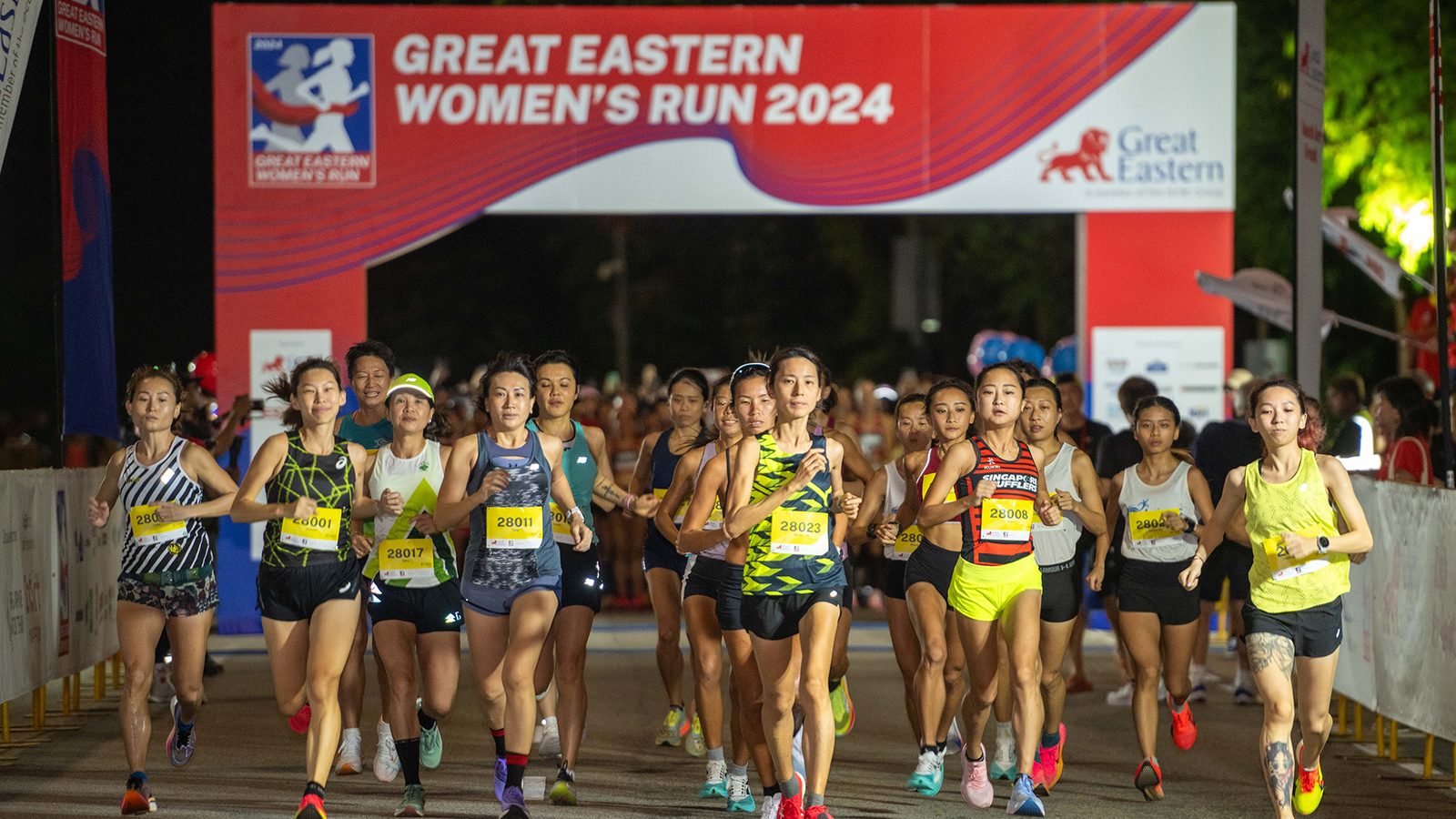
The 2026 edition, the event's 20th, is held at The Kallang, the precinct around the National Stadium. The 7am start sits in the cooler edge of the early-morning window; surface temperatures hold around 27 to 28 degrees with the heat index sitting in the high 20s. The race has a strong post-event social atmosphere with vendor booths, family activities, and a charity component supporting women's health programmes.
The Catalyst training block calibrates differently across the distance options. For the 100m Princess Dash, no formal training needed, but the participation is meaningful for young daughters entering their first race environment. For the 5km, an 8 to 10-week block is achievable from a sedentary baseline. For the 10km, 12 to 14 weeks. For the half marathon, 14 to 16 weeks with three runs and two strength sessions per week. We programme this race specifically against women's strength and cardiorespiratory profiles, which differ from men's in injury susceptibility (knee, hip, pelvic floor) and in pacing patterns. The 4-Pillar Assessment includes Y-Balance asymmetry testing that catches the patterns most likely to break down at half-marathon distances. Registration: greateasternwomensrun.com.
10. AIA HYROX Singapore 2026 (26 to 29 November, Singapore Expo)
AIA HYROX Singapore is the headline functional-fitness race on the 2026 calendar. After a record three-day weekend at the National Stadium across 3 to 5 April 2026, the marquee edition returns from Thursday 26 to Sunday 29 November 2026 at Singapore Expo. The April weekend drew 14,000-plus athletes across all categories, the first time HYROX staged a three-day race in Singapore, which reflects how the format has grown locally since its Singapore debut a few years ago. The race format is fixed: one kilometre of running followed by one functional workout station, repeated eight times. Stations include SkiErg, sled push, sled pull, burpee broad jumps, rowing, farmer's carry, sandbag lunges, and wall balls. Thinking further ahead? Our HYROX Singapore page covers what is known about 2027, the divisions and entry costs.

Categories on offer cover the Open (Pro and Standard), Doubles (Pairs), and Relay formats, with weight loads and station rep counts differing between divisions. The race draws a mixed field: HYROX-specific athletes peaking for the event, CrossFit-style functional athletes treating it as a benchmark, and increasingly, runners adding HYROX as a strength-and-conditioning target alongside their marathon calendar. We coach HYROX athletes year-round at Catalyst, with Jeremy (3 HYROX podium finishes), Kaihan (multiple podium finishes plus HYROX Level 1 certification), and Elly (over 20 HYROX international podium finishes over-40, most recently a double win at HYROX Mumbai) on the coaching stack.
The training time-frame is 10 to 16 weeks depending on starting baseline. The HYROX-prep programme we run with clients is split across run-station intervals (the 8 x 1km running between stations is the hidden bottleneck for runners who think their conditioning is fine), strength-endurance work at HYROX station-specific loads, and a final taper week. Our HYROX training landing covers the format-specific work in more detail. The most common preparation error is treating HYROX as a CrossFit race; the running between stations is what separates podium times from middle-of-the-pack times. We catch the run-pacing problem early in the block with the Cardiorespiratory Fitness pillar of the 4-Pillar Assessment, and we cover the practical race-day tips in our HYROX first-timer guide. Registration: hyroxsingapore.com/find-my-race. HYROX runs a Singapore race once on the confirmed 2026 calendar, the April National Stadium weekend; the sport's 2026/27 season may add a second Singapore date later in the year, so check hyroxsingapore.com for the next-season calendar before you commit to a Q4 block.
11. Sundown Marathon 2026 (no 2026 edition, event dormant)
Sundown Marathon is Singapore's only major night marathon and one of Southeast Asia's most distinctive race events, but it has not returned to the calendar: no 2026 edition was announced, and the organiser's own site remains frozen on the 2023 race, the last edition that verifiably ran (20 to 21 May 2023). The organiser also skipped 2024 entirely. We keep the entry here because the format is worth knowing if it revives: distances spanning 5km, 10km, 21.1km half marathon, and 42.195km marathon, with the flagship marathon starting late on Saturday evening and finishing in the early hours of Sunday morning, the only mass-participation race in the calendar where runners cross the line under stadium floodlights rather than sunrise.
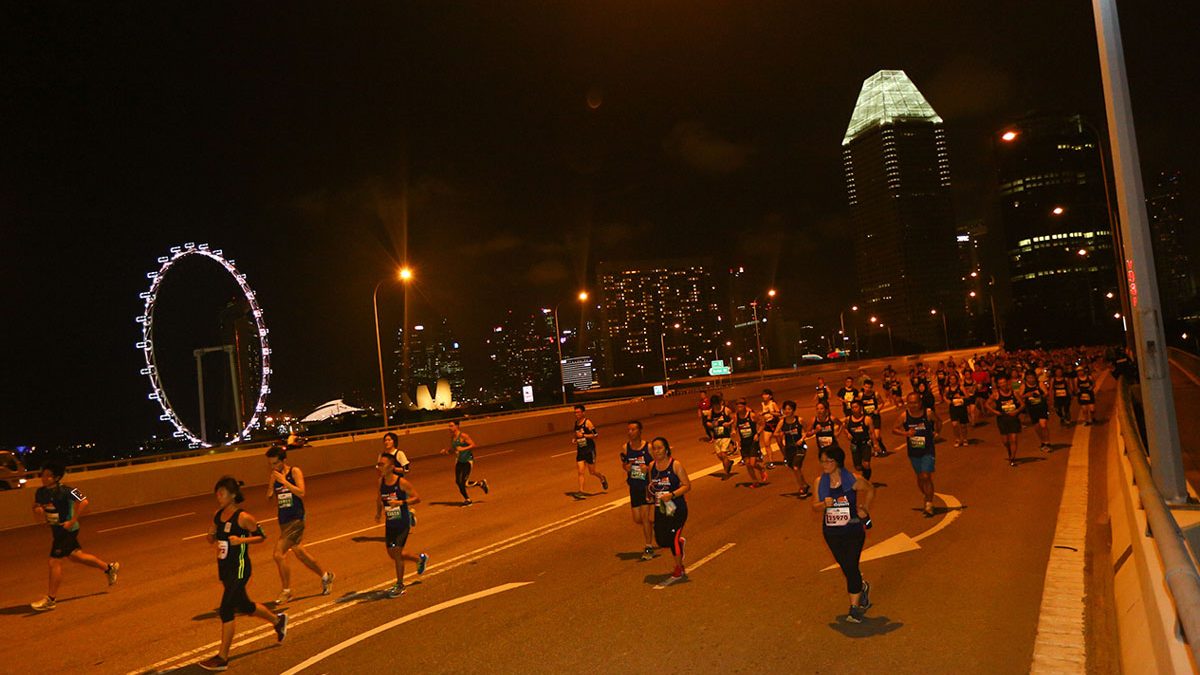
The cooling premise is real but partial. Overnight surface temperatures in Singapore drop to around 26 to 28 degrees by midnight, which is genuinely cooler than the 30-to-32-degree mid-day baseline. But the humidity holds at 80 to 90 percent overnight, which means the heat index sits around 28 to 30 degrees, only modestly better than the early-morning window. Sundown's claim to be cooler than other Singapore marathons is broadly true; the claim that it is comfortable is more generous. Runners who do well at Sundown specifically condition for high-humidity overnight running in training, not just for the heat.
If Sundown returns, the Catalyst training block is 18 to 22 weeks for a debut marathoner, 16 to 20 weeks for an experienced runner stepping up from the half marathon. The unique element is the late-night training simulation: at least four overnight long runs in the final twelve weeks, starting at 8 to 10pm and finishing at 1 to 3am, so the body adapts to the circadian profile of the race. Jeremy writes the periodisation against the announced race date, with sleep architecture protected on training days that are not overnight long runs. The two strength sessions per week stay on the calendar throughout, since lower-body durability is what separates a 4-hour Sundown finisher from a 4:45 finisher in the final 8km. Check sundownmarathon.com before trusting any third-party 2026 or 2027 date for this race; aggregator listings are forecasts carried forward from old editions, not announcements.
12. BYD Singapore International Marathon 2026 (4 to 6 December, F1 Pit Building)
The BYD Singapore International Marathon (formerly the Standard Chartered Singapore Marathon) is the country's flagship year-end race and the only World Athletics Gold Label road race in Southeast Asia. The 2026 edition runs from Friday 4 to Sunday 6 December at the F1 Pit Building and Great Eastern Promenade, with distances spanning 5km, 10km, 21.1km half marathon, 42.195km marathon, and a Kids Dash. The 2025 edition drew over 55,000 participants; the 2026 edition is expected to match or exceed that figure under the new BYD title sponsorship. The race organising body changed in 2026 (SG Marathon Pte Ltd took over from Ironman Group), which is a structural change to watch as registration and logistics roll out. For the December race itself, our Singapore Marathon 2026 race guide covers the new two-day format, registration deadlines and the 12-week preparation window.

The course is Singapore's flagship marathon route: from the F1 Pit Building, north along the Esplanade and Marina Bay, across the Helix Bridge into Gardens by the Bay, then south through Marina South and East Coast Parkway, and back to the F1 Pit Building finish. The route is overwhelmingly flat (one short rise at the Helix Bridge), well-stocked with water stations every 2.5km, and lined with thousands of spectators in the Marina Bay zone. The 4am start for the marathon mitigates the morning heat for the first 25-30km, but the final 12km lands between 7:30 and 9:30am, which is where most marathoners hit the wall in the rising surface temperature.
The Catalyst training block for the BYD Marathon is the most consequential race-prep on the year-end calendar. 18 to 22 weeks for a debut marathoner, 16 to 20 weeks for an experienced runner targeting a sub-4 or sub-3:30 finish. The plan is built around four runs per week (one easy Zone 2, one tempo, one Zone 4 to Zone 5 interval session, one long Zone 2 building to 32km in the final fortnight), plus two strength sessions, plus weekly Heart Rate Recovery tracking. Jeremy writes the periodisation specifically against the December race date; we tend to insert the Garmin Half (25 October) or the Great Eastern Half (1 November) as a confidence-building tune-up race in the final 6 weeks. The most common preparation error is over-training in the final 4 weeks, which destroys race-day capacity; the second most common is under-training the long-run progression, which produces a 30km wall on race day. The Catalyst-coached marathoner approach is consistency over intensity, with the calendar protected against both errors. Registration: singaporeinternationalmarathon.com. Our marathon training plan for Singapore sets out that build week by week, and average marathon times in Singapore shows where a realistic first finish sits.
13. 2XU Compression Run 2026 (5 April, F1 Pit Building)
The 2XU Compression Run is one of Singapore's largest early-year road races and, for many runners, the first half marathon of the calendar. The 2026 edition starts pre-dawn at the F1 Pit Building on Sunday 5 April, with 5km, 10km, and 21.1km options sharing the flat, fast Marina Bay circuit. The early-April slot makes it the natural target for runners who want a half marathon banked before the mid-year heat peaks.
The Catalyst training block for a 2XU debut half is 14 to 16 weeks, three runs and two strength sessions a week, with the long run built progressively toward 18km. The course is flat and the start is cool, so it rewards even pacing over early surges. If you are not sure you are aerobically ready to commit to a 21.1km block, the Cardiorespiratory Fitness score from the Catalyst Healthspan Assessment is the honest place to start. Our running pace calculator turns a target finish time into the per-km pace to train at.
14. Income Eco Run 2026 (19 April, Bayfront Event Space)
The Income Eco Run is Singapore's best-known sustainability-themed road race and one of the most beginner-friendly large events on the calendar, with a distance ladder from 3km up to the 21.1km half marathon. The 2026 edition is set for Sunday 19 April from the Bayfront Event Space, two weeks after the 2XU run, which makes the pair a convenient April progression for a runner moving up in distance.
The wide range of distances makes the Income Eco Run a good first organised race for someone fresh out of a Cardiorespiratory Fitness baseline. We typically point first-timers at the 5km or 10km here and reserve the half for runners with a 12-to-16-week block behind them. For structured run coaching around either target, see our personal training for runners in Singapore.
15. Unlabelled Run 2026 (6 June, The Kallang)
The Unlabelled Run is a mid-year 10K-and-5K race at The Kallang, the venue formerly known as the Singapore Sports Hub, on Saturday 6 June 2026 with a 7am flag-off. The premise is in the name: a race stripped of the heavy commercial branding that defines most of the Singapore calendar, with a community-first start line and a flat, fast stadium-and-Kallang-Basin loop. For a runner emerging from a sedentary baseline, the 10km here is one of the better early-summer targets, banked before the July heat peak.
The Catalyst training block for a 10K debut is 12 to 14 weeks, three runs a week (one Zone 2 base, one interval session at 5K pace, one progressively longer Sunday run) plus one to two strength sessions. If you are not certain your aerobic base is ready for a 10K block, the Cardiorespiratory Fitness score from the Catalyst Healthspan Assessment is the honest starting point. Registration and updated timings are released through the organiser's channels and the JustRunLah race calendar.
16. GU Forest Force Run Series 2026 (5 July and 13 September, Dairy Farm)
The GU Forest Force Run Series is the trail entry on this list, and the only one that takes runners off the road and onto Singapore's nature-reserve terrain. The 2026 series runs a 21km trail half marathon on Sunday 5 July and a 30km trail ultra on Sunday 13 September, both starting from the Dairy Farm MOE Adventure Centre at the edge of the Bukit Timah and Central Catchment nature reserves with a 6:50am flag-off. Trail distances are not directly comparable to road distances: the 21km trail route, with its elevation, roots, and technical descents, sits closer to a 25 to 28km road effort in physiological cost, and the 30km is a genuine ultra-distance introduction.
Trail racing demands a different training block from road racing. The bottlenecks are ankle stability, eccentric quad strength for the descents, and the aerobic durability to hold form over uneven ground for two to four hours. We build trail runners with a heavier emphasis on single-leg loading and the Y-Balance asymmetry work surfaced in the 4-Pillar Assessment, because a stability deficit that a road runner can mask on flat tarmac gets exposed immediately on a technical descent. Plan 14 to 18 weeks for the 21km trail and 18 to 22 weeks for the 30km, with at least four sessions on trail terrain in the final eight weeks. Registration and route details are confirmed through the organiser's channels and the JustRunLah race calendar. For routes to build that durability on, see our guide to trail running in Singapore.
17. Singapore Half Marathon and Run 2026 (19 July, East Coast Park, completed)
The Singapore Half Marathon and Run, themed "Run as One" around unity and racial harmony, is one of the stronger mid-year half marathon options on the 2026 calendar. The race was held on Sunday 19 July 2026 at East Coast Park, with a 5am start for the 21.1km half marathon, a 3.5-hour cut-off, and a distance ladder of 3km, 5km, 10km, and the half. The pre-dawn start and the sea-breeze ECP route make this one of the cooler-feeling half marathons of the year, which matters in July when daytime surface temperatures sit in the low thirties.
For runners on a December marathon block, the Singapore Half in July sits at almost the same calendar position as the Lazada Half, and either one works as the mid-year confidence-building race that calibrates your marathon pace projection. Jeremy writes the periodisation against your race date; the half marathon time you run in July becomes the data point that sets your BYD Marathon goal pace in December. The Catalyst training block is 14 to 16 weeks for a debut half, three runs and two strength sessions a week, with the long run built progressively to 18km. This race has now been run, and its registration listing has been taken down. It is a separate event from the Singapore Half Marathon Powered by JomRun, which is a different organiser at a different venue and is still ahead on the calendar; see number 24 below if you are looking for a half marathon in the second half of the year.
18. SAFRA Singapore Bay Run and Army Half Marathon 2026 (no 2026 edition, last ran 2023)
The SAFRA Singapore Bay Run and Army Half Marathon is one of the largest mass-participation races in Singapore, drawing in the region of 40,000 to 50,000 runners across its categories, with a strong NSmen and uniformed-services community at its heart. The race historically lands in late August in the Kallang precinct, but it has not run since 27 August 2023: no 2024, 2025 or 2026 edition appears anywhere on SAFRA's own site, and the old event page now returns a dead link. Treat the race as dormant until SAFRA publishes a new edition. The category lineup is built around the 21.1km Army Half Marathon, with a SAFRA 10km, a 5km fun run, and team and family categories alongside it.
The 21.1km here is a serious target in the hottest, most humid stretch of the Singapore year, so heat conditioning is non-negotiable: the August heat index can sit above 33 degrees even at the morning start, which punishes any runner who has trained only in air-conditioned comfort. The Catalyst block for the Army Half is 14 to 16 weeks, with the heat-acclimatisation runs front-loaded and Heart Rate Recovery tracked weekly to catch the cardiovascular drift that humidity drives. We cover where to put your training runs in the day in our six best times to run guide. If it returns, registration will surface on safra.sg.
19. Running Lab Run 2026 (30 August, East Coast Park)
The Running Lab Run is the specialist running retailer's annual race, scheduled for Sunday 30 August 2026 at East Coast Park, with a 5km easy run, a 10km competitive run, and a 15km category. As a retailer-organised event, it draws a more committed running crowd than the family-themed runs, which makes the 10km a useful race-pace benchmark in the run-up to the October and December calendar. The flat ECP course and the late-August timing put it within a fortnight of the Army Half, so the two pair naturally for runners stacking races in the back half of the year.
For a runner targeting the December marathon, the Running Lab 10K at the end of August is a clean threshold-pace data point: run it at controlled Zone 4 effort rather than an all-out personal best, and it tells you what your heat tolerance and threshold pace look like entering the final twelve-week marathon build. Treat it as a tune-up, not a peak, with no taper week. The Catalyst Healthspan Assessment Cardiorespiratory Fitness score is the baseline you measure that progress against. Registration and timings are released through the organiser's channels and the JustRunLah race calendar.
20. Yellow Ribbon Run 2026 (20 September)
The Yellow Ribbon Run returns on Sunday 20 September 2026 after a hiatus, with a refreshed format that moves the race away from its traditional home around the Changi prison complex to The Kallang, running from 7am to noon. The race is the running arm of the Yellow Ribbon Project, which champions second chances for ex-offenders and their reintegration into the community, and the start-line atmosphere is built around that cause rather than competitive timing. The 2026 categories are confirmed: a 5km, a 10km, and an 888m parent-child run.
For a charity-cause runner building toward a first 10K, this is a friendly debut: a participation-first field, a meaningful cause, and a September date that sits at a sensible 12-to-16-week build from a mid-year start. The Catalyst Healthspan Assessment tells you whether a 10K is realistic from your current aerobic baseline, and our running coaching structures the block. Registration is open at yellowribbonrun.sg.
21. Decathlon KipRun Run 2026 (27 September, Kallang)
The Decathlon KipRun Run is the newest addition to the Singapore calendar, the local edition of the global running event built around Decathlon's KipRun performance-running line. The inaugural Singapore race runs on Sunday 27 September 2026 from the Decathlon Singapore Lab in Kallang, with a 21.1km half marathon as the headline distance, plus a 10km, a 5km, and a kids' dash. Registration is open. The pitch is value: a well-organised half marathon at a price point below the established commercial races, aimed at runners chasing a personal best without the premium race-entry cost stack.
For a runner on a December marathon block, a late-September half marathon is well-timed as the first of two tune-up races before BYD, paired with the Garmin Half in late October. Run the KipRun half at Zone 3 to low Zone 4 and it sits within plus-or-minus 90 seconds per kilometre of your December goal pace. The Catalyst block for a debut half is 14 to 16 weeks; Jeremy writes the periodisation against the 27 September date, and every runner starts with the Catalyst Healthspan Assessment to set the baseline. Registration: decathlon.sg/s/the-kiprun-singapore.
22. Run For Hope 2026 (29 November, Marina Barrage)
Run For Hope closes the year's charity calendar, an annual race organised by Four Seasons Hotel Singapore and the National Cancer Centre Singapore to raise awareness and funds for cancer research. The 2026 edition, the 33rd, runs on Sunday 29 November at Marina Barrage. The race offers a 5km from SGD 30 and a 10km from SGD 45, and the field is all-ages and participation-first, with the cause rather than the clock as the organising principle.
The November date makes Run For Hope a natural final tune-up or a season-closing 10K for runners coming off the October and early-November calendar, and a gentle first race for someone who started a training block mid-year. A 10K at this point in the year, run at a controlled effort, is a clean way to measure the season's aerobic gains; track it against your earlier Heart Rate Recovery readings to see the conditioning curve. Registration: runforhopesg.com.
23. HomeTeamNS REAL Run 2026 (3 October, Punggol Digital District)
The HomeTeamNS REAL Run is the Home Team's annual mass-participation race, and the 2026 edition stays at Punggol Digital District with a format that is unusual on the Singapore calendar: the event runs from 3.30pm to 7.30pm rather than at dawn. Categories are a 10km, a 5km, and the T-Play Fun Walk for families. Entry runs from SGD 25 for the walk to SGD 70 for the 10km, with early-bird pricing closing in late July and normal registration closing on 9 September.
The late-afternoon start makes this the hardest heat test of the three October races. Surface temperatures at 3.30pm sit far above a dawn race, so the pacing plan matters more here than the fitness does: start 20 to 30 seconds per km slower than your cool-morning 10K pace and let the effort build as the light drops. For a runner on a year-end half or full marathon block, a hot-condition 10K in early October is a useful stress test of hydration strategy and pacing discipline, and a far better diagnostic than a cool-morning time trial. Registration: hometeamns.sg/realrun.
24. Singapore Half Marathon Powered by JomRun 2026 (11 October, Marina Barrage)
This is a different race from the Singapore Half Marathon and Run listed at number 17, which was held in July at East Coast Park. The JomRun edition runs on Sunday 11 October 2026 from Marina Barrage, with a 3.30am flag-off for the 21.1km competitive category and 5km and 10km fun runs alongside it. The pre-dawn start is the whole point: a half marathon that finishes before the sun is properly up is a materially different race from one that does not, and in October that gap is worth several minutes over 21.1km.
For a runner on a December marathon block, an 11 October half sits eight weeks out from the BYD Singapore International Marathon, close to the textbook position for a tune-up race. Run at goal marathon pace plus 10 to 15 seconds per km it works as a pacing rehearsal rather than a race that costs a week of recovery. Run flat out and you are trading December for October. Jeremy writes the periodisation against the target date, which is what decides which of those two the day becomes. Registration: jomrun.com.
25. Stride For Good 2026 (17 October, Punggol Digital District)
Stride For Good is Bethesda CARE Centre's fourth edition and its 30th-anniversary one, run by a north-east social service agency that has supported low-income families, isolated seniors, and people managing mental health conditions since 1996. It has raised over SGD 1 million since its 2023 debut. Flag-off is 6.30am on Saturday 17 October at Punggol Digital District, and entry and donations go toward a SGD 500,000 target that funds milk powder and diapers for low-income families, active ageing programmes, and a psychiatric day rehabilitation programme.
The 2026 edition introduces a 6km Competitive Run, the first competitive category in the event's history, on a waterfront route that extends into Coney Island. The 3km Fun Run stays for families, with no entry fee for children aged 6 and under accompanied by a parent or guardian. Entry is SGD 40 for the 6km, SGD 35 for the 3km, and SGD 15 for children aged 7 to 12. Before flag-off, ActiveSG runs a 30-minute Active Health Mobility Assessment covering mobility, stability and functional movement. Guest of Honour is Mr Baey Yam Keng, Mayor of North East District.
A 6km at a controlled effort is a fair early-season benchmark if you are building toward a longer race later in the year, and the flat waterfront route makes it a clean one to pace. Our full write-up of the race is at Stride For Good 2026: a new 6km route marks BCARE's 30th anniversary. Registration: sfg.sg.
Disclosure: Catalyst Performance is an official sponsor and supporter of Stride For Good 2026. We are providing four Catalyst Healthspan Assessments as prizes for the top two male and top two female finishers in the 6km Competitive Run. Bethesda CARE Centre links to our site from the event pages. We have no commercial interest in any other event on this list.

26. KEEN Dark Forest Run 2026 (31 October, Sarimbun Scout Camp)
The KEEN Dark Forest Run is the only night trail race on the Singapore calendar, run by King Trail Events, the same organiser behind the GU Forest Force series at number 16. It flags off at 6.45pm on Saturday 31 October at Sarimbun Scout Camp in Choa Chu Kang, over three distances: 8km, 12km and 20km through the Lim Chu Kang forest. A headlamp or hand-held torch is mandatory. Roughly 75 percent of the route is gravel and dirt road with the remaining quarter on trail inside the camp perimeter, and a complimentary shuttle runs from Kranji MRT.
Racing in the dark changes the demand rather than the distance. Your stride shortens because you cannot read the ground ahead, cadence rises, and the stabilising work through the ankle and hip goes up sharply for the same pace, which is why the 20km here is a harder night than a 20km road run. Train it the way we train any trail block: ankle stability, eccentric strength for the descents, and at least two runs in low light before race day so the shortened stride is familiar rather than a surprise. Anyone with a left-right asymmetry will feel it fastest on uneven ground at night. Registration: kingtrailevents.online/dark-forest-run.
Family, charity and character fun-runs (2026)
Beyond the coached races above, Singapore's 2026 calendar is thick with participation-first family runs, charity walks, character-themed events, and national fitness challenges. These are not races you build a structured training block for; they are a morning out, a cause to back, or a child's first finish line. We list them here so this stays the most complete 2026 running calendar in Singapore, with dates as published by each organiser. Fun-run dates move more than the headline races do, so confirm on the official event page before you commit. For the shorter races worth entering, see our pick of the best 5km and 10km runs in Singapore.
| Event | Distances | Date | Venue |
|---|---|---|---|
| Skechers Friendship Walk | 5km walk / 10km run | 7 Jun 2026 | Marina Barrage |
| VIVA Charity Walk | 2km | 27 Jun 2026 | Marina Barrage |
| Cold Storage Kids Run | 1.6km / 2km | 28 Jun 2026 | Sentosa |
| One Piece Run | 2km / 4km | 25 Jul 2026 | Marina Barrage |
| Cinnamoroll Run | 2km / 4km | 26 Jul 2026 | Marina Barrage |
| Snoopy Run | 2km / 4km | 15 Aug 2026 | Marina Barrage |
| Jujutsu Kaisen Run | 3km / 5km | 6 Sep 2026 | Stadium Roar, The Kallang |
| Pompompurin 30th Anniversary Run | 2km / 4km | 10 Oct 2026 | Marina Barrage |
| 7-Eleven Run | 5km / 10km, 1.5km parent-child | 23 Aug 2026 | Marina Barrage |
| Walk for Our Children | 2km walk / 5km | 23 Aug 2026 | Sentosa |
| Race Against Cancer | 5km / 10km / 15km | 20 Sep 2026 | East Coast Park |
| POSB PAssion Run for Kids | 800m to 10km | 25 Oct 2026 | The Promontory, Marina Bay |
| Pokemon Run | about 4km | 7 to 8 Nov 2026 | The Kallang |
| KDF x Paul Frank Got To Walk | 4km walk | 14 Nov 2026 | Bayfront Event Space |
| Pink Ribbon Walk | 3km / 5km | 24 Oct 2026 | Punggol Digital District |
| SparkAbility (SPD and SOS) | 3km walk / 5km run | 19 Sep 2026 | The Meadow, Gardens by the Bay |
| Steps of Hope Walkathon (RWS Cares Festival) | 1.4km | 22 Aug 2026 | Resorts World Sentosa |
| Mr Bean Chase the Teddy Run | 3km / 5km / 10km | 6 Sep 2026 | Stadium Roar |
| BT21 Star Walk | 2km / 5km bonus route | 12 Sep 2026 | Marina Square |
| Healing Steps (Club HEAL) | 2km / 4km / 8km | 10 Oct 2026 | PAssion Wave, Bedok Reservoir |
| Match For Life Walkathon (BMDP) | Walkathon | 31 Oct 2026 | Bidadari Park |
| Butterbear Happy Walk | 1.5km | 17 Oct 2026 | SMU U-Square to Orchard Gateway |
| Walk of a Lifetime (St Andrew's Autism Centre) | 2km | 29 Aug 2026 | The Meadow, Gardens by the Bay |
| ISCA Run | 5km / 10km | 17 Oct 2026 | The Meadow, Gardens by the Bay |
| Run For Singapore (SG61) | 6.1km / 61km | 1 Aug to 30 Sep 2026 | Virtual |
| Santa Race for Wishes | Virtual | Dec 2026 (TBC) | Virtual |
One 2026 fixture sits outside the race-day format entirely. Run For Singapore (SG61) is RunSociety's virtual National Day challenge, open from 1 August to 30 September 2026: participants cover 6.1km or 61km, a nod to Singapore's 61st birthday, running, walking or cycling on their own route and schedule toward a collective national distance goal. There is no start line and no training block to write, which makes it a low-pressure way to hold a consistent-mileage goal through the hottest, most humid stretch of the year, when a self-paced early-morning or evening effort is the smarter session anyway. Used well, the two-month window is a clean base-building block ahead of a year-end target like the Garmin Half or the BYD Marathon.
How to pick which event to train for
These races are not interchangeable. The right one to put on the calendar depends on three things: your current fitness baseline, your race-day target, and how much training time you can defend on the calendar between now and the start line.
First, your fitness baseline. We measure this in the Catalyst Healthspan Assessment through Cardiorespiratory Fitness (the YMCA 3-minute step test, a sub-maximal proxy for VO2 max scored on Heart Rate Recovery, with no volitional failure), grip strength percentile, and Y-Balance asymmetry. Runners below the 50th percentile for their age and sex band should anchor on a 5K or 10K target race 12 to 16 weeks out, not a half or full marathon. Runners between 50th and 75th percentile can target a half marathon in 12 to 14 weeks or a full in 18 to 22. Runners above the 75th percentile have the option of targeting a competitive HYROX race or a sub-3:30 marathon with the time-investment that requires. We cover why the step test is the right diagnostic at our VO2 max guide.
Second, your race-day target. There is a meaningful difference between "I want to finish a half marathon" and "I want to run a half marathon at 5:00 per km pace." The first is a 14-week block of consistent training; the second is a 16 to 20-week block with structured intensity work, threshold pace running, and a tune-up race four to six weeks out. Most runners who hit a Singapore PB are running their second or third edition of the same race, not their first. Pick the race target you can train for honestly, then stack PBs on subsequent editions. Our running paces explained guide covers which runs belong at which pace.
Third, the training time-frame you can defend on the calendar. Three to five hours per week of running plus strength is the threshold for meaningful adaptation; below three hours, most adults plateau within 6 to 8 weeks. Above five hours, the marginal benefit per hour drops sharply for non-competitive runners. Our coached clients average 4 to 5 hours per week across three or four runs and one or two strength sessions, which is a calendar load that working adults with executive jobs can maintain for 16-week blocks. Pair that load with the right time-of-day window for your schedule (our guide on the six windows covers this), and the race-day result follows. Most of those hours belong at an easy Zone 2 effort; our heart-rate zones calculator sets yours.
For runners with no current race in the calendar, the lowest-friction starting point is the 4-Pillar Healthspan Assessment. Sixty minutes in studio, four pillars measured, and you walk out with the data that tells you which 2026 race is realistic and a printed Healthspan Report you keep regardless. We coach the calendar from there.
New to running entirely? Our guide on how to actually start running covers the first eight weeks from a sedentary baseline. Already managing a niggle? Why runner's knee keeps coming back covers the most common running injury and how to resolve it for good.
The race-prep block matters more than the race itself. The runners who hit a Singapore PB are the ones who put 12 to 18 weeks of structured training between the registration and the start line, not the ones who picked the best race on the calendar.
Before you commit to a race block, check your aerobic base: our free VO2 max calculator shows where your cardiorespiratory fitness sits for your age and sex. The companion fitness age calculator turns a resting heart rate into a single age number.
Frequently asked questions
Q. How far in advance should I sign up for a Singapore race in 2026?
For the headline races (BYD Singapore International Marathon, AIA HYROX Singapore, Great Eastern Women's Run), the early-bird registration windows typically open six to nine months before race day, and the marathon-distance categories tend to fill within the first two to three months of registration. Sign up as soon as the early-bird window opens, both for the price advantage (S$10-30 cheaper) and to lock in your race-prep timeline. For the family and charity runs (Diaper Dash, Disney Run, Great Green Run), registration typically opens 8 to 12 weeks before race day and stays open until the categories fill, which can be one to two weeks before the event.
Q. How long does it take to train for a half marathon in Singapore from scratch?
For most working adults with no current running base, 14 to 16 weeks of structured training is the honest answer for a debut half marathon. The block builds long-run distance progressively from 6km to 18km, with three runs per week (one Zone 2 base, one interval session, one progressively longer Sunday run) plus two strength sessions per week. The most common failure is running too hard on the easy days, which we catch by checking Heart Rate Recovery after every easy session for the first 4 to 6 weeks of the block.
Q. Is the Singapore climate too hot to train for a marathon outdoors?
No, but the climate constraints decide your training windows. Surface temperatures from 11am to 3pm sit in the 31-to-34-degree range, with heat indices often above 38 degrees. Marathon training in this window is unsustainable and increases heat-illness risk meaningfully. The viable windows are pre-dawn (4:30 to 6am), early morning (6 to 7:30am), and early evening (6:30 to 8pm). For long runs of 90 minutes or more, the early-evening Marina Bay loop is the most consistent slot in the year because the surface temperature drops by 3 degrees across the run. We cover the full breakdown in our six best times to run in Singapore guide.
Q. Do I need a personal trainer to train for a Singapore race?
Not technically. Many Singapore runners self-coach successfully through their first 5K or 10K, especially when their starting baseline is already moderate. The case for a coach gets stronger as the race target gets harder: a sub-2 hour half marathon, a sub-4 hour marathon, a HYROX Pro division placement. The Catalyst-coached approach is built around the assessment data, the periodisation calibrated to your specific race date, and the strength work that runners almost universally under-do on their own. The honest test is: if you have run a self-coached debut race already and you want a meaningful PB on the next one, structured coaching produces a faster outcome than another self-coached block. Our runners' coaching page covers the full approach.
Q. What is the difference between a 5K, 10K, half marathon, and full marathon in race-prep terms?
The shape of training is the same; the volumes and time-frames differ. A 5K builds in 8 to 10 weeks from a sedentary baseline. A 10K, 12 to 14 weeks. A half marathon, 14 to 16 weeks. A full marathon, 18 to 22 weeks. The intensity distribution stays roughly the same across distances: 70 to 80 percent easy Zone 2, 10 to 15 percent moderate Zone 3 to threshold, 5 to 10 percent hard Zone 4 to Zone 5. The volume scales upward as the race distance does. The strength work scales modestly: two sessions per week for the 5K, three for the marathon. The longest run in the build peaks at 5km for a 5K race, 8 to 10km for a 10K, 18 to 20km for a half, and 30 to 32km for a full.
Q. When is the Decathlon KipRun in Singapore in 2026?
The inaugural Decathlon KipRun Run in Singapore is on Sunday 27 September 2026, held around the Marina Bay area. The race offers a 21.1km half marathon, a 10km, a 5km, and a kids' dash, and registration opens on 3 June 2026. It is the local edition of Decathlon's global KipRun running event, pitched as a well-organised half marathon at a price point below the established commercial races.
Q. Which 10km and half marathon races are on in Singapore in the second half of 2026?
From August onward the calendar is dense: the Running Lab Run 10K (30 August), the Decathlon KipRun half marathon (27 September), the HomeTeamNS REAL Run 10K (3 October), the Singapore Half Marathon Powered by JomRun (11 October), the Garmin Run half marathon (25 October), the Great Eastern Women's Run half marathon (1 November), and the year-end BYD Singapore International Marathon (4 to 6 December). Run For Hope adds a 10K charity option on 29 November. Most working adults need 12 to 16 weeks of structured training for a 10K and 14 to 16 weeks for a debut half marathon.
Q. Is there a trail running race in Singapore in 2026?
Yes, and there are two. The GU Forest Force Run Series runs a 21km trail half marathon on 5 July and a 30km trail ultra on 13 September, both from the Dairy Farm MOE Adventure Centre at the edge of Singapore's Central Catchment nature reserves. Trail distances are not directly comparable to road distances: the 21km trail route sits closer to a 25 to 28km road effort in physiological cost, so plan 14 to 18 weeks for the 21km and 18 to 22 weeks for the 30km. The same organiser also runs the KEEN Dark Forest Run on 31 October at Sarimbun Scout Camp, an after-dark trail race over 8km, 12km and 20km with a headlamp or torch mandatory, which is the only night trail race on the Singapore calendar.
The 2026 Singapore running calendar has a race for every shape of runner: parents with babies, first-time 5K hopefuls, charity walkers, HYROX athletes, half marathoners, and sub-3-hour marathon hopefuls. The harder problem is not finding a race; it is committing to one and giving yourself the 12 to 22-week race-prep block that the climate and the distance demand. The runners who finish strong are the ones who registered early, structured the calendar, and protected the training window weekly. The Catalyst-coached approach is to start with the diagnostic, calibrate the block against your specific race date, and build the strength work that runners almost universally under-do on their own.
The Catalyst Healthspan Assessment is the entry point. Sixty minutes in studio, four pillars measured, and you walk out with the data that tells you which 2026 race is realistic for your current baseline and a printed Healthspan Report you keep regardless of whether you train with us. Book the assessment, or read the full breakdown of our running coaching.
Citations
- AIA Singapore. (2026). AIA HYROX Singapore 2026 event page. Retrieved from aia.com.sg/en/about-aia/esg/health-and-wellness/hyrox.
- American College of Sports Medicine. (2019). ACSM's Guidelines for Exercise Testing and Prescription (10th ed.). Wolters Kluwer.
- BYD Singapore International Marathon. (2026). Official event website. Retrieved from singaporeinternationalmarathon.com.
- Garmin Singapore. (2026). Garmin Run Singapore 2026 event information. Retrieved from garmin.com.sg/event/2026/garmin-run/information.html.
- Great Eastern Women's Run. (2026). Official event website. Retrieved from greateasternwomensrun.com.
- JustRunLah. (2026). Calendar of Running Events Singapore 2026. Retrieved from justrunlah.com/calendar-of-running-events-singapore.
- Race Roster. (2025). Lazada Run Singapore 2025 event listing. Retrieved from raceroster.com/events/2025/90620/lazada-run-singapore-2025.
- National Environment Agency Singapore. (2025). Annual climate statistics. Retrieved from nea.gov.sg.
- National Vertical Marathon. (2026). Official event website. Retrieved from nationalverticalmarathon.com.
- SAFRA. (2026). SAFRA Diaper Dash 2026 event page. Retrieved from safra.sg/whats-on/safra-diaper-dash-2026.
- Sassy Mama Singapore. (2026). 18 Singapore Marathons and Running Events in 2026. Retrieved from sassymamasg.com/wellness-singapore-marathons-running-events.
- Singapore Athletics. (2026). Race calendar 2026. Retrieved from singaporeathletics.org.sg.
- Straits Times. (2026). Singapore International Marathon to flag off with new title sponsor BYD from Dec 4-6. Retrieved from straitstimes.com.
- Sundown Marathon. (2026). Official event website. Retrieved from sundownmarathon.com.
- The Smart Local. (2026). 10 Upcoming Runs and Marathons in SG and Around Asia to Train For in 2026. Retrieved from thesmartlocal.com/read/upcoming-runs-marathons-singapore-asia.
- Decathlon Singapore. (2026). The Kiprun Singapore 2026 event page. Retrieved from decathlon.sg/s/the-kiprun-singapore.
- RaceRoster. (2026). Singapore Half Marathon and Run 2026. Retrieved from raceroster.com/events/2026/119053/singapore-half-marathon-and-run-2026. The listing returned a 404 when re-checked on 25 July 2026, after the race was run.
- JomRun. (2026). Singapore Half Marathon 2026 Powered by JomRun event page. Retrieved from jomrun.com.
- HomeTeamNS. (2026). REAL Run 2026 event page. Retrieved from hometeamns.sg/realrun.
- Bethesda CARE Centre. (2026). Stride For Good 2026 event details and press kit. Retrieved from sfg.sg.
- Four Seasons Hotel Singapore. (2026). Run For Hope 2026 press release. Retrieved from press.fourseasons.com/singapore.
- SPD and Samaritans of Singapore. (2026). SparkAbility 2026: A Walk for Change. Retrieved from sparkability.org.sg.
- King Trail Events. (2026). KEEN Dark Forest Run 2026 event page. Retrieved from kingtrailevents.online/dark-forest-run.
- Institute of Singapore Chartered Accountants. (2026). ISCA Run 2026. Retrieved from iscarun.isca.org.sg.
- St Andrew's Autism Centre. (2026). Walk of a Lifetime 2026. Retrieved from walkofalifetime.sg.
- SAFRA. (2026). SAFRA Singapore Bay Run and Army Half Marathon. Retrieved from safra.sg.
- Yellow Ribbon Run. (2026). Yellow Ribbon Run 2026 official site. Retrieved from yellowribbonrun.sg.
- Run For Hope. (2026). Run For Hope Singapore. Retrieved from runforhope.sg.
- RunSociety. (2026). Run For Singapore 2026 (SG61). Retrieved from runforsingapore.com.
- Bethesda CARE Centre. (2026). Stride For Good 2026. Retrieved from sfg.sg.
The runners who reach the start line healthy treat the buildup as a strength project: see strength training for runners and, if a niggle appears mid-block, how to return to running after injury without losing the work.