The Edit · Founder Insights
1:1 Personal Training vs Small Group Training in Singapore: Which Should You Pay For?
One coach split across six people, or one coach on you alone. The supervision evidence, the honest arithmetic, and who each model actually suits.
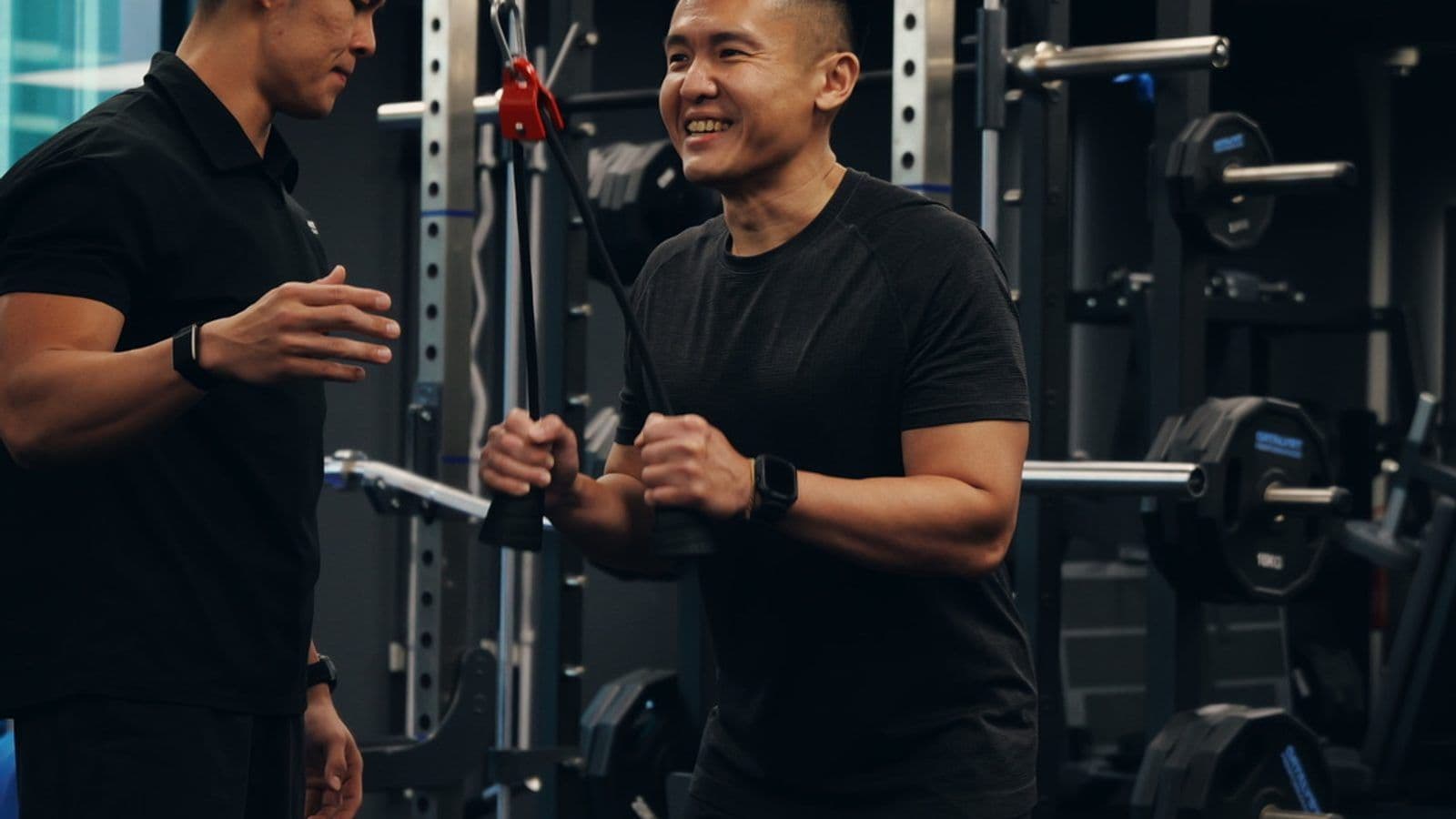
Small group personal training splits one coach across two to six clients. 1:1 personal training gives you the coach's full hour. Both build strength, and the research puts a number on the difference: in a controlled trial, lifters supervised at a 1:5 ratio gained 15.9% on their bench press in 11 weeks, against 10.2% for lifters at 1:25. Your budget, training age, and medical history decide which model earns your money.
TL;DR
- Small group training in Singapore usually means 2 to 6 people sharing one coach, running a shared programme scaled per person. The per-head price is lower because the coach's hour is divided.
- 1:1 personal training means the programme, the load, and every correction are built for one body. Across Singapore it runs roughly SGD 30 to SGD 350 a session, with most qualified, experienced coaches between SGD 90 and SGD 200.
- The supervision evidence points one way: closer supervision produced larger strength gains in both of the controlled trials that tested it, in untrained and in moderately trained men.
- Small group is the right call when budget leads, your technique is already clean, and the group booking is what keeps you showing up.
- 1:1 is worth the difference for beginners, anyone with an injury or medical context, pre and post natal clients, and anyone who wants progress measured rather than assumed.
What small group training actually is
Small group personal training, sometimes sold as semi-private training, puts 2 to 6 clients with one coach for the session. Everyone runs a version of the same programme, scaled up or down per person. The coach circulates, cues the lift that most needs cueing, and manages the room.
The model has real strengths, and it is worth naming them honestly. The per-head price is lower for simple arithmetic reasons: the coach's hour is split between the group, so each person pays a fraction of a 1:1 rate. The room has energy. And for a lot of people the strongest effect is adherence: a booked slot with people who notice your absence is a powerful reason to show up on a Tuesday when motivation is low. Consistency beats programme quality when the alternative is not training at all. There is also a middle path most comparisons skip: couples and paired 2:1 training, which keeps near-1:1 attention at a shared cost.
The model's limit is the same arithmetic. In a 6-person hour, your share of the coach's attention is 10 minutes. The programme was written for the group, and your individual context, an old shoulder, a pelvic-floor history, a left-right asymmetry, gets whatever slice of those 10 minutes is left after the room is managed.
What 1:1 personal training actually is
1:1 personal training gives one client the coach's full hour. Done properly, that hour is the visible part of a larger loop: the coach measures where your body is, builds a programme to the gap, loads it session by session, and re-measures whether it worked. Every set is watched. Load, tempo, and range are adjusted in real time against how you are actually moving that day, and the programme changes when your data says it should.
That is the standard the price is paying for. Across Singapore, 1:1 personal training runs roughly SGD 30 to SGD 350 a session, with most qualified, experienced coaches sitting between SGD 90 and SGD 200; the full market breakdown is in our guide to personal trainer costs in Singapore. A session at the bottom of that range often buys a rep counter. The four questions we suggest asking any trainer, including us, are how you tell the difference before you pay.
What the evidence says about supervision
Two controlled trials have tested supervision directly, and they point the same way.
Gentil and Bottaro (2010) randomised 124 untrained young men to identical 11-week resistance programmes under a 1:5 or a 1:25 coach-to-client ratio. The closely supervised group gained 15.9% on bench press 1RM against 10.2% for the low-supervision group, and only the closely supervised group significantly improved knee extensor torque, by 11.8%. Same programme, same weeks, different supervision, different result. The authors attributed the gap to training intensity: watched lifters push closer to what they can actually do.
Mazzetti and colleagues (2000) ran the comparison at the other end of the experience scale: 20 moderately trained men, 12 weeks of periodised training, directly supervised by a personal trainer or unsupervised. The supervised group progressed their training loads faster and finished with greater maximal strength gains.
An honest reading of these studies favours supervision as a spectrum, and both trials sit within it. A 1:5 small group is measurably better than a 1:25 class floor. The direction is consistent across both papers: the closer the supervision, the better the outcome, because intensity, technique, and progression all get managed instead of estimated. 1:1 is the far end of that spectrum. It also adds the one thing no ratio study measures: a programme written for your body in the first place.
The side-by-side
| Dimension | 1:1 studio coaching | Small group (2 to 6) | Large group class |
|---|---|---|---|
| Coach attention in a 60-minute session | The full hour | Roughly 10 to 30 minutes of direct attention | Minutes, if any |
| Programming | Built for your body and re-built as your data changes | Shared template, scaled per person | One class plan for the room |
| Progression tracking | Measured per lift, per session | Coach-dependent, usually informal | Rarely tracked at all |
| Injury and medical context | Screened and programmed around from day one | Accommodated where the room allows | Your own responsibility |
| Cost per head, per session | Highest | A fraction of the 1:1 rate, because the hour is split | Lowest |
| Strongest effect | Individual results, measured | Adherence and cost | Energy and cost |
When small group training is the right call
Pick small group training when budget is the deciding factor and the alternative is training alone or not at all. It suits lifters whose technique is already clean, who need structure and company more than correction. It also suits people whose honest biggest risk is skipping sessions: the social contract of a group booking is a real adherence tool, and adherence is the variable that dwarfs everything else over a year.
If that is you, choose a small group where the coach caps the room at 4 or fewer, screens newcomers before their first session, and actually records what you lift. Those three things separate a genuine semi-private programme from a class with a premium name.
When 1:1 is worth the difference
Pick 1:1 when your starting point is the thing being managed. Beginners set their movement patterns in the first months of training, and patterns learned wrong under light supervision get expensive to unlearn later. Anyone returning from injury, carrying a medical context, or training through the pre or post natal window needs the programme built around their constraints, and that is structurally a 1:1 job. The same holds past 50, where the gap between a generic programme and a calibrated one shows up in joints first.
It is also the honest choice when you want proof. A 1:1 coach who measures you at the start, programmes to the gap, and re-measures on a fixed cadence has nowhere to hide, and neither do you. That accountability loop is most of what you are paying for.
How Catalyst runs 1:1
Catalyst Performance is a 1:1 studio in Singapore's CBD, at Manulife Tower above Telok Ayer MRT. We do not run small group sessions, and this piece is not a claim that nobody should. The model we chose is the one the supervision evidence and our clientele point to: every member starts with the Catalyst Healthspan Assessment, and trains 1:1 on a programme built from those four pillar scores, re-tested every 16 weeks so progress is a tracked number rather than a feeling.
The first-time client rate is SGD 163.50 a session, sold in packages that never expire on a subscription clock, and the 60-minute assessment is complimentary whether you sign up or not. If the arithmetic of your year says small group, take the checklist above and choose a good one. If it says 1:1, start with the assessment and make the decision with your own data in hand.
Frequently asked questions
Is small group training as effective as 1:1 personal training?
For general fitness in people with clean technique, small group training works, and its adherence effect is real. For strength outcomes, the controlled evidence favours closer supervision: lifters at a 1:5 ratio gained roughly half as much again on bench press as lifters at 1:25 over 11 weeks. For anyone with an injury history, a medical context, or a pre or post natal consideration, the individual programming of 1:1 is the safer and more effective structure.
How much cheaper is small group training than a personal trainer in Singapore?
The per-head price of small group training is lower because one coach's hour is divided among the group; a 4-person group can price each head at roughly a quarter to a half of that coach's 1:1 rate. For reference, 1:1 personal training in Singapore mostly sits between SGD 90 and SGD 200 a session for qualified, experienced coaches. Compare on attention per dollar, not price per session: a 6-person group at a third of the 1:1 price is still buying you a sixth of the coach.
Which is better for a beginner, small group or 1:1?
1:1, for the first months at minimum. Beginners are setting the movement patterns every later programme builds on, and the evidence on supervision shows untrained lifters benefit most from close coaching. A practical middle path many of our members have taken: start 1:1 until your patterns are clean and your numbers are baselined, then decide whether a well-run small group can maintain what the 1:1 block built.
Citations
Gentil, P., & Bottaro, M. (2010). Influence of supervision ratio on muscle adaptations to resistance training in nontrained subjects. Journal of Strength and Conditioning Research, 24(3), 639-643. pubmed.ncbi.nlm.nih.gov/19661830
Mazzetti, S. A., Kraemer, W. J., Volek, J. S., Duncan, N. D., Ratamess, N. A., Gomez, A. L., Newton, R. U., Hakkinen, K., & Fleck, S. J. (2000). The influence of direct supervision of resistance training on strength performance. Medicine and Science in Sports and Exercise, 32(6), 1175-1184. pubmed.ncbi.nlm.nih.gov/10862549