The Edit · Founder Insights
HYROX Stations Explained: Weights and a Podium Coach's Tip for Each
All eight HYROX stations in race order, with the official 2026/27 weights for every division, what each station asks of your body, and one tip for each from Elly, our coach with over 20 HYROX podiums and a double win at HYROX Mumbai.

HYROX has eight stations, always in the same order with a 1km run before each one: SkiErg, sled push, sled pull, burpee broad jumps, rowing, farmers carry, sandbag lunges and wall balls. Loads depend on your division; Open women push a 102kg sled and Open men 152kg. Below are the official weights for every station and one tip for each from Elly, a coach with over 20 HYROX podiums.
This is a preparation guide, not a race calendar. For when and where to race in Singapore, our HYROX Singapore dates and venue page carries the confirmed dates, divisions and entry fees and updates the day each season is announced.
TL;DR
- Every HYROX is eight 1km runs and eight stations in a fixed order, so every metre of it can be rehearsed in advance.
- The weights depend on your division: under the 2026/27 rulebook, Open women push a 102kg sled, Open men and Pro women 152kg, Pro men 202kg, all including the sled.
- Roughly half the race is running, so the engine decides more finish times than any single station.
- Elly's one habit for all eight: jog straight out of every station, because you recover while you are already running.
- Wall balls catch first-timers out the most; practise them straight after a run, because race fatigue cannot be faked.
- A first Open race needs 10 to 12 structured weeks from a base of running 5km continuously; from a lower base, Doubles or Relay is the honest first step.
HYROX has grown from a Hamburg exhibition-hall experiment into the largest mass-participation fitness race format in the world, and Singapore has become one of its strongest Asian stops: the most recent edition drew capacity crowds across a full weekend at the EXPO halls. The event's appeal is its honesty. Unlike obstacle races, every HYROX everywhere is identical, same distances, same stations, same weights by division, so your time is comparable across the world and across your own years. That standardisation is also why preparation is so tractable: you know precisely what is coming, and the only question is the work.
1. The format: eight runs, eight stations
The format is the sport's whole identity: 8 x 1km of running, alternating with 8 workout stations, always in the same order, SkiErg, sled push, sled pull, burpee broad jumps, rowing, farmers carry, sandbag lunges, and wall balls to finish. No obstacles, no surprises, no course variation beyond the hall's layout. Roughly half of any HYROX is running, a fact the marketing photographs of sleds successfully hide from most first-timers.
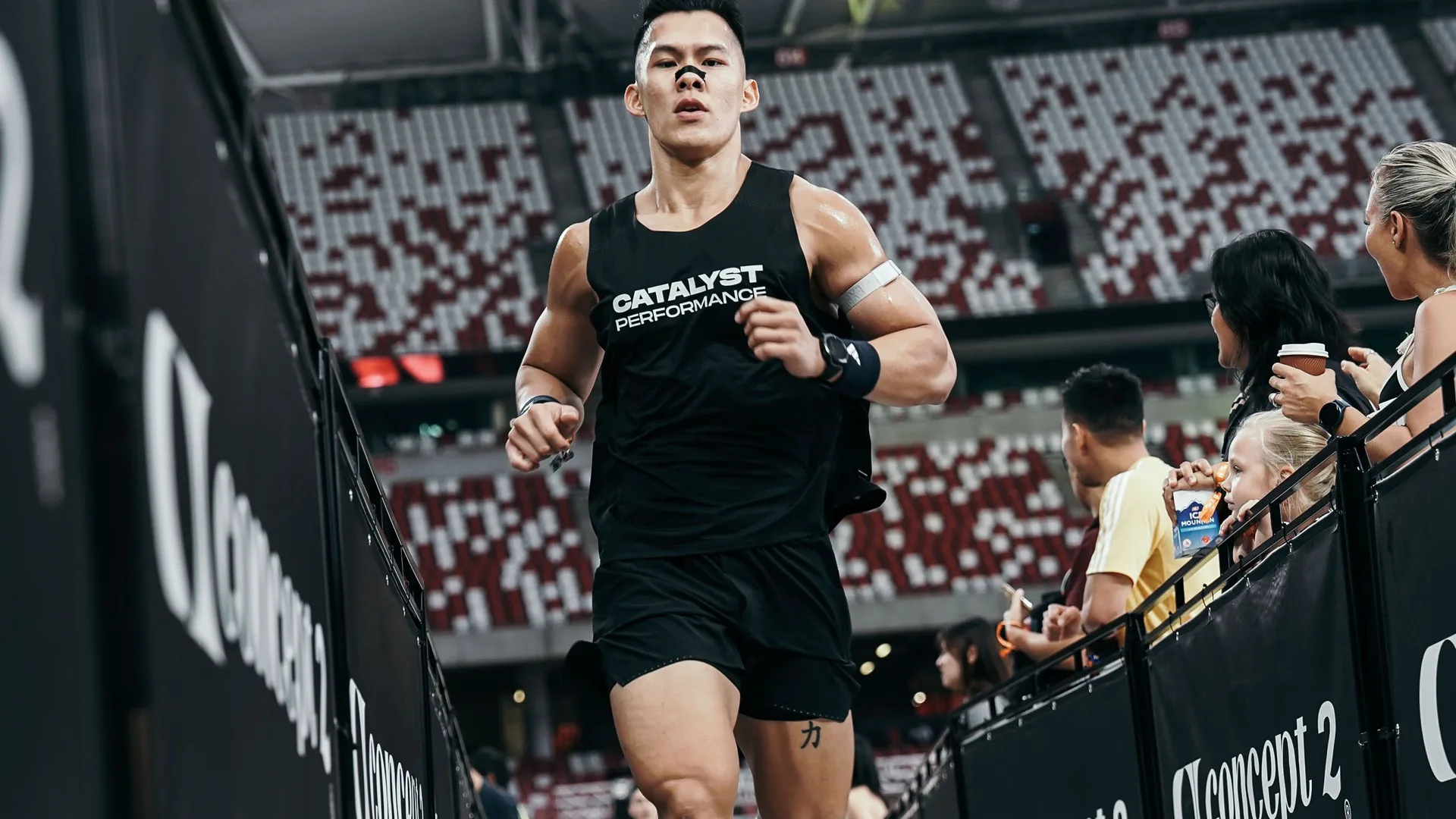
That run share is the format's central strategic truth. The athletes who suffer at HYROX are rarely undone by any single station; they are undone by what the stations do to their running, the compromised legs that make kilometre six feel like altitude. Preparation that alternates running with loaded work, the compromised running the format actually tests, beats preparation that trains both separately, and it is the organising principle of our training guide and the coached HYROX programmes we run at the studio. Our running pace calculator sets the 1km pace you can hold between stations, and the heart-rate zones calculator sets the effort for your easy runs.
For calibration: strong first-timers in Open commonly finish in the 75 to 95 minute range, the world's best run under an hour, and the median sits around 90 minutes or beyond depending on the field. The stations reward body mass on the sleds and punish it on the burpees and wall balls, which is why the format produces such an even contest between runner-shaped and lifter-shaped athletes, and why your first race is best treated as a calibration run for the second; the first-timer tips piece covers the race-day craft.
2. The eight stations, and Elly's tip for each
Every HYROX race runs the same eight stations in the same order, with a 1km run before each one, so you can prepare for every metre of it in advance. Elly, our strength coach, has stood on more than 20 HYROX podiums in the Over-40 category, most recently winning twice at HYROX Mumbai in September 2026. Below is what each station asks of your body, the load for your division under the official 2026/27 rulebook, and the one piece of advice she gives clients about it.
| Station | Distance or reps | Women | Men and Women Pro | Men Pro |
|---|---|---|---|---|
| 1. SkiErg | 1,000m | Bodyweight | Bodyweight | Bodyweight |
| 2. Sled push | 50m (4 x 12.5m) | 102kg incl. sled | 152kg incl. sled | 202kg incl. sled |
| 3. Sled pull | 50m (4 x 12.5m) | 78kg incl. sled | 103kg incl. sled | 153kg incl. sled |
| 4. Burpee broad jumps | 80m | Bodyweight | Bodyweight | Bodyweight |
| 5. Rowing | 1,000m | Bodyweight | Bodyweight | Bodyweight |
| 6. Farmers carry | 200m | 2 x 16kg | 2 x 24kg | 2 x 32kg |
| 7. Sandbag lunges | 100m | 10kg | 20kg | 30kg |
| 8. Wall balls | 100 reps | 4kg to a 2.70m target | 6kg (men to 3.00m, Women Pro to 2.70m) | 9kg to a 3.00m target |
Loads from the HYROX Singles Rulebook, season 26/27. Doubles and Relay use the same stations with the work split between partners.
1. SkiErg, 1,000m
The first station, straight off the opening kilometre. The pull comes from the lats and a hinge at the hips, not from the arms, and it is the easiest place in the race to spend energy you will want later because you arrive fresh. Elly's tip. Do not sprint the first station. Treat it as a long warm-up into the race: long arms, a hinge at the hips, and a pace you could hold a conversation at.
2. Sled push, 50m
Four lengths of 12.5m, driving a sled that weighs 102kg for women and 152kg for men in the Open division, sled included. It is a full lower-body drive, and for many racers the calves give out before the quads do. Elly's tip. "I will push heavier sleds during training." Pushing more than race weight in the block is what makes race weight feel manageable on the day.
3. Sled pull, 50m
A hand-over-hand rope pull to bring the sled to you, then a walk back to the line, four times. Grip, upper back and a braced hinge do the work. Elly's tip. "The sled push and pull require a lot of strength through the posterior chain and hinge pattern, so I do not rely solely on sled work." Most people in Singapore do not have a race sled to train on; her substitute is standing cable rope rows plus strength work for the same muscles, then transferring that strength to a sled when one is available.

4. Burpee broad jumps, 80m
A burpee, then a two-footed jump forward, repeated for 80m. There is no load, but it arrives after both sleds and empties the legs right before the row. Elly's tip. Find a rhythm you can hold for all 80 metres, and aim for even jumps rather than your longest one.
5. Rowing, 1,000m
The start of the second half of the race. It is seated and rhythmic, which makes it the one station where you can claw some breath back if you row it well. Elly's tip. Use the row to settle your breathing: drive with the legs, hold a steady stroke rate, and get your heart rate down before the second half.
6. Farmers carry, 200m
Two kettlebells, 16kg each for women and 24kg each for men in the Open division, carried 200m without a rest allowance. Grip, upper back and core decide it, not the legs. Elly's tip. Grip is the limiter. Train heavy carries across the whole block, and walk briskly so you never have to put the kettlebells down.
7. Sandbag lunges, 100m
100m of walking lunges with a sandbag across the shoulders, 10kg for women and 20kg for men in the Open division. This is where the glutes and single-leg strength you have built, or not built, show up late in the race. Elly's tip. Stay tall and take even steps. The glute on the front leg does the work, so build it all block, not only in race week.
8. Wall balls, 100 reps
A squat and a throw to a target, 100 times, as the final station. The ball is 4kg for women to a 2.70m target and 6kg for men to a 3.00m target in the Open division. Elly's tip. Asked which station catches first-timers out the most, her answer was immediate: "Definitely the wall balls." As she puts it, "you can never really understand what they feel like when you have already run several kilometres and completed all the previous stations." So she has clients practise them straight after a run, because race fatigue cannot be faked.
One habit runs through all eight. "When I finish a station, I practise jogging straight out rather than strolling or walking," Elly says. The station is not the end of the effort; you recover while you are already running, and that is the skill that holds a finish time together.
3. The divisions, and which loads apply to you
Every HYROX offers the same five ways in, and choosing well matters more than most first-timers realise.
Open is the standard solo division and the right default: full format, standard station weights, and the field where most of the world's times are set. Pro raises the station loads substantially, heavier sleds, heavier lunges and wall balls, and belongs to experienced racers with a result to chase; a first-timer entering Pro out of optimism usually meets the sled pull in a way they do not enjoy. Doubles splits the station work between two athletes while both run every kilometre, which roughly halves the muscular load and makes it the single best entry point for anyone unsure of their strength endurance; Doubles Pro applies the heavier loads to the pair. The Relay hands the race to a team of four, each covering a share of the runs and stations, and functions as the social division, corporate teams, run clubs, families, with a required fitness floor low enough for almost any active adult.
The honest matching rule we use with clients: confident on both running and loaded carries, enter Open; strong on one but not the other, enter Doubles with a complementary partner; building from a low base or racing for the experience, Relay first, solo later. Whichever you choose, division determines the exact weights you should be training with, so fix it before the block starts, not at the registration deadline. Our complete HYROX training guide breaks down the loads by division and sex. If you want the block written and coached for you, our functional fitness racing prep starts from your assessment results.
4. Who coaches this, and why the podium is not the point
Three of our coaches race HYROX at podium level. Elly has more than 20 international podium finishes in the Over-40 category, and in September 2026 she won twice at HYROX Mumbai, coming home with two first-place flags. Jeremy, our co-founder and Head of Performance and Operations, has raced close to 10 HYROX events with multiple podium finishes, alongside more than 25 half marathons and marathons. Kai Han holds multiple consecutive HYROX podium finishes and is a HYROX Level 1 certified trainer. Between the three of them that is over 25 podiums, and every tip on this page comes from inside the race rather than from a highlight reel.
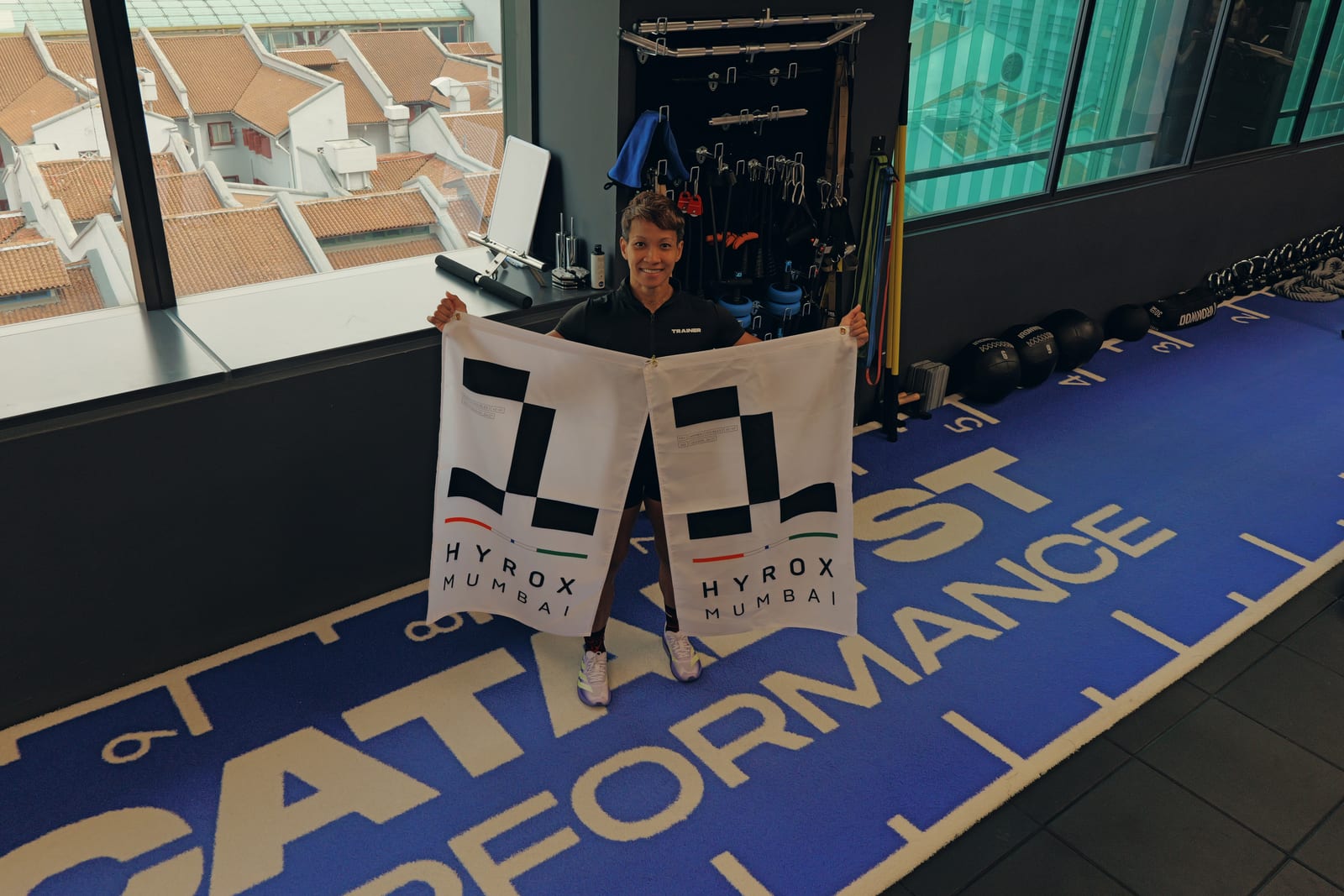
We are proud of those results, and they are still not why we coach the way we do. A racing career is a season in your training life. The strength, the aerobic engine and the joints you build for it are what carry you through the decades after the last race, and that is what we measure. Every HYROX block at Catalyst starts with the 4-Pillar Healthspan Assessment, so the race becomes a reason to train well rather than a reason to get hurt. Race it, enjoy it, and keep the body that raced it for a long time afterwards.
5. How long you need to prepare
Count back from your race day. From a reasonable fitness base, meaning you can run 5km continuously and train twice a week, 10 to 12 structured weeks is the honest minimum for a properly prepared Open debut. The block that works alternates three ingredients: running volume with some intensity, strength work biased toward the format's patterns, sleds, carries, lunges, squats, and weekly compromised-running sessions that chain the two together. Elly walks through her own 16-week HYROX training plan, and the full week-by-week structure is in our training guide.
From a lower base, the honest options are Doubles or Relay, both genuinely achievable inside ten weeks for most active adults, with a solo Open attempt at the following race. That sequencing beats forcing an underprepared solo, both for enjoyment and for the injury ledger; the format's volume of lunges and broad jumps is unkind to tissues given no runway, and the patterns we see mirror the running injury clusters that follow every sudden mileage spike.
Runners converting from the road have the aerobic half banked already and typically need eight weeks of loaded-work emphasis; our strength guide for runners is the bridge. Gym athletes converting from pure strength need the opposite: patient aerobic volume, built per the Zone 2 guide, because the race's engine demand cannot be muscled through. And whichever direction you are converting from, a measured baseline, a VO2 max test or a full assessment, turns the ten weeks from hopeful to engineered.
6. Racing HYROX in Singapore
The next Singapore race is AIA HYROX Singapore, 26 to 29 November 2026 at Singapore EXPO, and a 2027 edition has not been announced yet. Our HYROX Singapore page carries the confirmed dates, venue, divisions and entry fees, and you can set an email alert for the 2027 date on our 2027 Singapore race calendar.
Frequently asked questions
Q. What are the eight HYROX stations?
In race order: SkiErg (1,000m), sled push (50m), sled pull (50m), burpee broad jumps (80m), rowing (1,000m), farmers carry (200m), sandbag lunges (100m) and wall balls (100 reps), with a 1km run before each. Loads depend on division: under the 2026/27 rulebook, Open women push a 102kg sled and Open men 152kg, both including the sled.
Q. Which HYROX station is the hardest?
For first-timers, usually the wall balls: 100 reps as the final station, 4kg to a 2.70m target for Open women and 6kg to 3.00m for Open men, after 8km of running and seven other stations. Elly, a coach with over 20 HYROX podiums, says you can practise them but never fully feel race fatigue in training, so she has clients practise them straight after a run.
Q. What weights are used in HYROX?
Under the 2026/27 HYROX rulebook, the sled push is 102kg for Open women, 152kg for Open men and Pro women, and 202kg for Pro men, sled included. The sled pull is 78kg, 103kg and 153kg. The farmers carry uses two 16kg, 24kg or 32kg kettlebells, the sandbag is 10kg, 20kg or 30kg, and the wall ball is 4kg, 6kg or 9kg.
Q. Which HYROX division should a first-timer choose?
Open if you are confident on both running and loaded carries; Doubles if you are strong on one but not the other, since the pair splits station work while both partners run everything; Relay if you are building from a low base or racing for the experience. Pro divisions are for experienced racers, their station weights are substantially heavier.
Q. How long does it take to train for HYROX?
From a base of running 5km continuously and training twice a week, 10 to 12 structured weeks prepares an Open debut honestly. From a lower base, take Doubles or Relay this cycle and go solo at the next race. Roughly half the event is running, so the aerobic engine is the half most first-timers underprepare.
Every station is predictable, which makes HYROX one of the most trainable races there is. Build the engine first, rehearse each station under fatigue, and practise running straight out of every one. Start with the complete training guide, and check the HYROX Singapore page for the next race to aim at.
Catalyst Performance coaches HYROX preparation year-round at our CBD studio in Manulife Tower, sleds, carries and compromised-running sessions included, built on a measured 4-Pillar baseline and periodised to your race date. Book a complimentary consultation and we will map your block to your start line.
Citations
- AIA HYROX Singapore, official event information: dates, venue, divisions and entry pricing. aia.com.sg/en/about-aia/esg/health-and-wellness/hyrox. Accessed 31 August 2026.
- HYROX official race calendar and event page for AIA HYROX Singapore. hyrox.com/find-my-race. Accessed 31 August 2026.
- HYROX. (2026). HYROX Singles Rulebook, season 26/27. Retrieved from maintain.hyrox.com/rulebooks.
This is an independent guide. HYROX is a registered trademark of its owner; Catalyst Performance is not affiliated with, endorsed by or sponsored by HYROX, and this page is not an official event listing. Always confirm dates and entry on the official HYROX website before booking travel or entry.