The Edit · Founder Insights
Pilates or Strength After 40: What Singapore Women Need
Female personal trainer in Singapore explains why women over 40 need progressive strength training, not just Pilates or yoga, to protect bone and muscle.
If you are a woman in your 40s and Pilates or yoga is your only structured training, you are doing real good for your balance, mobility and posture, but you are almost certainly leaving your bone density and muscle mass under-loaded. The peer-reviewed evidence is consistent on this: Pilates and yoga do not build bone the way progressive resistance training does, and the decade either side of menopause is exactly when bone and muscle come under the most pressure. The answer is not to drop the mat. It is to add heavy, progressive strength work, because that is the one input the research keeps pointing to as non-negotiable after 40.
TL;DR
- A 2021 PLOS ONE meta-analysis found Pilates and yoga produced no statistically significant improvement in bone mineral density versus control (pooled effect size 0.07, 95% CI minus 0.05 to 0.19).
- The LIFTMOR randomised controlled trial showed heavy strength and impact training raised lumbar-spine bone density by about 4% relative to a low-intensity group in postmenopausal women, with around 92% adherence and only one minor adverse event.
- Women lose lean muscle fastest through perimenopause, roughly 2.5% to 5.7% versus premenopausal women, as estradiol falls.
- Grip strength predicts all-cause and cardiovascular mortality in women just as it does in men (PURE study, The Lancet).
- The fix is not either-or: keep the mat work for balance and fall prevention, add progressive resistance training for bone and muscle.
There is a specific search a lot of women in Singapore run somewhere around their 43rd birthday: some version of "is Pilates enough" or "do I need to lift weights now". It usually follows a health screening that flagged a borderline bone-density reading, a perimenopause conversation with a GP, or just the quiet sense that the body is changing and the old routine is not keeping up.
It is a good question, and the honest answer is more nuanced than either the strength-training purists or the mat-work loyalists will tell you. Pilates and yoga are genuinely valuable. They improve flexibility, balance, postural control and body awareness, and balance training is a recognised, evidence-backed component of fall prevention. None of that is in dispute, and none of it should stop.
The problem is what they do not do. Bone responds to mechanical load, specifically to load that is heavy enough and novel enough to signal the skeleton that it needs to remodel and strengthen. Muscle responds to progressive overload, to being asked to do meaningfully more than it did last month. Pilates and yoga, by design, deliver relatively low mechanical loading. That is part of why they feel sustainable and joint-friendly, and it is also exactly why the bone-density and muscle-mass evidence for them is so thin. This article walks through what the research shows, what genuinely changes in a woman's body after 40, and how to build a programme that keeps the mat work and adds the one ingredient it is missing.
Why Pilates and yoga are not enough on their own
Start with the bone evidence, because it is the cleanest. A 2021 systematic review and meta-analysis in PLOS ONE pooled the controlled trials on Pilates and yoga for bone mineral density in adult women. The headline result: the pooled effect size for Pilates or yoga versus a control group was 0.07, with a 95% confidence interval of minus 0.05 to 0.19. In plain terms, the confidence interval crosses zero, which means the studies as a body did not show a statistically significant improvement in bone density. A secondary before-and-after analysis of the intervention groups alone found a small significant change, but that design cannot separate the exercise from everything else happening over the study period, so it is the weaker signal.
Compare that to resistance training. The bone-density literature for progressive resistance training is large and consistent: multiple systematic reviews and network meta-analyses find significant improvements in bone density at the lumbar spine and femoral neck, the two sites that matter most for fracture risk. The mechanism is not mysterious. Bone is living tissue that adapts to the strain placed on it. A heavy deadlift or a loaded squat puts strain through the spine and hip that a mat-based flow simply does not approach. This is the same reasoning behind our deeper look at whether Pilates is enough after 40, where the loading gap is laid out in full.
This is not an argument that Pilates and yoga are useless. It is an argument about job description. Their place in a healthspan programme is real, but it is a different job: mobility, control, balance and fall prevention. The internationally used fall-prevention guidance explicitly lists balance and coordination training alongside resistance and impact exercise, not instead of it. So the precise version of the answer is this: if your goal includes protecting your bone density and muscle mass, Pilates or yoga on their own will not get you there, and the gap is not a matter of doing more classes. It is a matter of adding a different stimulus.
If you have worked with a women's-health physiotherapist or a Pilates instructor and felt genuinely stronger and more capable, that is real and worth keeping. The question is simply whether the heaviest thing you lift in a week is enough to move a bone-density scan, and for almost everyone doing mat work alone, it is not.
What changes in a woman's body after 40
The reason this matters more at 40 than at 30 comes down to two systems declining at once: muscle and bone, both accelerated by the hormonal shift of the menopausal transition.
Muscle first. Longitudinal data show that the rate of lean-mass loss is steepest through the perimenopausal years, not before and not long after. Across the transition, studies report reductions of roughly 2.5% in perimenopausal women and up to 5.7% in postmenopausal women compared with premenopausal women, with the postmenopausal decline then settling to around 0.6% per year. The hormonal story behind this is increasingly well described. A 2021 review in Frontiers in Endocrinology sets out how falling estradiol contributes to sarcopenia: estradiol normally helps activate the satellite cells that repair and rebuild muscle and helps restrain muscle protein breakdown, so when it declines, the body's capacity to maintain muscle declines with it.
Bone follows the same hormonal logic. Oestrogen is protective of bone, and its decline through menopause is the single biggest driver of the rapid bone loss that can take a woman from normal density to osteopenia, and sometimes to osteoporosis, in the space of a few years. This is why a bone-density reading that was fine at 38 can look quite different at 48 even if nothing about lifestyle has changed.
Put those two declines together and the picture is clear. The 40s and early 50s are not a time to coast on the routine that worked in your 30s. They are the window where the right training does the most to protect the decades ahead, and where the wrong assumption, that a few mat classes a week is "enough", quietly costs the most. The encouraging part is that both systems remain highly responsive to training through this window and well beyond it. Decline is not a one-way street; it is a stimulus problem, and stimulus is exactly what a well-built strength programme provides.
The 40s and 50s are not the decade to coast on your old routine. They are the decade your training does the most to protect the decades ahead.
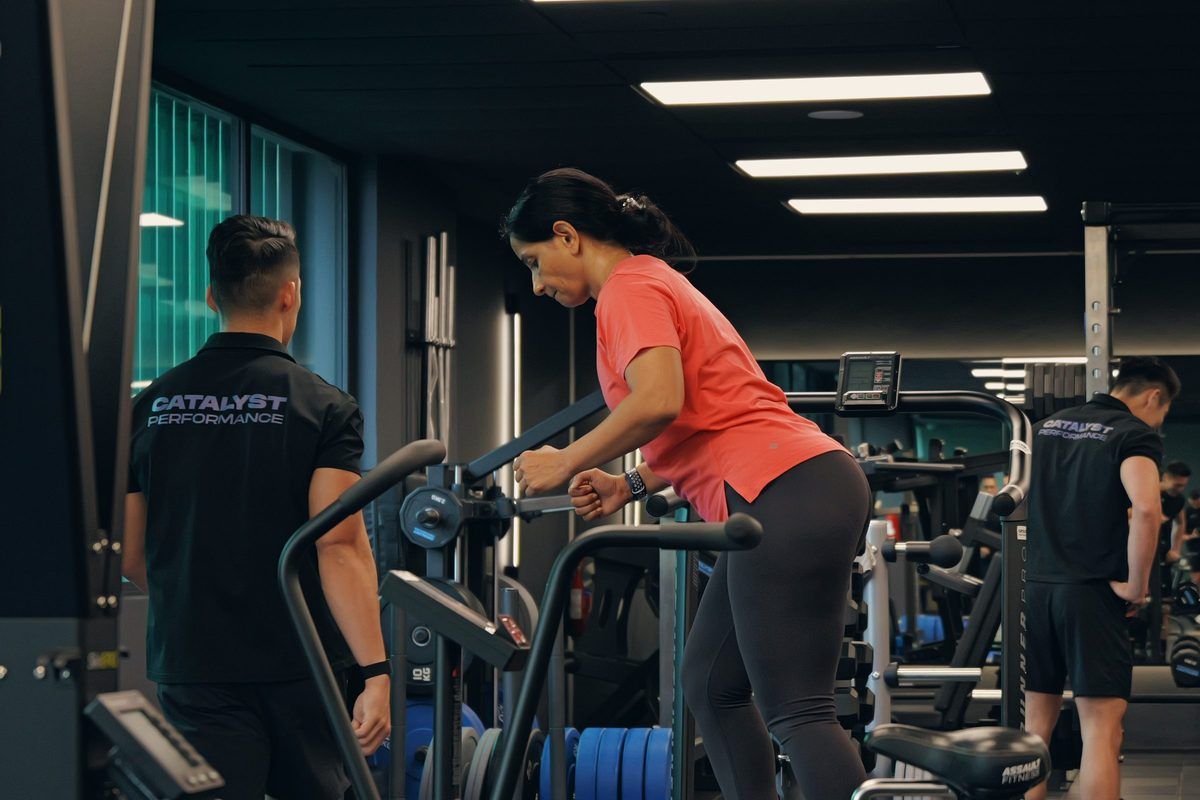 Coached resistance work at Catalyst: the mat builds balance and control, but bone and muscle respond to progressive load.
What strength training does that the mat cannot
The clearest single piece of evidence here is the LIFTMOR randomised controlled trial, published in the Journal of Bone and Mineral Research in 2018. Researchers took 101 postmenopausal women with low bone mass, the exact group most people assume should avoid heavy lifting, and randomised them to either eight months of supervised heavy resistance and impact training (5 sets of 5 repetitions above 85% of one-repetition maximum, twice a week, 30 minutes a session) or a home-based low-intensity programme.
The heavy-training group improved lumbar-spine bone density by roughly 4% relative to the low-intensity group, with significant gains at the femoral neck as well. Just as importantly for anyone nervous about injury, the heavy protocol was well tolerated, adherence averaged around 92%, and the trial recorded only one minor adverse event across the whole programme. This is the result that should retire the idea that heavy strength training is dangerous or inappropriate for women with thinning bones. Supervised and progressed properly, it was the intervention that worked. If the worry holding you back is getting visibly muscular, that fear is misplaced too, and we unpack the physiology of it in will lifting heavy make me bulky.
Muscle responds to the same stimulus. Progressive resistance training is the most reliable way to build and preserve lean muscle through and after menopause, directly countering the accelerated loss described above. And muscle is not just about how you look or how much you can carry. Grip strength, a simple proxy for whole-body strength, is one of the better predictors of how long you will live. The PURE study in The Lancet, following nearly 140,000 people across 17 countries, found that each 5 kilograms of lower grip strength was associated with a 16% higher risk of all-cause death, and the association held for women specifically. Grip strength was a better mortality predictor than systolic blood pressure.
This is the through-line of how we train women at Catalyst, and it is why our female personal training in Singapore is built on the same evidence-based resistance protocol we use for everyone, adapted around a woman's data rather than around an assumption that women should train lighter. The major guidance bodies agree on the floor: the WHO 2020 physical activity guidelines recommend muscle-strengthening activity across all major muscle groups on two or more days a week for older adults, alongside balance work for fall prevention. Note the "alongside". Even the most conservative reading of the guidelines puts strength training and balance training side by side, not one instead of the other.
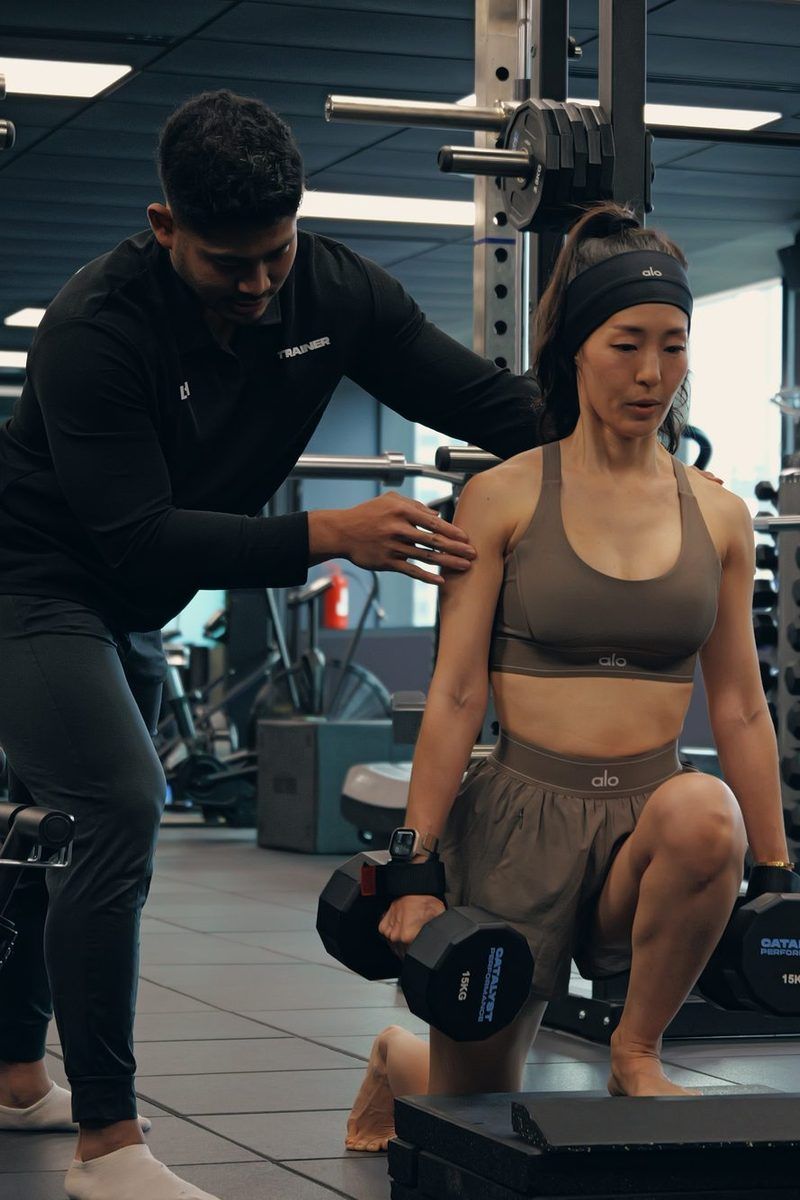 Load is calibrated to the individual, then progressed: the one input the research keeps pointing to as non-negotiable after 40.
How to combine both, not choose between them
The most useful reframe is to stop treating this as Pilates versus strength training, and start treating it as a portfolio. Each does a job the other cannot, and a sensible weekly structure carries both.
A practical template for a woman in her 40s or 50s looks like this. Two to three progressive resistance training sessions a week form the spine of the programme, built around heavy compound movements (squat, hinge, press, pull, carry) loaded and progressed over time. This is the bone-and-muscle engine, the part the mat work is missing. One to two Pilates, yoga or mobility sessions a week continue to develop balance, control and joint range, the fall-prevention and movement-quality layer. Add daily walking and the occasional bit of impact, going up stairs counts, and you have covered the full evidence base: load for bone, overload for muscle, balance for falls, and aerobic work for the heart.
The hard part is not the concept; it is the calibration. How heavy is heavy enough to move a bone scan without risking injury? Which compound lifts suit a body with a particular movement history, a past pregnancy, a niggling shoulder? How fast should load progress? Those are individual questions, and they are exactly where a structured assessment earns its place. At Catalyst, every member starts with the Catalyst Healthspan Assessment: 60 minutes in studio measuring four pillars, Body Composition, Cardiorespiratory Fitness, Stability and Strength, including a movement-pattern strength screen and dynamic-balance testing. That data is what sets the starting loads and the priorities, so the strength work meets your current capacity rather than a generic women's-fitness template. If you already have a recent bone scan, a DEXA or InBody body-composition reading gives the assessment an even sharper starting point, and a women's-health physiotherapist's report is welcome and respected from day one.
The point of measuring first is that it removes the two failure modes at once. It stops the under-loading that leaves bone and muscle unprotected, and it stops the reckless over-loading that the "lift light" instinct is trying, clumsily, to prevent. Progressed off real data, heavy can be safe, and safe can still be heavy enough to matter.
Choosing a female personal trainer in Singapore
Plenty of women prefer to train with a female coach, for reasons that range from rapport, to comfort during post-natal or hormonal-context conversations, to cultural or religious preference. That preference is completely reasonable, and a good studio will honour it at assignment rather than treat it as a marketing line.
But the coach's gender is not the thing that determines whether the training works. The thing that determines whether the training works is whether the programme is built on progressive resistance training and calibrated to your data, rather than defaulting to lighter loads and more cardio because that is the assumed template for women. The evidence does not support a categorically different, lighter protocol for women. Women adapt to progressive resistance training the same way men do, and the bone-density and mortality benefits described above apply to women specifically. Where female physiology genuinely changes the prescription, post-natal return, perimenopause, pelvic-floor history, a good coach adapts around the data, not around assumptions.
So the questions to ask a prospective coach are concrete. Will my programme include heavy, progressively loaded compound lifts, or is it mostly bodyweight and bands? How will you decide my starting loads and progress them? Do you measure anything at baseline, or do we just start? Can you work alongside my women's-health physio? Our female personal training page sets out how we answer those questions: 1:1 in a private CBD studio at Manulife Tower, a female-coach preference settled at the consultation, and a programme built off the four-pillar assessment rather than a women's-fitness script. The complimentary consultation and assessment are the place to test whether a coach's answers match the evidence before you commit to anything. And if you train outside Singapore, our online coaching applies the same evidence-based resistance protocol remotely.
| Dimension | Progressive strength training | Pilates / yoga | Why it matters after 40 |
|---|---|---|---|
| Bone mineral density | Significant gains at spine and hip (LIFTMOR: ~4% lumbar spine vs control) | No significant effect in pooled meta-analysis (PLOS ONE 2021) | Oestrogen decline accelerates bone loss; only heavy load reliably rebuilds it |
| Muscle mass | Builds and preserves lean muscle via progressive overload | Low mechanical load; limited muscle-building stimulus | Lean mass falls fastest through perimenopause as estradiol drops |
| Balance and fall prevention | Improves via loaded carries, single-leg work | Strong: a recognised fall-prevention component | Both load and balance sit in the fall-prevention guidance, not one or the other |
| Joint mobility and control | Improves with full-range loaded movement | Strong: core strength of the discipline | Mobility supports safe loading; the two are complementary |
| Longevity signal | Grip and whole-body strength predict mortality (PURE, Lancet) | Not a strength-loading stimulus | Strength is among the better predictors of healthy ageing in women |
| Best role in a weekly plan | 2 to 3 sessions: the bone-and-muscle engine | 1 to 2 sessions: the balance-and-control layer | The evidence supports a portfolio, not a single modality |
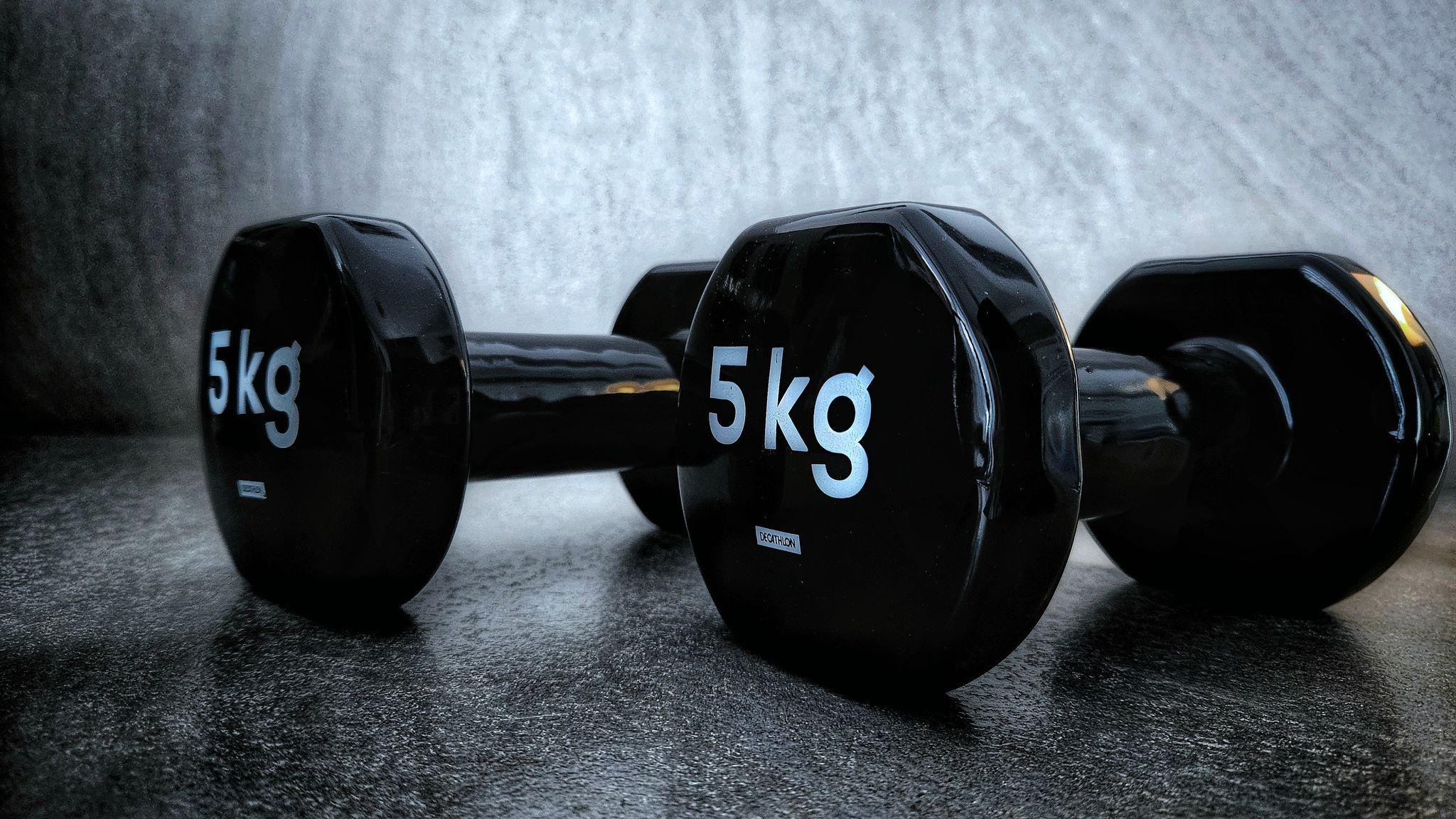 Where most women start. The point is not the number on the dumbbell, it is whether the load is progressed over time.
Frequently asked questions
Q. Is Pilates enough exercise after 40 for a woman?
Pilates is valuable for balance, mobility, posture and fall prevention, but on its own it is not enough to protect bone density or muscle mass after 40. A 2021 PLOS ONE meta-analysis found no significant bone-density benefit from Pilates or yoga versus control. The fix is to keep the Pilates and add progressive resistance training, the stimulus the mat work is missing.
Q. Does strength training really build bone density in older women?
Yes. The LIFTMOR randomised controlled trial found that supervised heavy resistance and impact training raised lumbar-spine bone density by about 4% relative to a low-intensity group in postmenopausal women with low bone mass, with around 92% adherence and only one minor adverse event. Resistance training is the most consistently evidence-backed exercise for bone after menopause.
Q. Is heavy lifting safe for women with osteopenia or osteoporosis?
In the LIFTMOR trial, women with osteopenia and osteoporosis trained at over 85% of their one-repetition maximum, supervised, and the protocol was well tolerated with high adherence and only one minor adverse event. Safety comes from supervision, correct technique and sensible progression off a baseline assessment, not from avoiding load. Always clear a programme with your doctor or GP if you have a diagnosed bone condition.
Q. Why do women lose muscle faster after menopause?
Estradiol helps maintain muscle by supporting the satellite cells that repair it and by restraining muscle protein breakdown. As estradiol falls through perimenopause, that protection weakens, and lean-mass loss is steepest across the menopausal transition. Progressive resistance training is the most reliable way to counter it.
Q. Can I request a female personal trainer in Singapore?
Yes. At Catalyst, you mention the preference at the complimentary 30-minute consultation and your assessment is scheduled with one of the female coaches, with ongoing 1:1 sessions kept with that coach. The preference is honoured at assignment, and the programme itself is the same evidence-based resistance protocol, adapted to your data.
The choice was never Pilates or strength training. After 40, with muscle and bone both under pressure from a falling-oestrogen environment, the evidence points to a portfolio: keep the mat work for balance and control, and add progressive resistance training for the bone density and muscle mass it alone can build. If you want to know exactly where your four pillars stand before you decide what to add, that is what the Catalyst Healthspan Assessment is for. You can read how our female personal training in Singapore is structured, or book the complimentary consultation to start with your own numbers rather than someone else's template.
Citations
Fernandez-Rodriguez, R., Alvarez-Bueno, C., Reina-Gutierrez, S., Torres-Costoso, A., Nunez de Arenas-Arroyo, S., & Martinez-Vizcaino, V. (2021). Effectiveness of Pilates and Yoga to improve bone density in adult women: A systematic review and meta-analysis. PLOS ONE, 16(5), e0251391. journals.plos.org/plosone/article?id=10.1371/journal.pone.0251391
Watson, S. L., Weeks, B. K., Weis, L. J., Harding, A. T., Horan, S. A., & Beck, B. R. (2018). High-Intensity Resistance and Impact Training Improves Bone Mineral Density and Physical Function in Postmenopausal Women With Osteopenia and Osteoporosis: The LIFTMOR Randomized Controlled Trial. Journal of Bone and Mineral Research, 33(2), 211-220. pubmed.ncbi.nlm.nih.gov/28975661
Geraci, A., Calvani, R., Ferri, E., Marzetti, E., Arosio, B., & Cesari, M. (2021). Sarcopenia and Menopause: The Role of Estradiol. Frontiers in Endocrinology, 12, 682012. frontiersin.org/journals/endocrinology/articles/10.3389/fendo.2021.682012/full
Leong, D. P., Teo, K. K., Rangarajan, S., Lopez-Jaramillo, P., Avezum, A., Orlandini, A., et al. (2015). Prognostic value of grip strength: findings from the Prospective Urban Rural Epidemiology (PURE) study. The Lancet, 386(9990), 266-273. thelancet.com/journals/lancet/article/PIIS0140-6736(14)62000-6/abstract
World Health Organization. (2020). WHO Guidelines on Physical Activity and Sedentary Behaviour. WHO. ncbi.nlm.nih.gov/books/NBK566046