The Edit · Founder Insights
Clinical Pilates or Strength Training for Back Pain After 40?
Clinical Pilates or strength training for back pain after 40? What the Cochrane reviews and network meta-analysis actually show, which to start with for your situation, and how the two combine.
Clinical Pilates or strength training for back pain after 40 is usually posed as a duel, and the evidence refuses to pick the winner people want. The 2020 network meta-analysis in the British Journal of Sports Medicine ranked Pilates, motor-control work and resistance training all among the most effective exercise modes for chronic low back pain, well ahead of doing nothing, and ahead of stretching and general aerobic-only approaches. The honest answer is therefore a sequencing question, not a superiority question: which one fits your presentation now, and how do you graduate from one to the other. This guide gives the evidence plainly, then the decision framework we use on a coaching floor that receives aching backs weekly.
| Question | Clinical Pilates | Strength training |
|---|---|---|
| What is it, honestly | Physio-informed movement re-education, low loads, high control, often 1:1 with equipment | Progressive loading of the whole body, including the back's muscles, with weights that increase |
| Evidence for chronic low back pain | Among the most effective modes in network meta-analysis; better than minimal care in Cochrane review | Among the most effective modes in the same analysis; builds capacity that protects against recurrence |
| Best entry point when | Pain is recent, movement feels threatening, confidence is low | Pain is chronic and stable, deconditioning is obvious, life demands load |
| Ceiling | Loads stay light; capacity gains plateau | Keeps building for years; requires competent coaching to start well |
| The combined path | Weeks 0 to 12: control and confidence | Week 8 onward: progressive load for the long game |
TL;DR
- Exercise is the best-supported non-drug treatment for chronic low back pain, and the specific mode matters less than starting and staying consistent.
- Network meta-analysis ranks Pilates, motor-control work and resistance training together at the effective end; neither side of this duel loses.
- Clinical Pilates is the gentler on-ramp when movement feels threatening; strength training is the higher-ceiling destination that rebuilds capacity for decades.
- The best results we see combine them in sequence: control first, load second, with overlap in the middle.
- Red flags, numbness, weakness, bladder or bowel changes, unexplained weight loss, night pain, mean doctor first, exercise second.
Back pain after 40 sits at an awkward junction in Singapore: physiotherapy clinics, clinical Pilates studios, chiropractors and gyms all claim it, and the person in pain has to arbitrate between industries. Two facts cut through most of the noise. First, for the common, non-specific chronic low back pain that makes up the overwhelming majority of cases, exercise is the intervention with the deepest evidence base. Second, the exercise industries fighting over your back agree with each other far more than their marketing suggests. What follows assumes your pain has no red flags attached; if it does, the final chapters say so plainly, and this article's medical reviewer would tell you the same thing: doctor first.
1. What the evidence says about exercise and back pain
The foundation stone is the 2021 Cochrane review of exercise therapy for chronic low back pain: 249 trials, over 24,000 participants, concluding that exercise reduces pain and improves function compared with no treatment, usual care or placebo. The effects are moderate rather than miraculous, and that honesty matters, because an industry of miracle cures orbits this diagnosis. Exercise is not a magic bullet. It is the most reliable lever available, it is cheap, and its side effects are the ones you want.
Why does loading a sore back help at all? The modern understanding has moved decisively away from the fragile-spine model. Chronic non-specific back pain behaves less like an unhealed injury and more like a sensitised alarm system wrapped around a deconditioned structure: tissues that have adapted downward to careful living, a nervous system that has learned to guard, and a person who has, rationally but counterproductively, started avoiding the movements that would rebuild tolerance. Exercise attacks all three at once, gradually raising tissue capacity, feeding the nervous system safe experiences of movement, and returning a sense of agency that catastrophising strips away.
Two practical corollaries fall out of the evidence before we even reach the Pilates-versus-strength question. Consistency beats modality: the programme you attend twice a week for six months outperforms the theoretically superior one you abandon in February. And guided beats unguided at the start: supervised programmes outperform sheet-of-exercises programmes in the trials, which is one reason both clinical Pilates and coached strength work outperform the printout from 2019 still stuck to your fridge.
2. What clinical Pilates actually is
Clinical Pilates is Pilates taken over by physiotherapy: the original method's movement vocabulary, spinal articulation, controlled breathing, low-load work on mat and spring-resisted equipment, delivered one-to-one or in tiny groups, by or under a physiotherapist, with exercises selected for your specific presentation rather than a class plan. The word clinical is doing real work in that sentence. A general mat class at a boutique studio programmes for the room; a clinical session programmes for your back, and modifies in real time when something provokes.
For back pain, its genuine strengths are three. Precision at low loads: when a back is irritable, the spring-based equipment allows movement to be loaded in grams rather than kilograms, finding the entry point that a barbell cannot offer. Graded exposure with supervision: the method is, functionally, a structured way of proving to a guarded nervous system that flexion, extension and rotation are safe again, which is exactly what the fear-avoidance research says recovery requires. And confidence: for the person who has come to treat their spine as glass, six weeks of moving well under expert eyes is often the psychological turn the whole recovery pivots on.
The evidence position is solid if unspectacular: the Cochrane review of Pilates for low back pain found it more effective than minimal intervention for pain and disability, with no convincing superiority over other exercise forms. Which is precisely the point this article keeps returning to: it works, and its working is not unique, so choose it for its fit to your situation, not for any claimed monopoly on the deep core. And its ceiling is real: spring resistance runs out long before life's demands do, which is where the next chapter takes over.
3. What strength training offers an aching back
Strength training's offer to a chronically sore back is blunt: make everything stronger, the back included, until yesterday's provocations sit far inside today's capacity. A back that can hinge 60kg with composure does not notice the grocery bags that used to threaten it. That margin, capacity in reserve, is the mechanical half of why resistance work keeps ranking among the most effective modes for chronic back pain.
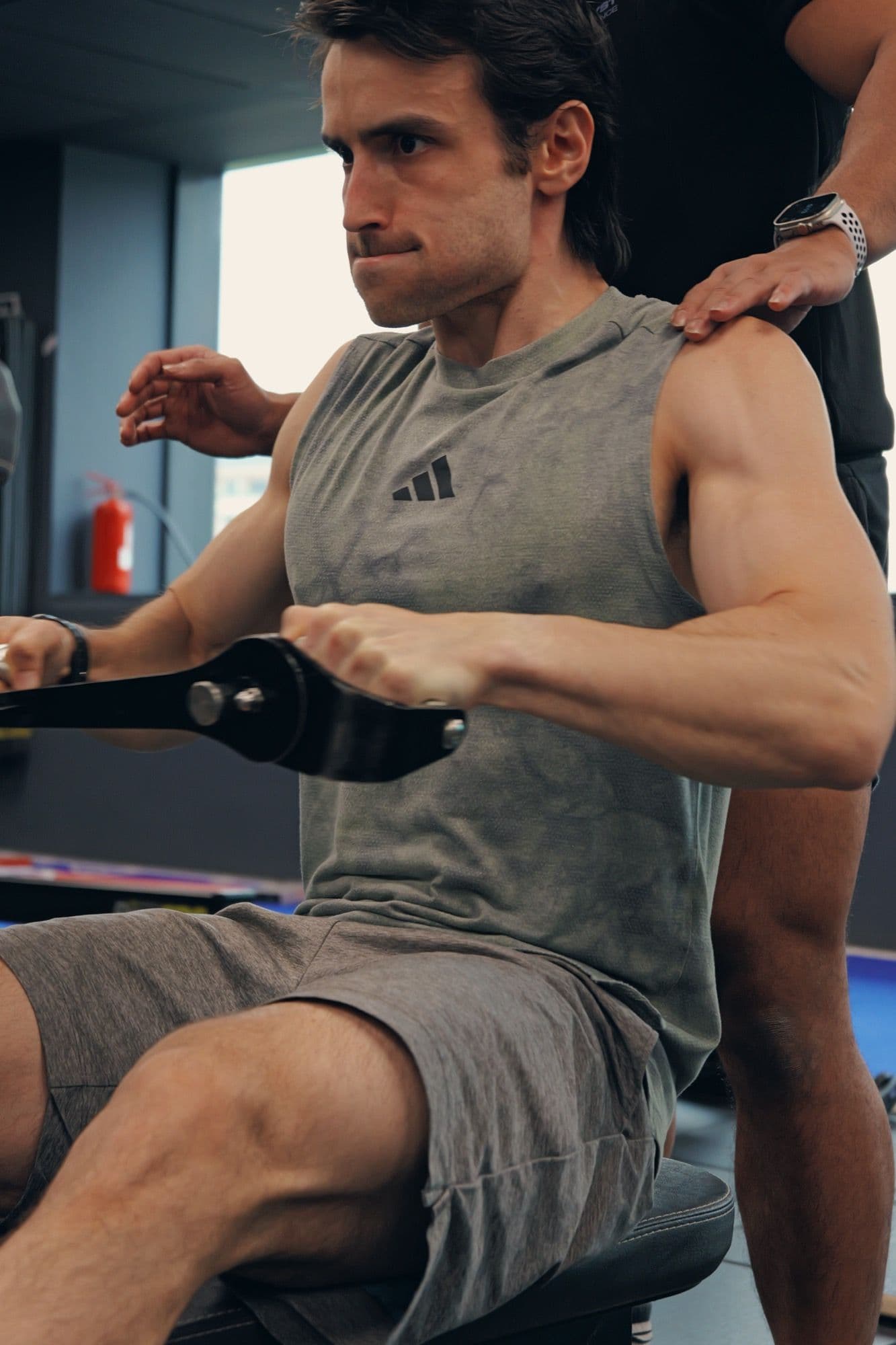
Done properly for this population, it looks nothing like the flat-bench machismo the words evoke. It is hinge patterns taught patiently, Romanian deadlifts from elevated blocks before anything comes from the floor, squats to a depth the back tolerates today, loaded carries that teach the trunk its actual job, stabilising under load, and rows that rebuild the posterior chain a decade of sitting has switched off. Loads start embarrassingly light and progress on schedule, because progression is the mechanism: the entire point is that the stimulus this month exceeds last month's, which is what deconditioned tissue answers to.
Its second offer is the one Pilates cannot match: a ceiling measured in years. Spring and body-weight resistance plateau within months; a barbell and dumbbell progression keeps paying into your 70s, and drags every other healthspan number along with it, bone density, muscle mass, the markers that predict ageing well. For the over-40 reader this matters beyond the back: the same sessions treating your pain are the ones defending you from sarcopenia.
The honest requirement is coaching quality at entry. A sore, guarded back handed a generic bro-split is how this modality earns its bad reputation; screened, programmed and progressed by someone fluent in painful backs, per our trainer-vetting guide, it is the highest-ceiling treatment in this article.
4. Head to head
The cleanest comparative evidence is the 2020 network meta-analysis in the British Journal of Sports Medicine, which pooled 89 randomised trials to rank exercise modes for chronic low back pain against each other rather than merely against nothing. The result reads like a truce declaration: Pilates, resistance training and motor-control exercise clustered together at the effective end for pain and function, with stretching and general low-dose aerobic work trailing, and everything beating no exercise.
Read carefully, the analysis supports three usable conclusions. The duel is a draw at the level of averages, so anyone selling you one modality as scientifically proven superior is quoting marketing, not the literature. The gap between doing either and doing neither dwarfs the gap between them, which relocates the entire decision to fit, cost and adherence. And the trailing performance of stretching, the default self-treatment of every stiff-backed desk worker in Singapore, deserves more publicity than it gets; our foam-rolling evidence review reached a similar conclusion about that adjacent ritual.
Averages, though, are where the honesty of a meta-analysis runs out, because you are not an average. Trials recruit broad chronic-pain populations; you arrive with a specific back, history, fear level and calendar. A modality that suits your presentation, which the next chapter maps, will beat its rival's trial average for you, and the modality you will actually attend in month four beats both. The evidence's deepest finding is almost anticlimactic: the winner of Pilates versus strength is whichever one you do.
5. Which to start with
First, the gate everyone must pass: red flags mean doctor before either studio. Numbness or weakness in a leg, bladder or bowel changes, unexplained weight loss, fever, night pain that does not ease with position, a history of cancer, or pain following real trauma, any of these takes you to a GP or specialist first, no exceptions. Non-specific pain without those features, the overwhelming majority, can proceed.
Start with clinical Pilates when the dominant feature is threat: pain that is recent or flaring, movement that feels dangerous, a history of every attempt making things worse, or a confidence level where lying on a mat feels like the outer edge of brave. The precision and supervision are exactly the on-ramp that presentation needs, and a physiotherapist's involvement doubles as ongoing screening. Start with coached strength training when the dominant feature is capacity: pain that is old, stable and boring, obvious deconditioning, a job and life that demand load, luggage, children, golf, or a previous good experience with training. Waiting until a stable back feels perfect before loading it is the most common way we watch people lose a year.
Two Singapore-specific routing notes. If your pain has never been assessed by anyone, one physiotherapy assessment before either choice is money well spent, and the physio-to-training handover is a path we know intimately from the other side; our guide to NeuroKinetic Therapy and physiotherapy explains how assessment-led movement work fits between clinic and gym. And if budget forces a choice, note the structural economics: clinical Pilates is typically bought in ongoing 1:1 blocks indefinitely, while strength coaching is front-loaded, intensive coaching early, then progressively more independence, which changes the five-year cost picture substantially.
6. The combined path
The either-or framing dissolves entirely once you sequence instead of choose, and the sequence is the protocol we would hand a friend: control first, load second, overlap in the middle.
Phase one, roughly weeks zero to eight for a threatened back: clinical Pilates or equivalent physio-led movement work, twice weekly, with walking rebuilt alongside it. The goals are specific and finite, calm the alarm, restore confident flexion and extension, learn to brace and breathe under gentle demand. Phase one is succeeding when sessions have become slightly boring, which is precisely the sign most people misread as this has stopped working rather than as graduation approaching.
Phase two begins while phase one is still running, around week six to eight: coached strength work enters at one session weekly, hinge and squat patterns at conservative loads, carries, rows, while a weekly Pilates session continues as the control-quality anchor. Phase three, from roughly month three onward, inverts the ratio: strength progresses to twice weekly and becomes the engine for years, with the Pilates vocabulary retained inside warm-ups and as a standalone session whenever a flare asks for a gentler fortnight. Flares, note, are part of recovery, not proof of failure; the plan absorbs them by dropping loads for a week, not by abandoning ship.
This is, recognisably, the shape of our own closed-loop method: assessment-led movement work and progressive training run as one system rather than two referrals who never speak. However you assemble the practitioners, insist on that property, whoever loads you should know what the movement work found, and vice versa.
7. The desk-worker special case
The archetypal Singapore back pain patient is not injured in any meaningful sense. They are a 45-year-old professional who sits ten hours a day, whose pain migrated in over months, and whose spine has adapted with complete success to the only demand it receives: staying still. For this presentation, covered in full in our desk-work back pain guide, the duel of this article needs one reframing: the enemy is not weakness or poor control alone, it is the 50 sedentary hours surrounding any training you do.
The implications are practical. Whichever modality you choose earns its keep partly by what it changes about the other 165 hours: a strength block that makes stairs and standing feel trivial changes how you move all week; a Pilates block that dissolves the fear of bending changes how often you bend. Movement snacks through the workday, two minutes hourly, remain the unglamorous co-treatment the evidence on sedentary behaviour keeps endorsing, and no studio hour buys them for you.
The office population also stacks the deck slightly toward the strength side of the sequence, for two reasons. Deconditioning, not threat, is usually the dominant feature, the pain is annoying rather than frightening, which per chapter five points to loading sooner. And the schedule realities of CBD life favour the format built for them; the lunch-hour training pattern exists precisely because a 45-minute coached session twice a week is the dose a working week reliably absorbs. Whichever door you enter through, enter one this month; the desk is not negotiating.
The one-paragraph protocol
Screen for red flags; any present, doctor first. None: if your back feels dangerous, start with clinical Pilates twice weekly and graduate toward load from week six; if it merely feels weak and weary, start with coached strength work at conservative loads and keep one control-focused session in the week. Either way, walk daily, break up the sitting, give it twelve weeks before judging, and expect flares to visit without letting them vote. The modality is a detail; the loading, supervision and consistency are the treatment.
Frequently asked questions
Q. Is Pilates or strength training better for lower back pain?
The comparative evidence calls it a draw: network meta-analysis ranks Pilates, motor-control work and resistance training together among the most effective exercise modes for chronic low back pain. Choose by fit, Pilates as the gentler on-ramp when movement feels threatening, strength for capacity and the longer ceiling, and ideally sequence them.
Q. Is it safe to lift weights with back pain after 40?
For non-specific back pain without red flags, progressively loaded strength training is not just safe but among the best-supported treatments, started at conservative loads under competent coaching. Red flags, leg weakness or numbness, bladder or bowel changes, night pain, fever, unexplained weight loss, mean a doctor's assessment comes first.
Q. What is the difference between clinical Pilates and a normal Pilates class?
Clinical Pilates is delivered or supervised by physiotherapy, one-to-one or in very small groups, with exercises selected and modified for your specific presentation. A general class programmes for the room. For an actively painful back, the clinical version is the appropriate entry point.
Q. How long does exercise take to help chronic back pain?
Most people feel meaningful change inside six to twelve weeks of consistent twice-weekly work, with confidence often improving before pain scores do. Flares along the way are normal and absorbed by temporarily reducing load, not by stopping.
The back pain industry thrives on the idea that you must find the one correct method, and the evidence keeps replying that the correct method is the one that gets you moving, progressively, for months. Control first if you are frightened, load first if you are merely weakened, both eventually, and twelve honest weeks before the verdict. Your spine is sturdier than the marketing needs you to believe. The companion reads: back pain and desk work and strength training after 50.
Catalyst Performance sits deliberately on the bridge this article describes: movement screening and NeuroKinetic-informed assessment feeding directly into coached progressive training, one system, at our Raffles Place studio. If your back has been waiting for a safe way to get strong, the 4-Pillar Assessment is the entry point, and a complimentary consultation is the safe first step before it.
Citations
- Hayden JA, Ellis J, Ogilvie R, Malmivaara A, van Tulder MW. Exercise therapy for chronic low back pain. Cochrane Database of Systematic Reviews. 2021;(9):CD009790. doi:10.1002/14651858.CD009790.pub2
- Owen PJ, Miller CT, Mundell NL, et al. Which specific modes of exercise training are most effective for treating low back pain? Network meta-analysis. British Journal of Sports Medicine. 2020;54(21):1279-1287. doi:10.1136/bjsports-2019-100886
- Yamato TP, Maher CG, Saragiotto BT, et al. Pilates for low back pain. Cochrane Database of Systematic Reviews. 2015;(7):CD010265. doi:10.1002/14651858.CD010265.pub2