The Edit · Founder Insights
Desk-Work Lower Back Pain in Singapore: What Massage Misses
Chronic lower back pain is the single most common complaint at Catalyst intake. The CBD desk-worker pattern is consistent enough to predict, and the standard treatments (back massage, stretching, painkillers) keep failing because they treat where the pain is felt, not the inhibited glutes and facilitated hip flexors that drive it.
Chronic lower back pain is the single most common complaint at Catalyst intake. Among Singapore CBD professionals especially, the pattern is consistent enough to predict from the first conversation: a dull lower-back ache that has been present for months or years, worse after a long day at the desk, worse after a long-haul flight, slightly better with movement, slightly better with massage but always recurring within a few days. The standard treatments fail in predictable ways. Here is the compensatory pattern that actually drives the pain, why localised treatment keeps relapsing, and the sequence that resolves it.
TL;DR
- Lower back pain in desk workers is rarely caused by the lower back. It is caused by inhibited gluteus maximus and facilitated hip flexors (a near-universal pattern in chair-bound adults), which forces the lumbar erectors to over-fire as compensation. The pain shows up at the lumbar spine; the cause is at the hip.
- Standard treatments (back massage, lumbar stretches, painkillers, lumbar support cushions, heat pads) target the symptom location. None of them address the inhibited gluteus maximus or the facilitated hip flexors, which is why the pain returns within days every time.
- The high-leverage resolution: NeuroKinetic Therapy to identify and release the facilitated hip flexors and erectors, immediately followed by gluteus maximus reactivation drills, then targeted strength programming (hip thrusts, deadlifts, single-leg work) to load the glutes progressively and consolidate the change.
- Singapore-specific aggravators: long sedentary commutes (private-hire car, MRT), AC environments encouraging shoulder elevation and hip flexor shortening, the desk-then-treadmill weekend pattern that loads a body that has not been mobilised all week.
- The pattern is consistent enough that we can predict it from the description before the assessment. The pattern's near-universality is also what makes it tractable: the treatment plan generalises across most cases with minor variations.
Why lower back pain dominates Catalyst intake
The Global Burden of Disease study has consistently ranked lower back pain as the single leading cause of disability worldwide for over two decades. In office-worker populations, prevalence estimates range from 30 to 60 percent in any 12-month period. Singapore CBD specifically has one of the highest sedentary-work densities per capita in Asia, with the average CBD professional spending 8 to 11 hours per day seated between commute and work, plus another 1 to 3 hours seated in the evening. The cumulative load (or rather, the cumulative absence of load) on the posterior chain is unusually high.
What this looks like at intake: the new Catalyst client is typically a 35 to 55-year-old professional who has had chronic lower back pain for 1 to 10 years. They have usually tried: massage (works for a few days, returns), stretching (some short-term relief), painkillers (works during the workday but does not change anything), a few sessions of physiotherapy (helpful but did not resolve), and various ergonomic interventions (standing desk, lumbar support cushion, ergonomic chair). None of these interventions resolved the pain. They are not wrong interventions; they are partial interventions that do not address the underlying pattern.
The good news for clients arriving at Catalyst with this profile: the pattern is consistent and the treatment plan generalises. We do not start from scratch on every case; we apply a refined version of the same protocol that has resolved hundreds of similar cases, with adjustments for the individual's specific compensations and training history. The reliability of the pattern is what makes the resolution tractable.
The compensatory pattern driving the pain
Three muscle groups drive the desk-worker lower back pain pattern. The interaction between them is what produces the chronic ache.
1. Hip flexors (facilitated). The hip flexors (primarily psoas and rectus femoris) are in a shortened position for every hour spent seated. Over months and years of sitting 8 to 11 hours per day, the hip flexors adapt to that shortened position by becoming chronically tight and over-firing under loading. Under any movement that requires hip extension (standing up from sitting, walking, climbing stairs), the hip flexors compete with the gluteus maximus for control of the movement.
2. Gluteus maximus (inhibited). The opposite of the hip flexors. Sitting for hours per day chronically lengthens and electrically silences the gluteus maximus. Functional anatomists sometimes call this 'gluteal amnesia' or 'dead glute syndrome': the muscle is intact and structurally normal, but the neuromuscular firing pattern has degraded to the point where the muscle is not contributing meaningfully to hip extension. The brain has stopped recruiting it because it has not been asked to fire for hundreds of hours.
3. Lumbar erectors (compensating). When the gluteus maximus is inhibited and the hip flexors are facilitated, the lumbar erectors (the long muscles running along the spine) over-fire to provide the hip extension and lumbar stability that the glutes should be providing. The erectors are not designed for this load. They are designed for postural maintenance and short bursts of stabilisation, not for sustained compensation across the demands of daily life. After months of overfiring, they become chronically tight, ischaemic, and painful.
The painful muscle is the lumbar erector. The cause is the inhibited gluteus maximus. The intermediate driver is the facilitated hip flexor. Treatment that addresses only the painful muscle (back massage, lumbar stretches) gives short-term relief and the pattern resumes the moment the client sits at their desk again. For the broader clinical lens on why compensatory patterns like this need a structured manual therapy framework rather than generic massage, the cluster pillar is Sports Massage Singapore: What NKT Adds That Foam Rolling Doesn't.
Why localised treatment keeps relapsing
Five standard treatments dominate the chronic lower back pain self-treatment kit. Each one targets the symptom location and misses the cause.
1. Back massage. Massaging the lumbar erectors gives temporary relief by releasing the tension in the over-firing muscle. The relief typically lasts 1 to 3 days, then the erectors retighten because the underlying compensation has not changed. Generic sports massage that focuses on 'wherever it hurts' will produce this cycle indefinitely.
2. Lumbar stretches (child's pose, cat-cow, knee-to-chest). These stretches provide short-term reduction in lumbar muscle tension and feel good. They do not lengthen the facilitated hip flexors meaningfully (the stretch position does not target the psoas), and they do not reactivate the inhibited gluteus maximus. Useful as a temporary pain-management tool, not as a treatment.
3. Painkillers (paracetamol, ibuprofen). Effective for symptom management during a flare and useful for getting through a workday with severe pain. They are not a treatment for the underlying pattern. Many desk workers end up using daily ibuprofen for years, which carries gastrointestinal and renal risks worth taking seriously, with no resolution of the pattern.
4. Ergonomic interventions (standing desk, lumbar cushion, ergonomic chair). Reducing total sedentary time and improving posture reduces the rate at which the compensatory pattern is reinforced. They do not reverse a pattern that has already developed. A standing desk is useful as a preventive measure for someone who does not have the pattern yet; for someone who already has it, the pattern persists because the underlying inhibition and facilitation are already there.
5. General exercise (running, cardio classes, generic gym work). Some movement is better than no movement, but generic exercise that does not target the inhibited gluteus maximus specifically usually does not resolve the pattern. A runner with the desk-worker pattern often has the same gluteal inhibition as a non-runner with the desk-worker pattern, because running with an inhibited gluteus maximus tends to recruit the hamstrings and quads rather than reactivating the glutes. Without targeted reactivation, generic exercise reinforces compensations rather than resolving them.
The high-leverage fix
The treatment plan that resolves the desk-worker lower back pain pattern, in order of operations:
Stage 1: NKT assessment and release-then-reactivate. The NKT practitioner tests the gluteus maximus bilaterally for facilitation status (typically a prone hip extension test against resistance). In most desk-worker cases, the gluteus maximus tests as inhibited on both sides (sometimes more on one side than the other). The practitioner then releases the facilitated muscles compensating for it (the hip flexors first, then the lumbar erectors, often the hamstrings if they are also compensating), and immediately reactivates the inhibited gluteus maximus through targeted drills (banded hip extensions, glute bridges, prone hip extension holds). The session ends with a movement retest: the gluteus maximus should hold against the resistance that it failed against at the start.
Stage 2: Posterior chain strength programming. The NKT reactivation is temporary unless the gluteus maximus is loaded progressively in the days and weeks that follow. The programming that locks the change in: hip thrust variations (barbell hip thrust, single-leg hip thrust, banded hip thrust), Romanian deadlifts, conventional deadlifts at appropriate loads, single-leg work (Bulgarian split squats, step-ups, single-leg Romanian deadlifts), and posterior chain accessory work (good mornings, banded glute work, hip extensions). The target is to load the gluteus maximus progressively over 8-16 weeks until the muscle has the strength and motor control to dominate hip extension under any demand.
Stage 3: Daily integration. Once the strength base is in place, the work shifts to integrating the pattern into daily life: micro-breaks every 60-90 minutes of seated work to do a 90-second hip flexor stretch plus 10 banded clamshells; standing-desk segments during the workday so the gluteus maximus is recruited intermittently; deliberate gait cueing (heel-strike with glute engagement) during walks. The integration phase is what keeps the pattern from re-developing under the same daily-life pressures that produced it the first time. Without integration, the pattern returns within 6-12 months even after stages 1 and 2 successfully resolved it.
Why all three stages matter: skipping stage 1 means the strength work in stage 2 is being applied to a muscle that does not know how to fire, so the load gets absorbed by the hip flexors and erectors (the compensating muscles) rather than the glutes. Skipping stage 2 means the activation gained in stage 1 erodes within 2-3 weeks. Skipping stage 3 means the same daily inputs that produced the pattern reproduce it within a year, no matter how well stages 1 and 2 worked.
Singapore-specific aggravators
Three Singapore-specific factors make the desk-worker lower back pain pattern more common and more entrenched in this market.
1. Long sedentary commute. A CBD professional in Singapore typically spends 60 to 90 minutes per day in transit, often seated the whole time (Grab/private-hire, MRT, taxi). On top of 8 to 11 hours at the desk, the cumulative seated time can exceed 12 hours per day. The cumulative effect on hip flexor shortening and gluteal inhibition is higher than for workers in jurisdictions with shorter commutes or more walking-based commuting.
2. AC environments encouraging hip flexor and shoulder shortening. Singapore offices are typically air-conditioned to 22 to 24 °C year-round, which most workers experience as cool. The unconscious postural response to feeling cool while seated is to draw the limbs in, elevate the shoulders, and slightly hunch forward. This posture reinforces hip flexor shortening, hip extensor lengthening (the same gluteal inhibition pattern), and upper back rounding. Over months and years, the postural pattern compounds the seated-position effect.
3. The desk-then-treadmill weekend pattern. Many Singapore CBD professionals are sedentary 5 days per week and then go hard on weekends: 10K run on Saturday morning, gym session on Sunday afternoon. The weekend high-intensity loading is applied to a body that has been seated for 50 hours that week. Without the strength base to manage the loading pattern (and especially without functioning glutes), the lumbar erectors absorb load they are not designed for. The lower back pain often flares on Sunday evening or Monday morning, which the worker then attributes to the weekend activity rather than to the 5 preceding days of inactivity. The activity is not the cause; the absence of strength to manage the activity after a sedentary week is the cause.
When to see a physiotherapist first
Most chronic desk-worker lower back pain fits the compensatory pattern picture above and is appropriately handled with the NKT-plus-strength approach. A subset of cases warrants physiotherapy assessment first, before any soft-tissue work. The red flags to rule out:
- Radiating pain from the lower back into the buttock, thigh, calf, or foot, especially in a dermatomal pattern. Suggests possible nerve-root involvement (sciatica, disc protrusion) and warrants physiotherapy assessment for clearance.
- Numbness, tingling, or weakness in a specific muscle group of the leg or foot. Neurological symptoms always go to physiotherapy or medical assessment first.
- Bladder or bowel changes alongside the lower back pain. Rare, but a red flag for cauda equina syndrome and a medical emergency. Go to A&E.
- Pain that wakes you at night or is constant at rest. Inflammatory or systemic features warrant medical workup.
- Sudden onset after a specific incident (a fall, a heavy lift, a twist) rather than gradual development. Acute injuries need structural assessment.
- Persistent pain after 6-8 weeks of consistent posterior chain strength work and NKT. The diagnosis may need revisiting.
If any of these apply, book a physiotherapy assessment first. Once structural concerns are cleared, the NKT-plus-strength sequence becomes appropriate.
Where to start
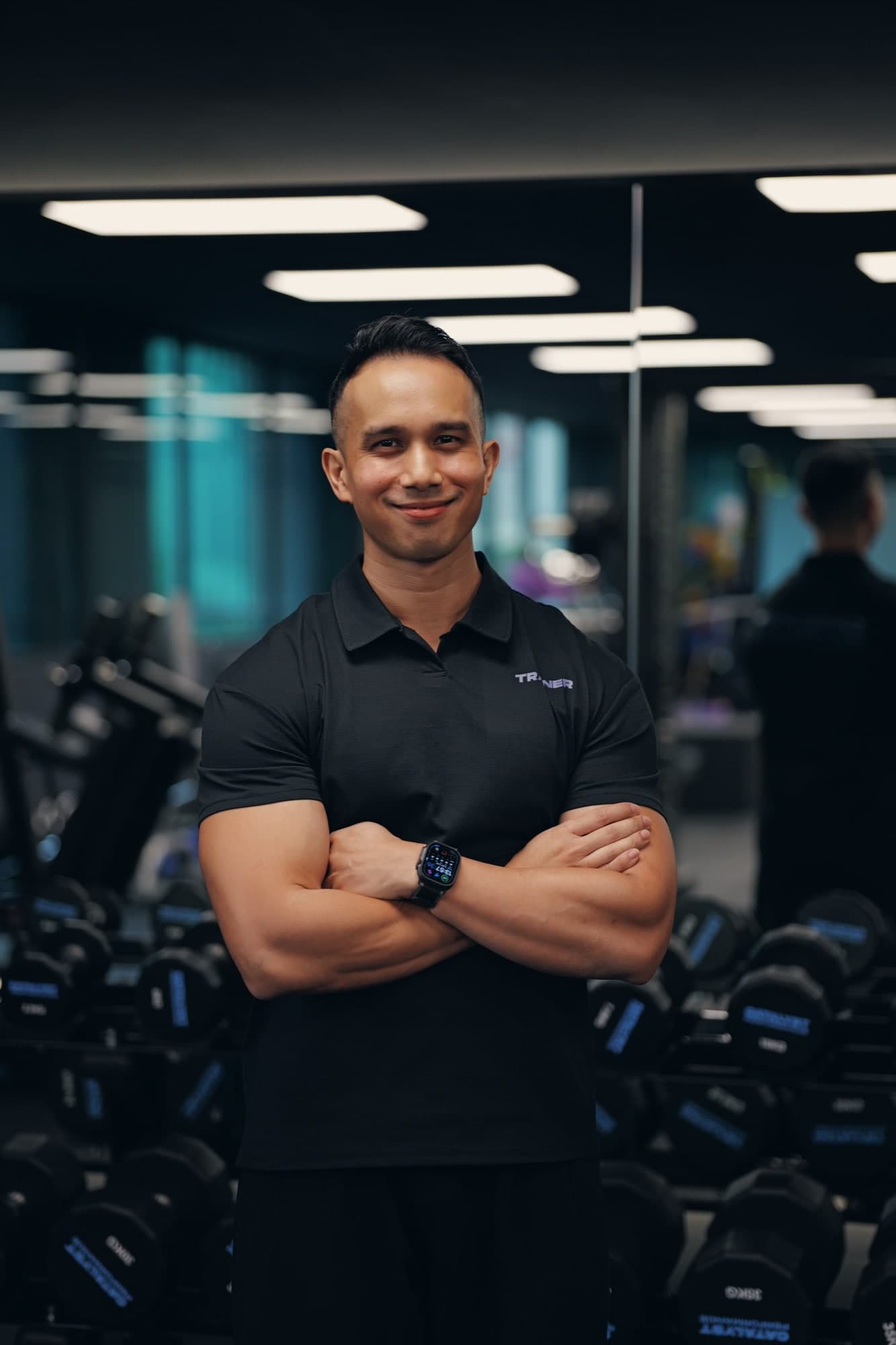
If you are dealing with chronic desk-worker lower back pain in Singapore and the standard treatments have not held, the high-leverage sequence is: book a Sports Massage and Neurokinetic Therapy session with Hafiz Adnan for the NKT assessment and reactivation work, then transition into strength programming with one of the founder-coaches to consolidate the gluteus maximus reactivation into a durable pattern. The combined NKT-plus-strength sequence is the dominant Catalyst pathway for the chronic-desk-worker case profile.
If you want a baseline measurement of where you stand before treating, the in-studio Catalyst Healthspan Assessment includes the Y-Balance Test (a stability measure that flags hip stabiliser issues directly) and the InBody composition scan (which often reveals the asymmetric musculature that develops alongside chronic compensations). The 60-minute first session is yours to keep. For the lighter starting point, the free three-minute Healthspan Audit lands a banded stability score in your inbox.
If you are over 50 and concerned that the chronic lower back pain is age-related rather than postural, training after 50 is a related Catalyst service angle. The compensatory pattern picture applies regardless of age; the strength-building piece becomes more important the older you get because the margin between sufficient and insufficient posterior chain strength narrows.
The cluster context: this post is one of eight in the Catalyst sports-massage and NKT cluster. For the broader frame, the pillar is Sports Massage Singapore: What NKT Adds That Foam Rolling Doesn't. For the physiotherapy-or-NKT decision, see NKT vs Physiotherapy in Singapore. The contrasting condition spoke is Runner's Knee in Singapore, which covers the same compensatory-pattern framework applied to the runner population.
Frequently asked questions
Q. How long does it take for chronic lower back pain to resolve?
Most desk-worker chronic lower back pain that fits the compensatory pattern picture shows meaningful reduction in pain within 2-4 NKT sessions and full resolution within 8-16 weeks of the combined NKT-plus-strength sequence. Pain reduction often precedes full pattern resolution; the absence of pain is not the same as the absence of the underlying pattern. Continuing the strength work past the point of pain resolution is what makes the change durable.
Q. Can a standing desk solve chronic lower back pain on its own?
Usually not, once the pattern is established. A standing desk reduces the rate at which the pattern is reinforced and is useful as a preventive measure. For a desk worker who already has the pattern, standing all day instead of sitting all day shifts the loading without resolving the gluteal inhibition. Many people who switch from full-time seated to full-time standing develop a different compensatory pattern (anterior pelvic tilt, lumbar hyperlordosis) within 3-6 months. The high-leverage intervention is alternating seated and standing intervals with micro-breaks for hip-mobility and glute-activation drills, plus the NKT-plus-strength sequence to resolve the underlying inhibition.
Q. Is squatting bad for lower back pain?
Squatting with poor form, insufficient hip mobility, or an inhibited gluteus maximus is bad for lower back pain. Squatting with good form, adequate hip mobility, and a functioning gluteus maximus is one of the best exercises for resolving lower back pain because it loads the posterior chain progressively. The answer depends on the technique and the stage of treatment. Early in stage 1 of the treatment plan, squatting is typically modified or substituted with single-leg variations and hip thrusts. Later in stage 2, full squat patterns return as the strength base develops. Weighing up the modality question specifically, our comparison of clinical Pilates and strength training for back pain after 40 reads the evidence head to head.
Q. Are deadlifts safe for chronic lower back pain?
Conventional deadlifts at appropriate loads, with good form and after the gluteus maximus has been activated, are one of the highest-leverage exercises for resolving the desk-worker pattern. They directly load the posterior chain (glutes, hamstrings, erectors) in the exact pattern that the compensation has been blocking. Conventional deadlifts at inappropriate loads, with poor form, or before the gluteus maximus has been activated will reinforce the erector-dominant compensation and aggravate the pain. The variable is not the exercise; it is the readiness of the lifter and the supervision. At Catalyst, deadlifts are introduced in stage 2 of the treatment plan after stage 1 has established gluteal activation.
Q. What's the difference between this and what a chiropractor would do?
Chiropractic care focuses on spinal manipulation (high-velocity low-amplitude adjustments) to mobilise joint segments. Chiropractic can provide rapid short-term reduction in pain by altering the joint biomechanics. It is less consistent at addressing the soft-tissue compensatory pattern that drives the pain in the first place. Some chiropractors are also trained in NKT and combine the two; many are not. NKT plus strength programming addresses the pattern (the inhibited glute, the facilitated hip flexor); chiropractic addresses the joint. Both can be valid; the NKT-plus-strength approach is more consistently durable in our intake population because it changes the underlying neuromuscular pattern rather than the joint position alone.
Q. How do I keep this from coming back once I've resolved it?
Three ongoing practices. First, maintain the posterior chain strength work: two strength sessions per week with hip thrusts or single-leg deadlifts as standard inclusions, indefinitely. Second, integrate micro-breaks into the workday: every 60-90 minutes, stand up, do a 90-second hip flexor stretch and 10 banded clamshells. Third, occasional maintenance NKT sessions: every 8-12 weeks during heavy work periods (year-end, project sprints, long travel) when the seated load is highest. Most Catalyst members who have resolved the pattern stay resolved indefinitely with this maintenance cadence.
Related reads in this cluster
- Sports Massage Singapore: What NKT Adds That Foam Rolling Doesn't. The pillar overview of the soft-tissue toolkit and how the clinical-frame modalities (NKT, IASTM, cupping) differ from generic deep-tissue work.
- NKT vs Physiotherapy in Singapore: How to Choose Where to Start. The decision frame for choosing where to start when you are in pain.
- Runner's Knee in Singapore: Why Localised Treatment Keeps Failing. The gluteus medius compensatory pattern that drives patellofemoral pain in recreational runners.
- Cupping Therapy Singapore: What It Does and What It Doesn't. The sports-cupping vs TCM-cupping distinction, and what the modern myofascial-decompression evidence supports.
- IASTM Explained: The Graston-Style Tools You've Seen in Singapore Clinics. Instrument-assisted soft-tissue mobilisation, how it works, and where it actually beats hands.
- How to Vet a Sports Massage Therapist in Singapore: Beyond the Service Menu. The decision frame for choosing a sports-massage practitioner: credentials, vetting questions, red flags.
- The Closed-Loop Recovery Method: Integrating Training Data with Manual Therapy. Why Catalyst integrates training-load and wearable data with manual therapy sessions, instead of running them as independent interventions.
- Foam Rolling: What 12 Years of Peer-Reviewed Evidence Actually Says. The honest read on self-myofascial release: what foam rolling does and doesn't deliver.
Citations
GBD 2019 Diseases and Injuries Collaborators. (2020). Global burden of 369 diseases and injuries in 204 countries and territories, 1990 to 2019: a systematic analysis for the Global Burden of Disease Study 2019. The Lancet, 396(10258), 1204 to 1222. thelancet.com
Hodges, P. W., & Richardson, C. A. (1996). Inefficient muscular stabilization of the lumbar spine associated with low back pain. A motor control evaluation of transversus abdominis. Spine, 21(22), 2640 to 2650. journals.lww.com/spinejournal
Sahrmann, S. A. (2002). Diagnosis and Treatment of Movement Impairment Syndromes. Mosby. (Comprehensive framework for compensatory movement pattern assessment; the source text for many manual therapy approaches including NKT.)
Suni, J., Rinne, M., Natri, A., Statham Pasanen, M., Parkkari, J., & Alaranta, H. (2006). Control of the lumbar neutral zone decreases low back pain and improves self-evaluated work ability: a 12-month randomized controlled study. Spine, 31(18), E611 to E620. journals.lww.com/spinejournal