The Edit · Founder Insights
Lunch-Hour Personal Training in the CBD: The One-Hour Session That Fits a Workday
How lunch-hour personal training works in Singapore's CBD: the real timeline from desk to shower to desk, what a 45-minute coached session can achieve, costs, and how to make it survive week nine.
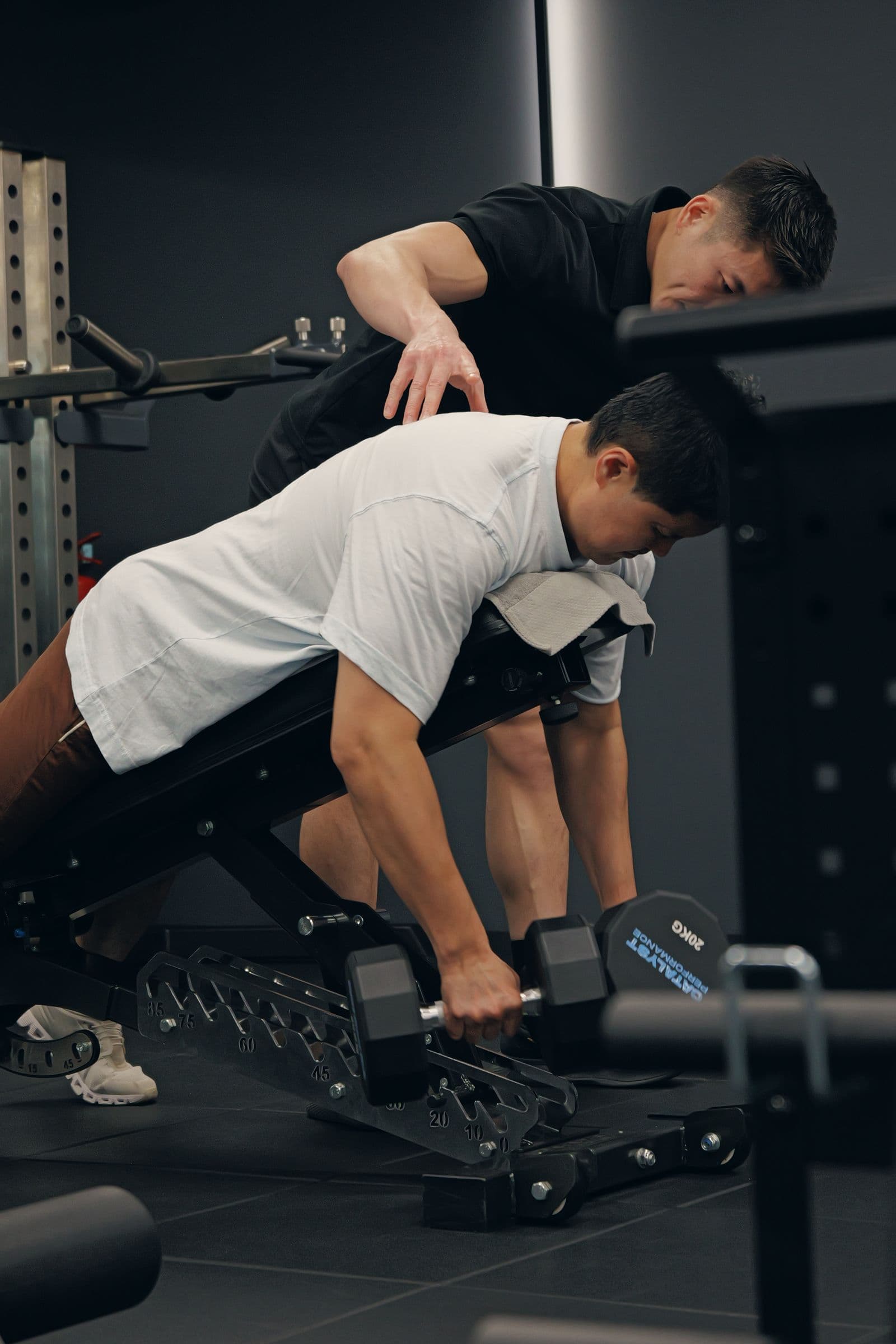
Personal training in the CBD at lunch works on a simple piece of arithmetic: a 60-minute calendar block converts to about 45 minutes of coached training once you walk, change and shower, and 45 focused minutes twice a week is enough to change strength and body composition measurably inside twelve weeks. The professionals who make it work are not the ones with unusual discipline. They are the ones whose studio is inside a seven-minute walk of their desk, whose sessions are booked as recurring meetings, and whose programme was designed for the constraint rather than squeezed into it. This guide covers the logistics, the programming and the costs, from a studio that runs the lunchtime pattern in Singapore's CBD.
| Slot | Door-to-door cost | What it suits | The catch |
|---|---|---|---|
| Before work, 7 to 8:30am | 75 to 90 minutes | Meeting-heavy calendars, guaranteed consistency | Early alarm; gym bag on the commute |
| Lunch, 12 to 2pm | 60 to 75 minutes | Anyone within a 10-minute walk of the studio | Needs a shower on site and a booked slot |
| After work, 5:30 to 8pm | 75 to 90 minutes | Flexible evenings, social trainers | First slot cancelled when work runs late |
TL;DR
- A one-hour lunch block yields about 45 coached minutes; programmed properly, that is a complete strength session, twice a week.
- The make-or-break variable is walking distance: past ten minutes each way, lunchtime training stops surviving busy weeks.
- Showers, towels and grooming space at the studio are not amenities; they are the mechanism that gets you back to your desk credible at 1:55pm.
- Recurring bookings at fixed times beat ad-hoc scheduling; treat the session like a standing meeting with the one colleague who never reschedules.
- Costs match standard CBD 1:1 rates, roughly $120 to $200 per session; some employers offset it through wellness benefits.
The CBD lunch hour is the most contested real estate in a professional's week, and the fitness industry has historically served it badly: commercial gyms at capacity from 12:15, queues for racks, and forty of your sixty minutes spent on everything except training. The coached-studio format fixes the structural problems, no queue, no improvisation, a floor that is yours at 12:30 because it was booked, which is why lunchtime 1:1 training has quietly become a standard fixture among Raffles Place and Tanjong Pagar professionals. What it cannot fix is physics: the hour is still an hour. Everything below is about spending it well.
1. The 45-minute truth
Subtract a seven-minute walk each way and a quick change, and your 60-minute block holds about 45 minutes of training. The instinct is to treat that as a compromised session. The evidence and our coaching floor both say otherwise: 45 coached minutes, with rest periods managed and zero waiting for equipment, routinely contains more productive work than the average self-directed 90-minute gym visit.
What fits comfortably: a full-body strength session built on four to six exercises, warm-up included, with the coach compressing rest on the accessory work and protecting it on the main lifts. What does not fit: long specialised sessions, extensive conditioning pieces on top of full strength work, and social warm-down time. The lunch format trades breadth within a session for frequency across the week, and the trade works because two tight full-body sessions cover everything twice where one sprawling session covers it once.
Twice a week at this density is the minimum effective dose we wrote about in the three-hours-a-week case, and it is enough to move the numbers that matter, strength, lean mass, waist, measurably by week twelve. The constraint that ruins lunch training is never the 45 minutes. It is the session that was designed for 75 and gets amputated live, every visit, by the clock. Design for 45 and the window is generous.
2. Desk-to-desk logistics
Lunchtime training is a logistics product. The training is the easy half. The timeline that has to survive is: leave desk 12:25, train 12:35 to 1:20, shower and change by 1:40, back at your desk 1:50 looking like someone who took a normal lunch. Three variables decide whether that timeline is realistic or fantasy.
Distance is the first and least negotiable. Inside a seven-minute walk, the pattern is durable; at ten minutes it survives good weeks only; beyond that, it quietly dies by November. Choose the studio by walking time from your actual desk, not by any other merit. This is why CBD studios cluster inside the office towers themselves; ours sits in Manulife Tower, above Telok Ayer MRT, precisely so that the walk, for most of our lunchtime clients, is a lift ride and a street crossing.
Showers are the second. A studio serving lunch traffic properly has private showers, towels provided, and space to hang a shirt so it does not emerge from a gym bag looking slept in. Grooming logistics sound trivial until they are the reason afternoon meetings make you skip.
The booked slot is the third. Lunch capacity is finite everywhere; the professionals who succeed hold a recurring booking, same days, same time, treated in the calendar exactly like a standing meeting. Ad-hoc lunch training loses the negotiation with the workday almost every time it is attempted.
3. Programming for the lunch window
A lunch programme is written differently from an open-schedule programme, and you can audit a prospective trainer by whether theirs reflects it.
The skeleton: two weekly full-body sessions, each opening with one main lift, a squat pattern one day, a hinge the other, loaded honestly and rested properly, because strength work is the least compressible part of training. Around it, paired accessory work run as supersets, a push with a pull, a single-leg pattern with a carry, which is how 45 minutes holds 20 working sets without ever feeling rushed. Conditioning, where it belongs at all, is a short finisher, six to eight minutes on an ergometer, not a second workout.
Sweat management is a real programming input at lunch, and coaches who run lunch floors programme around it: the heavy sweating goes early in the session, the final ten minutes de-escalate, and the true high-intensity conditioning lives in your other weekly slot or the weekend. This is also why the lunch format pairs so naturally with a morning run habit; our timing guide for running in Singapore covers those windows.
Progression is tracked exactly as in any serious block, loads and reps recorded, baselines re-tested, because the compressed format makes drift easier to hide. This is where assessment-led coaching earns its fee: our programmes are anchored to 4-Pillar Assessment baselines, so a lunch client sees the same objective progression a two-hour-session client would, just delivered in denser packets. Busy professionals have been sold the myth that short sessions mean maintenance only; the loads on the bar disagree, and our guide for busy working adults makes the broader schedule case.
4. Lunch, morning or evening
The right slot is the one your calendar fails least often, and CBD calendars fail predictably by slot. Our own bookings from July to September 2026 put lunch first: 25.7 percent of sessions started between 11am and 1pm, and the hour-by-hour table is in our session data on when the CBD trains.
Evening sessions have the highest sabotage rate: 5:30pm is the first thing a late meeting, a closing deadline or a client dinner cancels, and each cancellation weakens the habit. If your role regularly runs past six, evening training is aspiration, not a plan. Morning sessions are the consistency king: nothing corporate happens at 7am, and the session is banked before the day can touch it. The costs are the alarm and carrying the day on the commute; our lunchtime and morning clients split roughly along chronotype lines.
Lunch is the compromise that suits the densest calendars: no earlier alarm, no evening exposure, and a hard psychological reset in the middle of the day that most clients come to defend as fiercely as the training itself. Its risks are the two logistics variables above, distance and slot discipline, plus the occasional lunch meeting that must be scheduled around.
Two honest heuristics from our floor. If you cancel more than one session in four, the slot is wrong, not your character; move it before you conclude training does not fit your life. And pairs work: several of our lunch regulars train as colleague pairs, which halves the per-person cost and adds a witness to every booking, the same accountability mechanism that makes training as a pair effective for spouses.
5. Cost, and who pays
Lunchtime 1:1 coaching in the CBD prices at the standard premium-district rates: roughly $120 to $200 per session depending on studio and coach seniority, mapped fully in our cost guide. Twice weekly, budget $1,000 to $1,700 a month; as a colleague pair sharing sessions, materially less per person. There is no lunch surcharge anywhere reputable, but the 12 to 2pm slots are the scarcest inventory in every CBD studio, which is one more argument for the recurring booking.
The employer angle is worth five minutes of your time. A growing share of Singapore firms run wellness benefits, flexible spending, insurer-linked programmes or direct fitness subsidies, that reimburse part of coached training, and finance teams approve strength coaching more readily than they once did because the absenteeism and healthspan arithmetic favours it. Some firms go further and bring the coaching in-house as a perk; that is the model our corporate programmes serve, on-site assessments and executive training blocks. If your firm has any wellness budget at all, ask before assuming the invoice is fully yours.
Evaluate the spend the way the private-gym maths chapter does: against the exercise that actually happens without it, not the theoretical membership. For most lunchtime clients the honest counterfactual was desk lunch and no training; measured against that, the per-outcome price of two banked sessions a week is the best line on the ledger.
6. Making it stick past week nine
Every lunchtime training arrangement is easy in week one and decided in week nine, when novelty is gone and the quarter is closing. The mechanics that survive are boringly specific.
Recurring calendar blocks, marked busy, named something meeting-shaped if your culture requires it. Kit kept at the studio or office, two full sets, so a forgotten shirt is never the failure point; good lunch studios hold lockers for exactly this reason. A default-reschedule rule agreed with your coach in advance: a cancelled Tuesday automatically becomes Wednesday same time, so a missed session is displaced rather than deleted. And a re-test on the calendar, week twelve, numbers against baseline, because a visible finish line for each block does more for attendance than any motivational technique we have watched attempted.
The last mechanism is the coach relationship itself. A lunch hour with a professional who measured you, programmed for you and is standing on the floor waiting is structurally harder to skip than any solo intention. That accountability is most of what distinguishes coached training from access products at every price point, and at lunch, where the excuses are strongest, it earns its keep most visibly.
Setting it up this month
The sequence that works: map the studios inside a ten-minute walk of your desk, and shortlist the ones with private showers and true 1:1 floors. Take one assessment or single session at each finalist during your actual lunch window, and time the full desk-to-desk round trip honestly. Pick the studio where the timeline held, book a recurring twice-weekly slot, and commit to a single sixteen-week block with a re-test at the end. From there the numbers, and the how the afternoon feels after a trained lunch, will make the renewal case themselves.
Frequently asked questions
Q. Is 45 minutes of personal training enough?
Yes, when programmed for the window: one main lift plus superset accessory work delivers a complete full-body strength session in 45 coached minutes. Twice a week at that density produces measurable strength and body-composition change within twelve weeks.
Q. How do people shower and get back to work in an hour?
By training inside a short walk of their desk at a studio with private showers and towels provided. The workable timeline is roughly: leave at 12:25, train 12:35 to 1:20, shower, desk by 1:50. Past a ten-minute walk each way, the arithmetic stops working.
Q. How much does lunchtime personal training cost in the CBD?
Standard CBD 1:1 rates: roughly $120 to $200 per session, with no lunch premium. Training as a colleague pair shares the cost, and some employers offset it through wellness benefits.
Q. Is lunch better than training before or after work?
It depends where your calendar fails. Evenings are cancelled by late meetings, mornings cost an early alarm but are nearly cancellation-proof, and lunch suits dense calendars within walking distance of a studio. Pick the slot you would still hold in week nine, and move it if you cancel more than one session in four.
The lunch hour is the only appointment in a CBD day that belongs entirely to you, and 45 well-coached minutes twice a week is a complete training programme wearing a lunch break's clothes. Solve the walking distance, book the recurring slot, and let the programme be designed for the window rather than despite it. For the wider decision of what format to train in at all, start with 1:1 versus small group and how to choose a trainer.
Catalyst Performance sits in Manulife Tower, above Telok Ayer MRT, with private showers, 1:1 floors and lunch slots built around the desk-to-desk timeline above. Every client starts with the 4-Pillar Healthspan Assessment, and re-tests every 16 weeks, so your lunch hours report to a number. Book a complimentary consultation, at lunch, naturally.