Catalyst View
Our reading of the numbers
Co-Founder and General Manager, Catalyst Performance
Every source on this page was re-checked this month and every existing figure held. What we added is two ceilings. The mortality benefit of strength training peaks at around 60 minutes a week, where all-cause mortality risk sits 27 percent lower, and higher volumes do not add to it. Daily steps stop lowering mortality risk somewhere between 6,000 and 8,000 for adults over 60, and between 8,000 and 10,000 for adults under 60.
A ceiling is good news, and I want to say that plainly, because most of what gets sold in this industry depends on the opposite being true. The work is finite. An hour a week of strength training fits into a Tuesday and a Thursday. Walking is genuinely protective and it pays out early, well before the numbers most people are chasing: moving from the lowest quartile of daily steps to the second, roughly 2,200 more steps a day, came with 40 percent lower mortality.
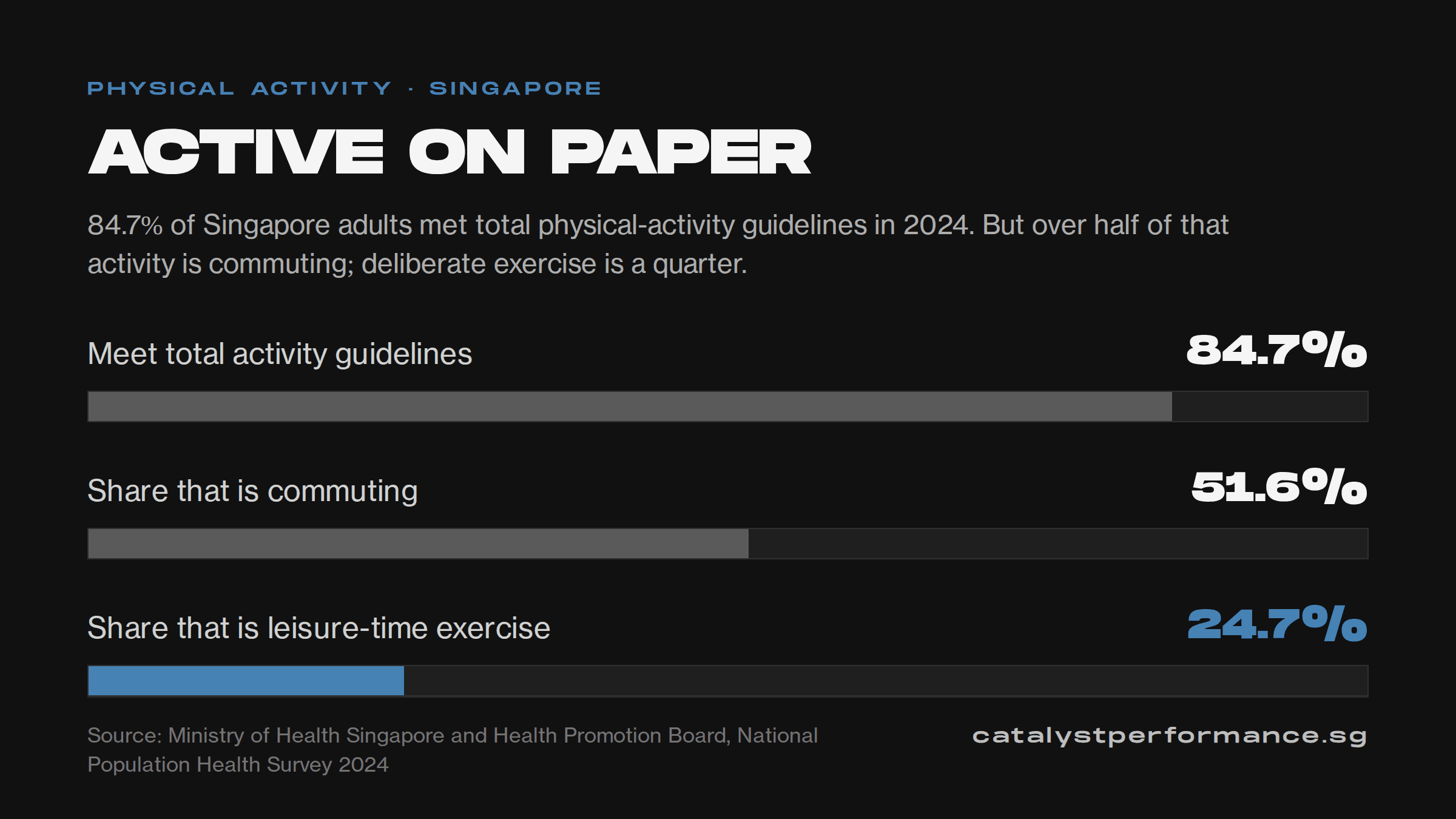
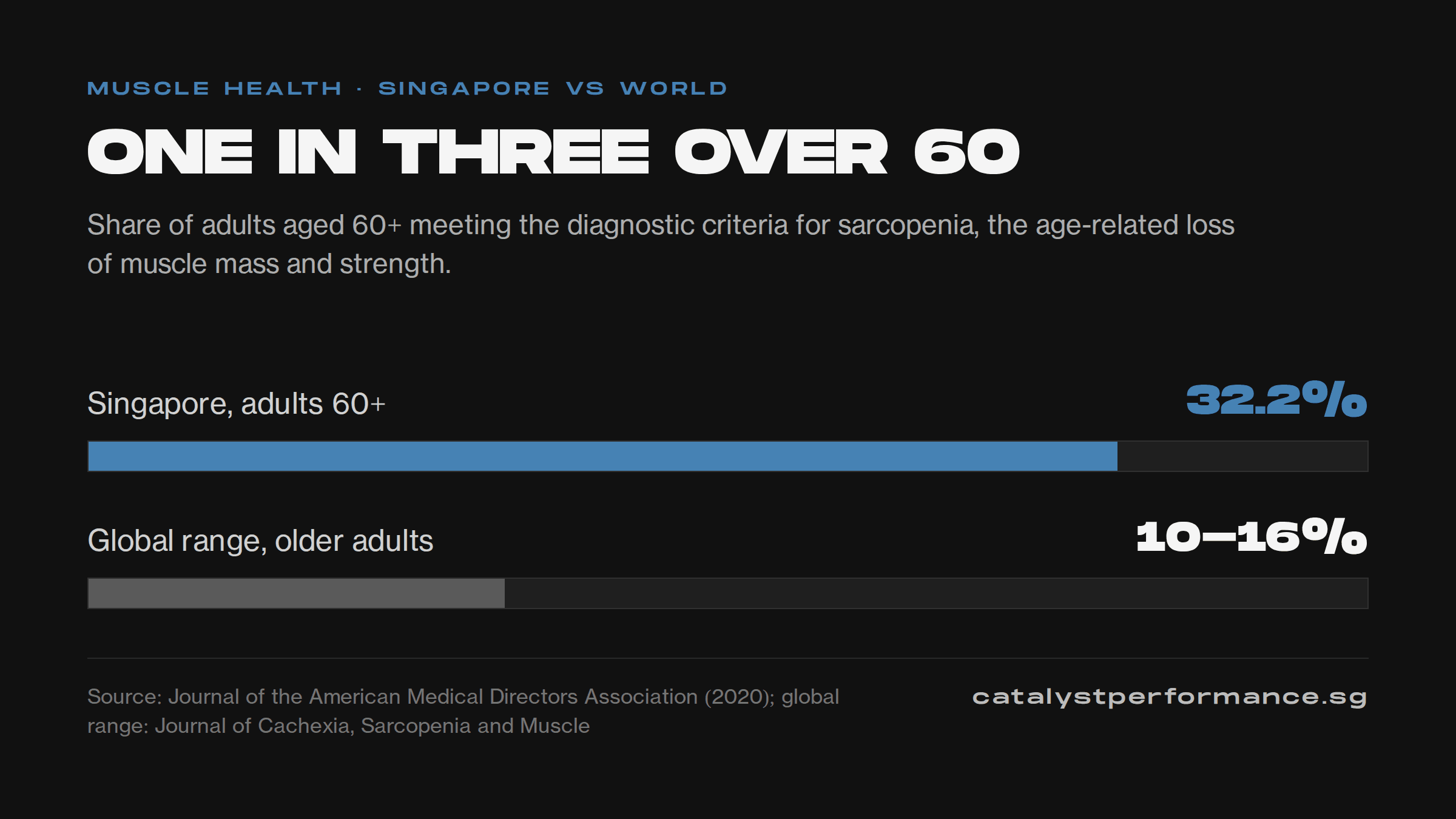
Set that 60-minute target against what people actually do, and the gap is the whole story. Only 17.3 percent of European adults strength train at least twice a week. In Singapore, 84.7 percent of residents met total activity guidelines in 2024, with commuting making up 51.6 percent of that activity and leisure-time exercise 24.7 percent. We clear the walking bar comfortably and most of us stop there. By 60, 32.2 percent of Singaporeans meet the criteria for sarcopenia.
The honest reading of this month's data is that the target is lower than most people fear and further away than most people think. One hour a week is the dose that protects the back half of life, and the majority are not doing it. That is a problem of priority, not capacity.
An hour a week of strength training carries a 27 percent lower mortality risk. Fewer than one in five European adults are doing it.