Skip to content
Catalyst Performance

Goal · Bone density through menopause

Bone density doesn't have to fall off the cliff

Peri- and post-menopausal bone loss is the most preventable cause of fractures in later life, and the only non-pharmacological intervention with strong evidence is heavy resistance and impact training. 1:1 personal training in Singapore CBD, grounded in the Catalyst Healthspan Assessment.

For: Women in peri-menopause, post-menopause, or with low bone density (osteopenia or osteoporosis), under medical supervision, looking for an evidence-based exercise intervention beyond walking and yoga.

Not sure where you stand on the four pillars? Take the free Healthspan Audit before committing to a programme.

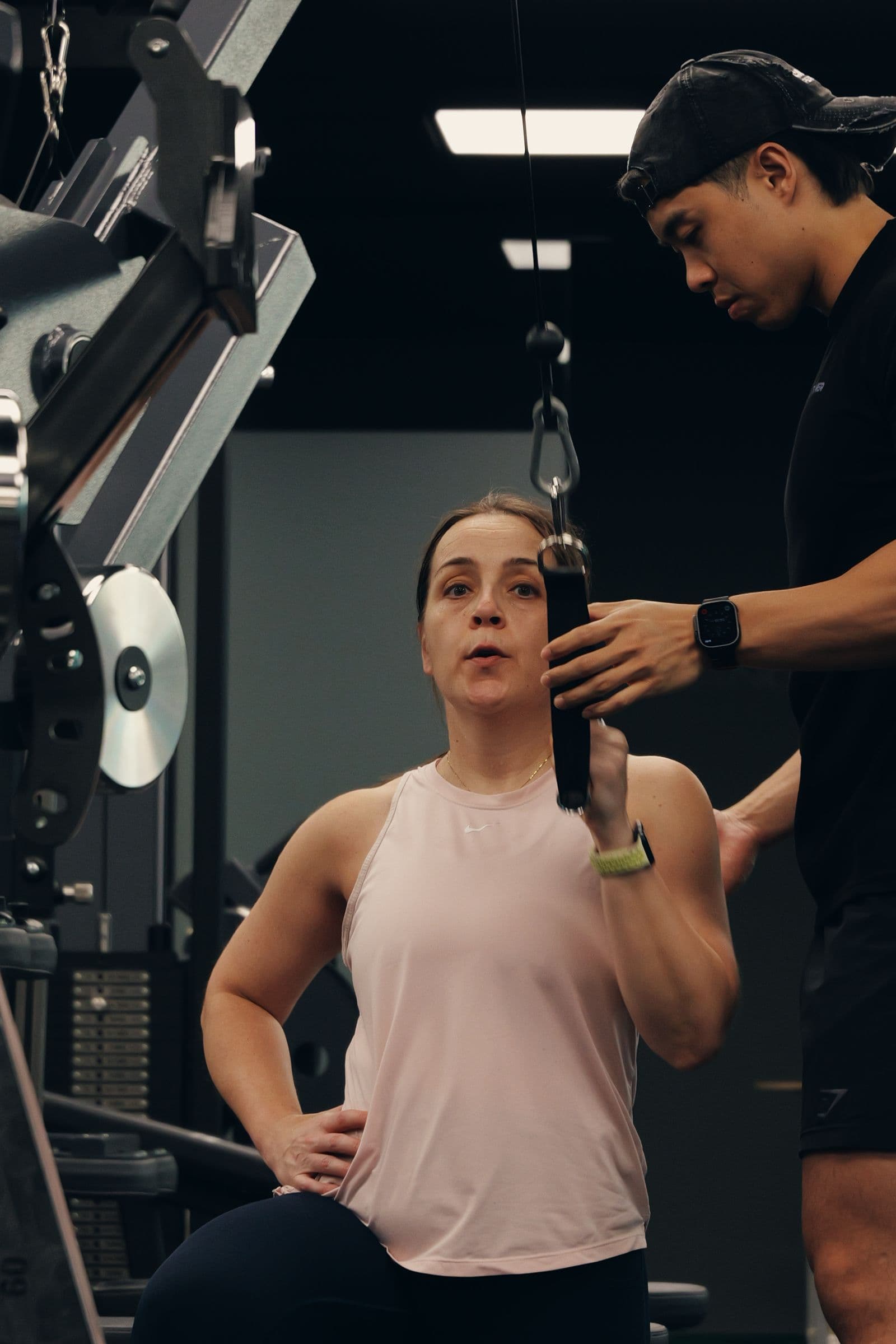
Catalyst Performance coach guiding a woman through a cable strength exercise, 1:1 personal training in Singapore CBD
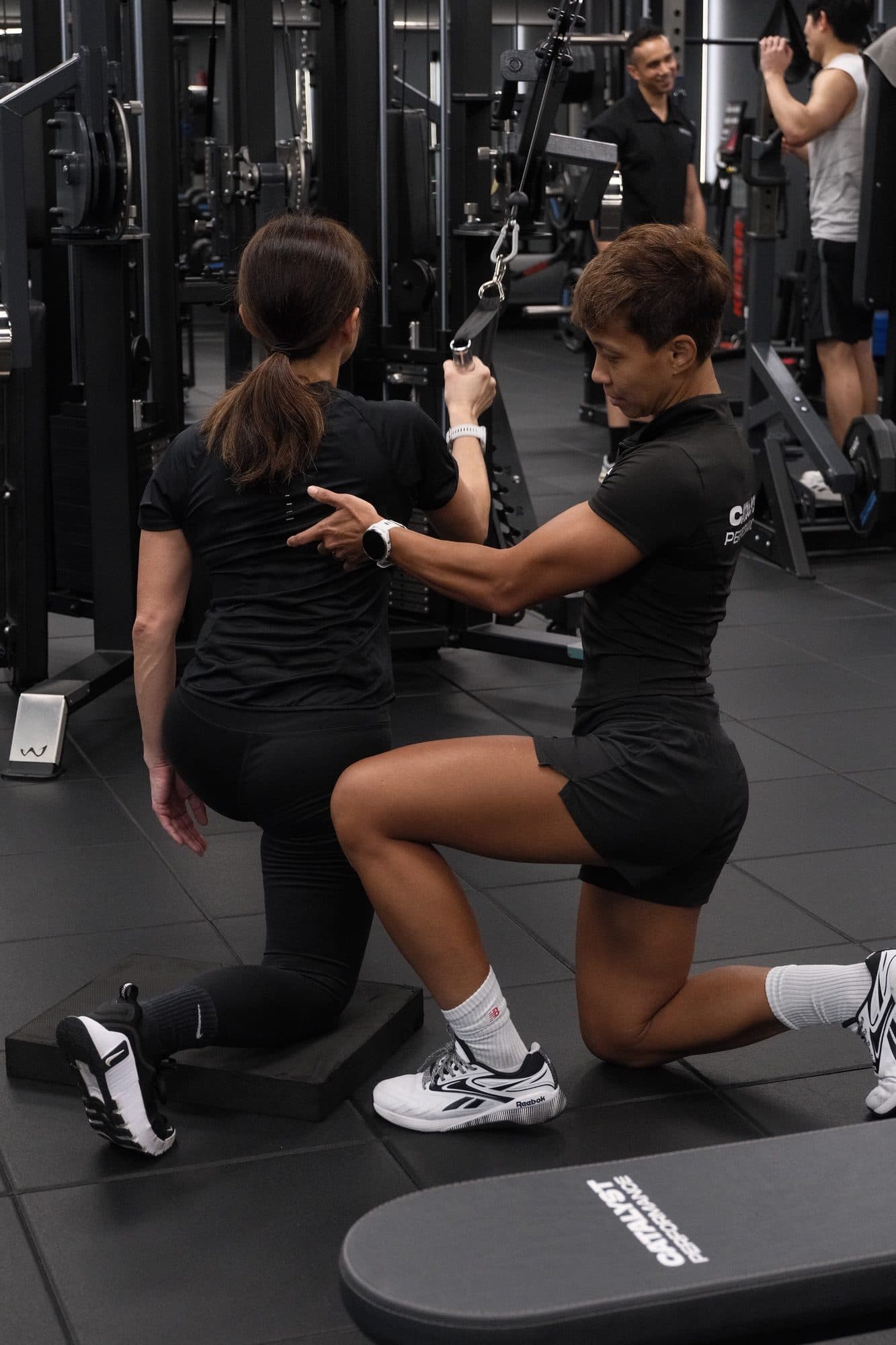
Catalyst Performance coach coaching a woman through a kneeling cable movement with hands-on form correction, Singapore CBD studio

Real Catalyst sessions, Manulife Tower

Quick answer

Why a personal trainer for menopause, not a class?

A personal trainer for menopause programmes heavy resistance training and high-impact loading, not walking, not yoga, not light bands. The LIFTMOR trial (Watson et al., 2018, Journal of Bone and Mineral Research) showed that 8 months of supervised heavy resistance training at 80-85% of one-rep maximum (deadlift, back squat, overhead press) combined with jumping chin-ups produced statistically significant gains in lumbar spine and femoral neck bone mineral density in post-menopausal women with low bone mass, with no fractures or significant adverse events. Catalyst Performance runs 1:1 personal training in Singapore CBD calibrated to this protocol, under your gynaecologist's coordination and grounded in the Catalyst 4-Pillar Assessment.

If this sounds like you

The pattern

  • Your DEXA scan came back with osteopenia or borderline osteoporosis, and your doctor's lift weights advice doesn't translate into a concrete plan.
  • The mainstream menopause-fitness advice is unchanged from twenty years ago, walking, yoga, light resistance bands, but you've read enough recent research to know that isn't what moves bone density.
  • You've been told you shouldn't lift heavy at your age, and you suspect that's wrong, but no one has shown you a programme that takes the science seriously and the risk seriously.
  • Your sleep, mood, and energy have shifted in a way that interacts with how you train, and a generic programme doesn't account for any of it.

The Catalyst protocol

The method

  1. 01The Catalyst Healthspan Assessment as a baseline. Body Composition (including bone mineral content where available), Strength (1RM-scaled testing on the lifts that drive bone loading), Stability (Y-Balance for fall-risk profile), and Cardiorespiratory Fitness.
  2. 02Heavy resistance and impact training, the LIFTMOR protocol. The landmark Watson et al. 2018 trial (Journal of Bone and Mineral Research) demonstrated that 8 months of supervised heavy resistance training (deadlift, back squat, overhead press at 80-85% 1RM) plus impact loading (jumping chin-ups) in post-menopausal women with low bone mass produced significant gains in lumbar spine and femoral neck bone mineral density. This is the protocol Catalyst's bone-density programming is built off.
  3. 03Fall-risk screening at every Checkpoint. Y-Balance asymmetry, single-leg stance time, and posterior-chain strength, because the fracture isn't usually a bone-density failure, it's a fall caused by a stability or strength failure that landed on a vulnerable bone.
  4. 04Coordination with your medical team. We work alongside your gynaecologist, endocrinologist, or fracture-prevention clinic. If you're on bisphosphonates, HRT, or other osteoporosis pharmacotherapy, the training plan is built around the medication context.
  5. 05The 16-week Checkpoint re-test. Strength benchmarks, asymmetry indices, and Body Composition tracked against your own baseline. DEXA cadence stays with your clinician.

The outcome

A bone density curve that bends back up instead of off the cliff. Strength reserve that absorbs the everyday falls. A body that handles the next thirty years of independent living, on its own terms.
Take the Assessment →

Before you commit

Score your healthspan first

12 questions, 2 minutes, on a phone. The complimentary Catalyst Healthspan Audit estimates your score across the four pillars and surfaces which one is pulling the rest down. The same 0 to 10 scale we use in studio.

Take the Healthspan Audit →

Frequently asked, this goal

Q. 01

Is heavy lifting actually safe for women in their 50s, 60s, or 70s?

With proper screening and progression, yes, and the evidence base for this has reversed in the last decade. The LIFTMOR trial supervised women aged 58-75 with low bone mass through 8 months of 80-85% 1RM training with zero osteoporotic fractures and no significant adverse events. The follow-up Onero programme, supervised in over 100 sites in Australia, has replicated the safety profile in thousands of participants. The risk is in unsupervised heavy lifting without prior screening, not in the loading itself. Catalyst runs every member through a full 4-Pillar Assessment before loading begins, and progression is data-led, not template-led. For the full trial breakdown, see strength training for menopause: the evidence.

Q. 02

Why heavy lifting and impact work, not light weights and gentle mobility?

Bone only remodels in response to loads well above what daily life provides, and the two stimuli with the strongest evidence are heavy resistance and impact. Heavy compound lifting drives high mechanical strain through the spine and hip; impact loading, like jumping and controlled landings, adds the high strain-rate signal that bone responds to. Light resistance bands, walking and gentle mobility have real value for balance and general health, but they sit below the threshold that meaningfully changes bone mineral density. This is exactly why the LIFTMOR trial paired heavy lifting at 80 to 85% of one-rep maximum with jumping and drop landings, rather than light, high-repetition work. At Catalyst the programme is built on the same two levers, loaded only after the 4-Pillar Assessment and scaled to your screening.

Q. 03

Do I need a DEXA scan, and where do I get one in Singapore?

A recent DEXA scan (within the last 12 months) is strongly recommended but not required for the assessment. DEXA is the standard measure of bone mineral density and is widely available in Singapore: at public-hospital radiology departments through a GP or specialist referral, at private imaging providers such as Parkway Radiology and NHG Diagnostics, and at screening clinics including ATA Medical, which has a Tanjong Pagar branch in the CBD, and Thomson Medical. Cost ranges from heavily subsidised public screening to a few hundred dollars privately. If you have a report, bring it: the bone mineral density, T-score and Z-score values shape the programming directly. Bone changes slowly relative to the scan's own measurement error, so a repeat every one to two years is the standard monitoring interval, not every few months. We don't run DEXA at the studio.

Q. 04

I'm on HRT, bisphosphonates, or denosumab. Does that change the training plan?

Yes, it shapes the context. HRT and pharmacotherapy provide their own bone-density support and you should remain under your prescribing clinician's care; the training works alongside, not instead. The plan is built around your medication schedule, recent labs, and any specific clinical guidance from your gynaecologist or endocrinologist. We coordinate, we don't substitute.