Catalyst Performance
Loading
Catalyst Performance
Loading
The GLP-1 Muscle Protocol · The Other Half
Built and medically reviewed by Dr Luqman Haris, MBBS, and real Catalyst coaches. Not an app, not AI.
A GLP-1 strips muscle too: 25 to 39% of the weight you lose can be muscle, not fat. This is the 12-week plan that keeps it, for adults on, or considering, a GLP-1.
One payment, yours for life · See what’s inside first

Designed by a medical doctor
“The most significant health gains for most people happen long before they need a doctor.”
Dr Luqman Haris, MBBS, Co-Founder
The clinical thinking behind the Protocol is Dr Luqman Haris, a Bachelor of Medicine and Surgery (MBBS) doctor who chose preventative health over clinical practice and co-founded Catalyst Performance. The muscle-loss science, the screening logic, and the line between coaching and medicine are his. Every claim is cited, and prepared for his medical review.
The coaching craft behind the method
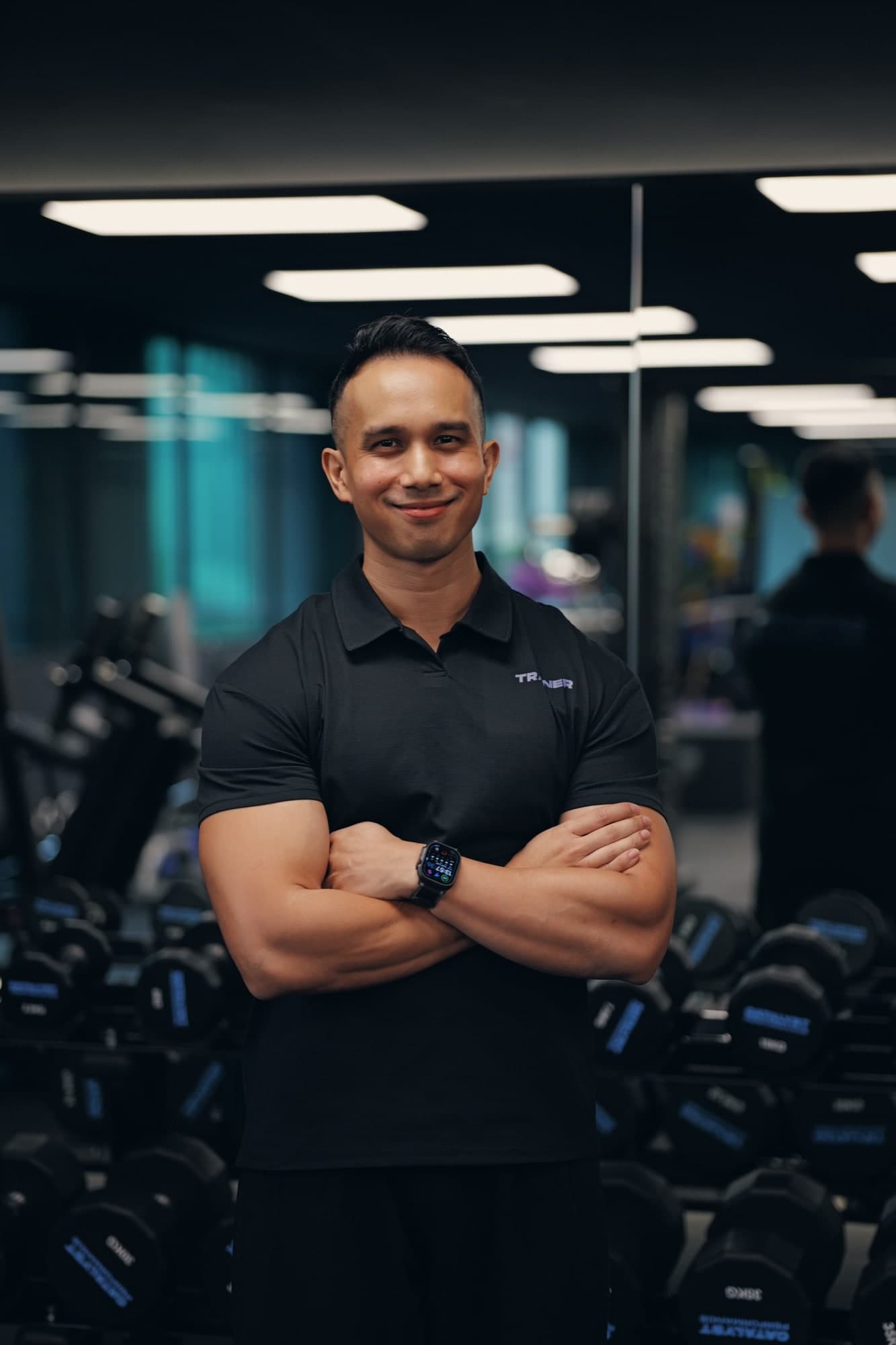
The coach who trains the coaches
Bervin Manoharan, Co-Founder
Bervin Manoharan has spent over a decade in the industry, a coach first. He has coached hundreds of clients one-on-one, and has hired, trained and mentored hundreds of trainers, managers and leaders across Singapore’s fitness industry. The Protocol’s programming, its form-first standard, and its assessment logic are his craft.
The short version
What you get
Why start today
The muscle leaves while the weight does, not after. Every week on the medication without resistance training and enough protein is lean mass you may not get back. The sooner you protect it, the more of it you keep. Launch pricing is held for the first 50 buyers.
What it costs
One payment, from SGD 99, yours for life. Less than the cost of a single personal-training session, and a fraction of one month of the medication you are already paying for. No subscription, no upsell.
Get the Protocol, from SGD 99 →The problem nobody packages for
The medication is efficient at removing weight. It does not preferentially spare muscle.
GLP-1 receptor agonists work by slowing how fast your stomach empties and acting on the appetite centres in the brain, so you feel full sooner and eat less. That is the mechanism that makes the fat loss happen. It is also why eating enough protein becomes a deliberate act rather than something hunger reminds you to do.
Here is the part most people are not told. A meaningful share of the weight that leaves is muscle. The Lancet review the figure comes from puts it at 25 to 39% of total weight lost being fat-free mass, in people not training to protect it. In the semaglutide STEP 1 body-composition substudy, fat mass fell 19.3% while lean body mass fell 9.7%. On tirzepatide the ratio is kinder, fat loss outpaces muscle loss by roughly three to one, but muscle still goes.
Lose the fat and you improve the numbers on a screening report. Lose the muscle and you quietly erode the thing those numbers were meant to protect: strength, bone, glucose control, and the ability to stay independent through your later decades. The fix is not exotic. The same research names two levers, resistance training and adequate protein. The drug buys you a window. The muscle you build inside it is what keeps the door from swinging back open.
What you get
01
Three phases of four weeks: Foundation, Build, Consolidate. Two to three short strength sessions a week, built from compound patterns (squat, hinge, push, pull, loaded carry), with week-by-week loading and a defined endpoint. Three equipment tracks ship in the box, home, dumbbell-only, and full gym, so the same programme runs wherever you train. Form is earned before load is added.
02
A protein system designed for an appetite the medication has switched off. A realistic gram-per-kilogram floor, the eat-protein-first tactic, meal-by-meal scaffolding, and liquid options for the days nothing appeals. Built around the reality that on a GLP-1 protein has to be planned, not left to hunger.
03
How to position your harder sessions and your higher-protein meals around the days you tolerate them best, and how to protect the protein floor when appetite and energy dip. The training and eating side is ours to coach. The drug schedule itself stays with your prescribing doctor.
04
How to tell, without a studio body-composition scan, whether the weight leaving is fat or muscle. A week-0 self-baseline and a week-12 re-check using measures you can take at home: weight trend, waist-to-height ratio, and a simple strength self-test. Strength holding or rising while weight falls is the at-home signal that muscle is staying.
05
What to do in the weeks around stopping the medication, if and when you do. How the muscle you built becomes the exit strategy, what to expect as appetite returns, and how to hold your body composition once the drug is no longer doing the work. Whether to stop is your doctor's call; staying strong through it is the part you train for.
06
The full evidence base, referenced so a doctor, a scientist, or a sceptical family member would nod: the muscle-loss range, the resistance-plus-protein fix, the regain data, and the honest limitations. Your access does not expire, and updates land as the research moves.
A look inside, Foundation week 1
Full body, three sessions, built from compound patterns. Reps sit in the strength-relevant 6 to 10 band, the descent is controlled, and you leave two to three reps in reserve. You add load only when you own the top of the rep range with clean form. This is one sample week; the programme progresses it across twelve.
Session A
Lower-body lead
Control the descent, leave 2 to 3 reps in reserve
Hips back, flat back, feel the hamstrings load
Three seconds down, one second up
Tall and braced, walk at an even pace
Session B
Upper-body lead
Ribs down, press without arching the lower back
Lead with the elbows, pause at the bottom
Chest up, knees track over the toes
Breathe, keep the ribs and pelvis stacked
Session C
Full body
Own the depth you can control with clean form
Squeeze the shoulder blades, no momentum
Drive through the heel, no push off the trailing foot
Resist the twist, brace through the whole set
The book edition
The whole Protocol comes two ways: an online member area you train from on your phone, and a designed PDF book you keep and read away from a screen. Same content, regenerated together, yours for life. Here is a real taste of both.
Protein is the harder half of the equation on a GLP-1, because the drug that makes weight loss easy makes eating enough protein deliberate. This is how to hit the target anyway.
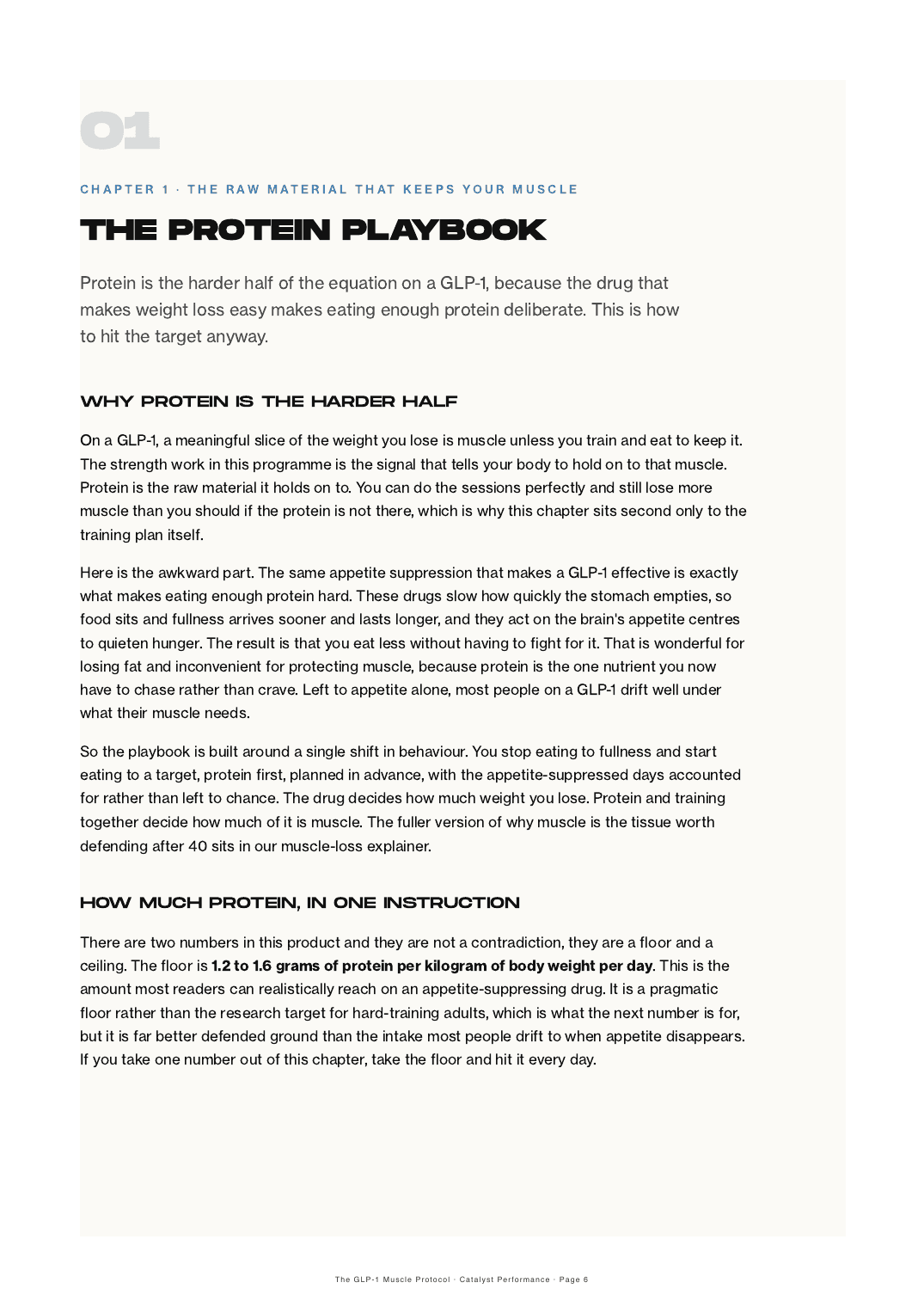
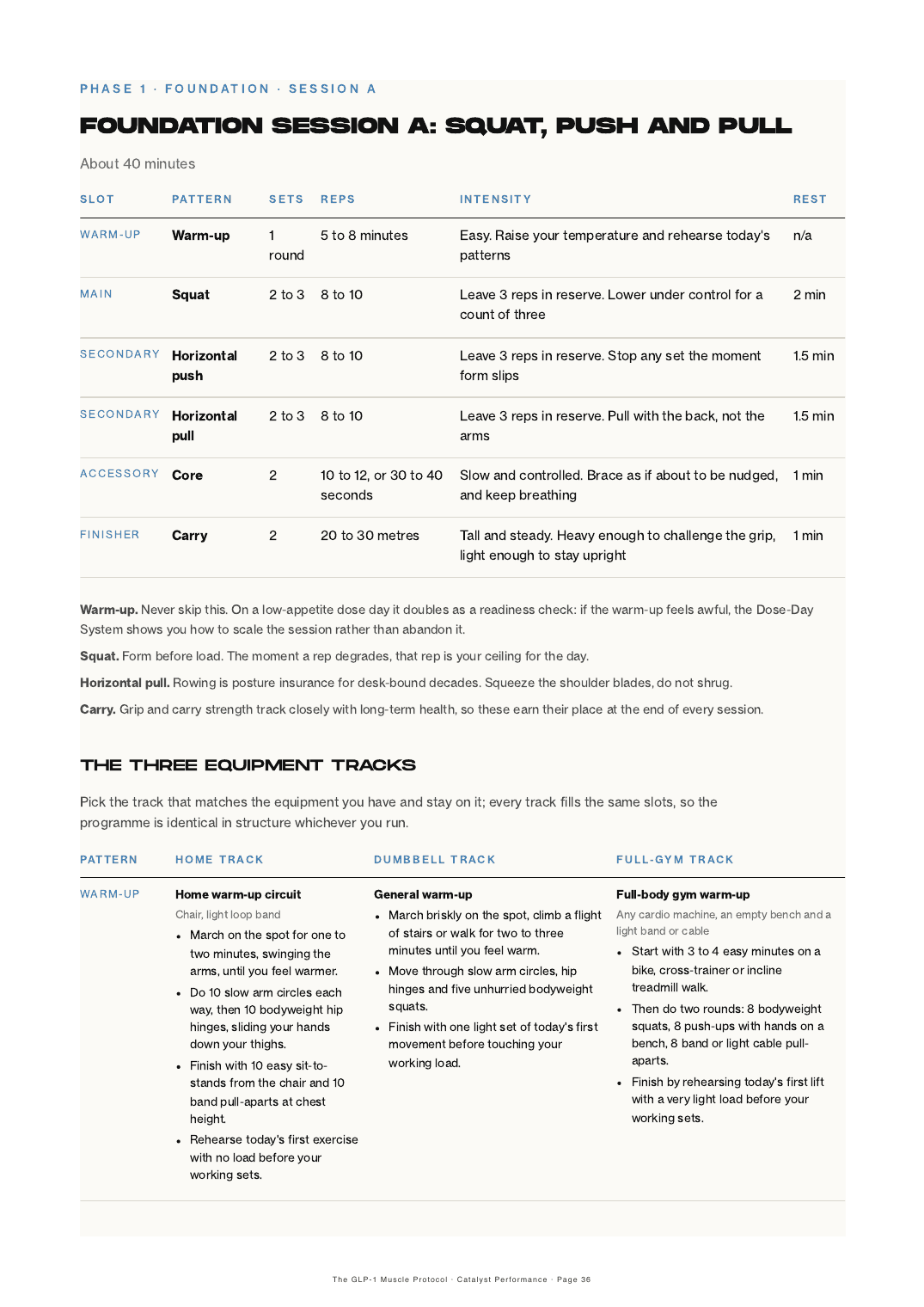
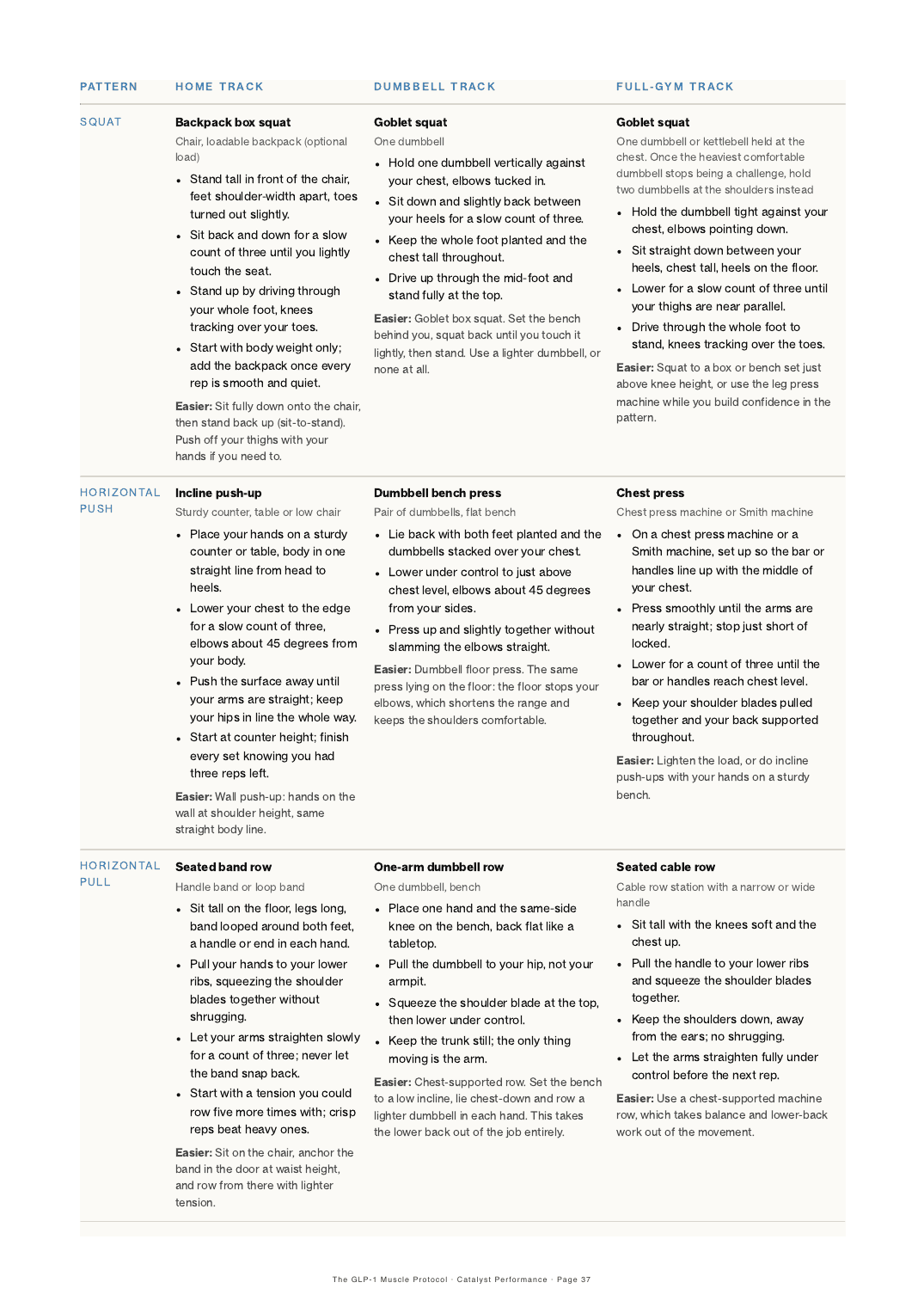
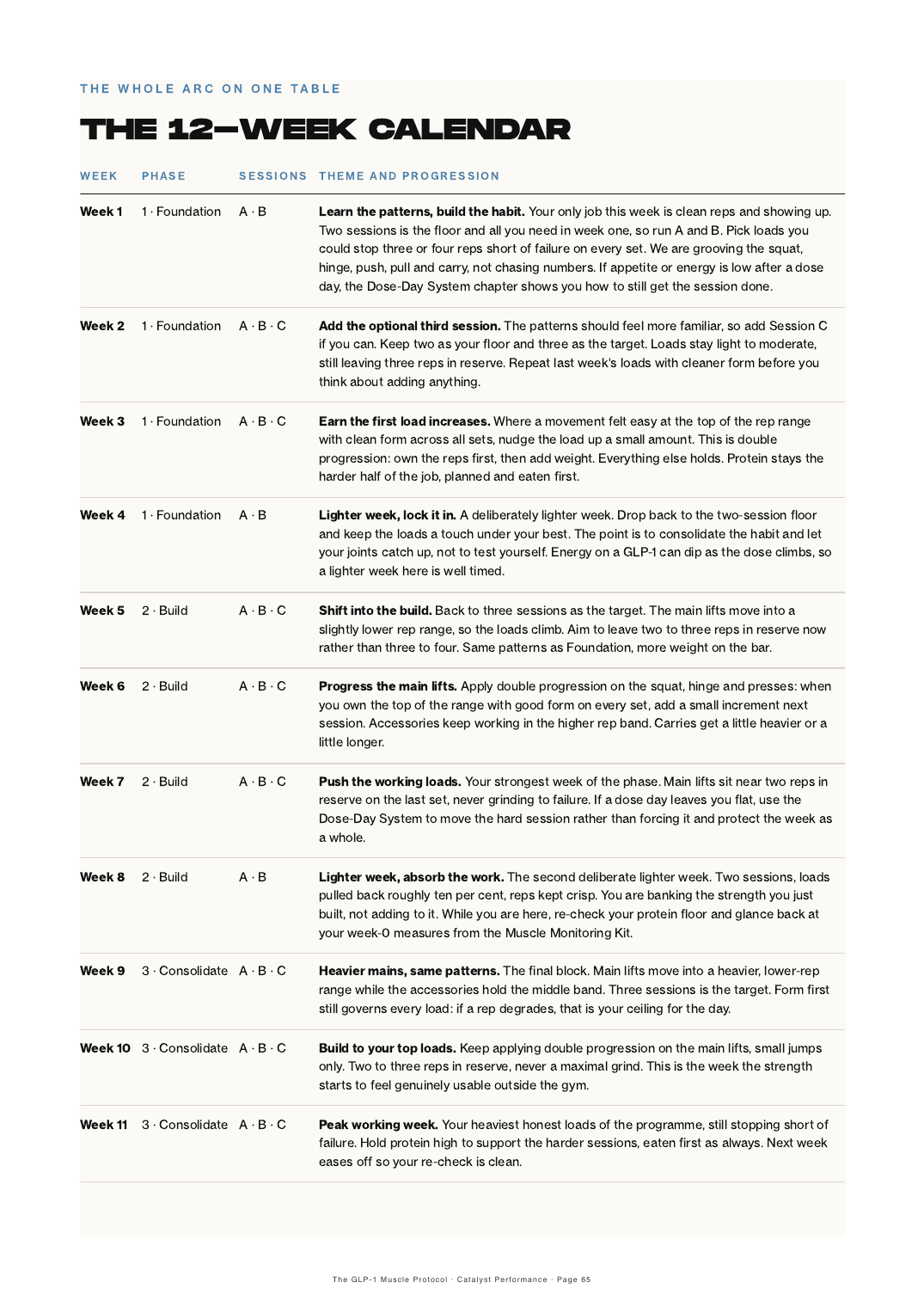
Swipe through. The full book runs to 67 pages.
The opening · The raw material that keeps your muscle
On a GLP-1, a meaningful slice of the weight you lose is muscle unless you train and eat to keep it. The strength work in this programme is the signal that tells your body to hold on to that muscle. Protein is the raw material it holds on to. You can do the sessions perfectly and still lose more muscle than you should if the protein is not there, which is why this chapter sits second only to the training plan itself.
Here is the awkward part. The same appetite suppression that makes a GLP-1 effective is exactly what makes eating enough protein hard. These drugs slow how quickly the stomach empties, so food sits and fullness arrives sooner and lasts longer, and they act on the brain's appetite centres to quieten hunger. The result is that you eat less without having to fight for it. That is wonderful for losing fat and inconvenient for protecting muscle, because protein is the one nutrient you now have to chase rather than crave. Left to appetite alone, most people on a GLP-1 drift well under what their muscle needs.
So the playbook is built around a single shift in behaviour. You stop eating to fullness and start eating to a target, protein first, planned in advance, with the appetite-suppressed days accounted for rather than left to chance. The drug decides how much weight you lose. Protein and training together decide how much of it is muscle. The fuller version of why muscle is the tissue worth defending after 40 sits in our muscle-loss explainer.
Read the rest first
That is the opening. Enter your email and we will send a link to unlock the complete Protein Playbook chapter, the first training week, and the cited evidence. Yours to keep, at no charge.
Built on the evidence, not on hype
25 to 39%
of the weight lost on a GLP-1 receptor agonist is fat-free (muscle) mass, not fat, in people who do not train to keep it.
Prado et al., Lancet Diabetes Endocrinol, 2024Fat down 19.3%, lean down 9.7%
in the semaglutide STEP 1 body-composition substudy. The drug removes weight efficiently, but it does not choose fat over muscle on your behalf.
Wilding et al., STEP 1, N Engl J Med, 2021The fix is not exotic
In a randomised trial of dieting adults, those who added resistance training preserved more lean mass than those doing aerobic work alone. Resistance training is the signal that tells the body to keep the muscle. Adequate protein is the raw material it keeps it with.
Villareal et al., N Engl J Med, 2017Around two-thirds
of the weight lost on semaglutide was regained in the year after stopping, in the STEP 1 trial extension. The muscle you keep on the drug is the part you carry into maintenance.
Wilding et al., Diabetes Obes Metab, 2022The full Science Brief inside the Protocol carries the complete reference list, a plain-English summary of each study, and the honest limitations (some trials used different drugs, doses, or populations). We do not claim what we cannot cite.
Who designed it
The Protocol was designed by the founders of Catalyst Performance, a longevity-focused personal training studio in Singapore's CBD, with more than twenty years in the industry between them, and is run in studio every day by our coaching team. The same movement vocabulary, the same form-first standard, the same four-pillar thinking, written down for you to run on your own.
This was not generated. It was written by the people whose names are on it.
Co-Founder
Over a decade coaching in Singapore, a coach first. Has coached hundreds of clients one-on-one, and hired, trained and mentored hundreds of trainers, managers and leaders across the industry. The coaching craft behind the programme.
Co-Founder, Head of Performance and Operations
HYROX-podium athlete with three career podiums and over 25 marathons. The applied-performance lens, refined inside the training, not above it.
Co-Founder, Head of Training Systems, MBBS
MBBS-qualified. The clinical lens on programming, screening, and the boundary between coaching and medicine. The rigour the four pillars are built on.
Medical review
Medically reviewed by Dr Luqman Haris, MBBS, co-founder and Head of Training Systems at Catalyst Performance.
Catalyst sells training, not medication. We are not a medical provider and do not prescribe. Keep working with your prescribing doctor on the medication itself.
How it compares
| What you are comparing | The Protocol | Medication alone | A generic fitness app | 1:1 personal training |
|---|---|---|---|---|
| What it does | Protects muscle and builds strength while the drug handles the fat | Removes weight efficiently; does not choose fat over muscle | Gives you a library of workouts to follow | Hands-on coaching, in person |
| Built for a suppressed appetite | Yes, a protein system for people who have to remind themselves to eat | Not addressed | Rarely; generic targets assume a normal appetite | Depends on the coach |
| Progressive structure | 12 weeks of week-by-week loading with a defined endpoint | None | Often a content playlist, not a progression | Yes, fully bespoke |
| Medical review | Medically reviewed by an MBBS-qualified co-founder | Prescribed and monitored by your doctor | Varies, often none | Varies by provider |
| Where you can do it | Anywhere, with home, dumbbell, and full-gym tracks | Not applicable | Anywhere | Location-bound to the studio |
| Cost | One payment, yours to keep | Prescription-only, an ongoing monthly cost | An ongoing subscription | Typically the highest, charged per session |
| After you stop the drug | An Off-Ramp Plan; the muscle you keep is the exit strategy | Regain is common without a plan | Not addressed | Depends on the coach |
What it does
Built for a suppressed appetite
Progressive structure
Medical review
Where you can do it
Cost
After you stop the drug
Why not just ask an AI
Ask ChatGPT, Perplexity, Claude, or Gemini to write you a training plan and you will get a confident answer in seconds. They are genuinely useful tools. What they cannot do is the part that decides whether this works: none has ever coached a real body, watched your form, or carried a doctor's review, and each starts fresh every time you ask, with no memory of the week before. Here is the honest difference.
| What you are comparing | The Protocol | A plan from a general AI tool |
|---|---|---|
| Who built it | An MBBS-qualified doctor and coaches who have hired and trained over 100 trainers, from more than a decade on the gym floor | Generated from text across the internet, with no author who has coached a body or carries the outcome |
| Medical review | Every health claim reviewed by Dr Luqman Haris, MBBS, and cited from primary research | No clinical review; it can sound certain and still be wrong |
| Watches your form | Optional Coach Check: a Catalyst coach reviews your three main lifts on video | Cannot see you train; it takes your word for your technique |
| Shows you the movement | Every exercise demonstrated on video by the coaches who wrote it | A text description, or a link to someone else's video |
| A finite, progressive plan | 12 weeks of week-by-week loading, with a defined endpoint and an Off-Ramp Plan | A fresh answer each prompt; no progression unless you build and track it yourself |
| Who stands behind it | A named Singapore studio; one payment, yours to keep with every update | No one is accountable for the result |
Who built it
Medical review
Watches your form
Shows you the movement
A finite, progressive plan
Who stands behind it
Get the Protocol
You are likely spending hundreds a month on the medication. This protects the half of the result it cannot deliver. It is built for people who train on their own terms, whether you are overseas or not ready for 1:1 yet. No subscription, no upsell mid-programme. Your access link lands in your inbox the moment payment confirms, and the whole Protocol also ships as a designed PDF book edition for offline use. Launch pricing is held for the first 50 buyers.
Want it coached instead of self-guided? See Catalyst Online Coaching for the same discipline coached anywhere, or strength on a GLP-1 if you are in Singapore and want to start with a complimentary 30-min consultation.
Questions, answered straight
When you do not train to protect it, 25 to 39% of the weight lost on a GLP-1 like Ozempic or Wegovy can be muscle rather than fat (Prado et al., Lancet Diabetes & Endocrinology, 2024); in the semaglutide STEP 1 substudy, lean mass fell about 9.7%. Resistance training two to three times a week plus enough protein is what preserves it. The GLP-1 Muscle Protocol structures both around a suppressed appetite, and the medication itself stays with your prescribing doctor.
Aim for roughly 1.2 to 1.6 g of protein per kilogram of body weight a day, spread across meals and eaten first, because a GLP-1 suppresses appetite and hitting that target becomes deliberate rather than automatic. Paired with resistance training two to three times a week, it is the evidence-backed way to keep muscle while you lose fat. This is training and nutrition guidance, not medical advice; confirm your target with your doctor if you have a kidney concern.
This is the part the Protocol is built around. GLP-1 medications slow stomach emptying and act on the appetite centres, so eating enough protein stops being automatic and has to be deliberate. The Protein Playbook leads with a realistic floor, the eat-protein-first tactic, small frequent meals, and liquid options for the days nothing appeals. It assumes the appetite you actually have, not the one a normal programme assumes. If you have any kidney concerns, confirm your specific target with your doctor or dietitian first.
No. The programme is beginner-first: you earn clean form at each movement pattern before any load is added, and every exercise carries an easier regression for the days a movement is too hard. Two to three short sessions a week is the whole ask, and three equipment tracks mean you can run it at home with almost nothing, with a pair of dumbbells, or in a full gym.
No. The Protocol is an educational training and nutrition programme, not medical advice. Catalyst is a training studio, not a medical provider, and we do not prescribe. Starting, dosing, continuing, or stopping a GLP-1 is a clinical decision for you and your prescribing doctor. We programme the training and the protein around the medication, never the medication itself.
Most people who stop a GLP-1 without a plan regain much of the weight: in the semaglutide STEP 1 trial extension, participants regained around two-thirds of what they had lost within a year. The muscle you build and the habits you keep are the levers you control. The programme ends with an Off-Ramp Plan for exactly this moment. There are no guarantees, only a credible mechanism: keep training, keep protein up, and plan for appetite returning. Whether to stop is your doctor's call.
No, and there is a fair reason. The Protocol unlocks in full the instant you buy, the book and the trackers included, so there is nothing to return. That is exactly why a complete chapter and four pages of the book sit on this page, complimentary: read the sample, and you will know whether the depth and the voice fit you before you pay a cent. Once you are in, it is yours to keep for life, with every future update.
Yes. The Protocol is fully digital and self-guided, so it works wherever you are, and the three equipment tracks mean it adapts to the gym you actually have. If you want the same discipline coached anywhere in the world, Catalyst Online Coaching is the next step up. If you are in Singapore and want it coached in studio, the complimentary 30-min consultation is the place to start.
Those are content libraries, a playlist of videos to pick from. The Protocol is a finite, progressive 12-week programme with week-by-week loading, a protein system built for a suppressed appetite, an at-home way to check your muscle is holding, and a plan for life after the drug. A playlist is not a plan.
Ask one and you will get a confident plan in seconds, and for many things these tools are genuinely useful. What they cannot do is the part that decides whether this works. A general AI tool has never coached a real body, it does not watch your form, it carries no medical review, and it starts fresh every time you ask, with no memory of the week before. The Protocol is a finite, progressive 12-week plan built by an MBBS-qualified doctor and coaches who have trained over 100 trainers, with every movement demonstrated on video and every health claim cited and reviewed. An AI hands you an answer. This is a plan that real professionals stand behind, and the optional Coach Check puts a human set of eyes on your lifts, which no chatbot can. Read the complimentary chapter on this page and judge the depth for yourself before you pay a cent.
The Protocol plus Coach Check tier includes everything in the Protocol, plus a one-time form review of your three main lifts by a Catalyst coach and personalised protein and calorie targets. It is the option for anyone who wants a human set of eyes on their technique before they load up.
Read it before you buy
There is no money-back guarantee, and there does not need to be. The Protocol unlocks in full the moment you pay, downloads and all, so we let you read it first instead. A complete chapter and four pages of the book are on this page, complimentary. Read the sample, buy only if it is for you, and once you are in it is yours to keep for life, with every future update.
Important
The GLP-1 Muscle Protocol is an educational training and nutrition programme. It is not medical advice, a diagnosis, or a treatment, and it is not a substitute for care from a qualified medical professional. Catalyst Performance is a personal training studio, not a medical provider, and does not prescribe, supply, or recommend any medication.
GLP-1 medications are prescription-only in most markets. Starting, dosing, continuing, or stopping any medication is a clinical decision for you and your prescribing doctor. Speak to your prescribing doctor before making changes to your medication, training, or nutrition, especially if you have an existing medical condition. Individual results vary, and no specific outcome is promised.