The Edit · Founder Insights
Is HYROX Good for Your Health? What the Race Asks of Your Body
What HYROX training does for your heart, strength and grip, the real injury risks, and who should get checked before racing.
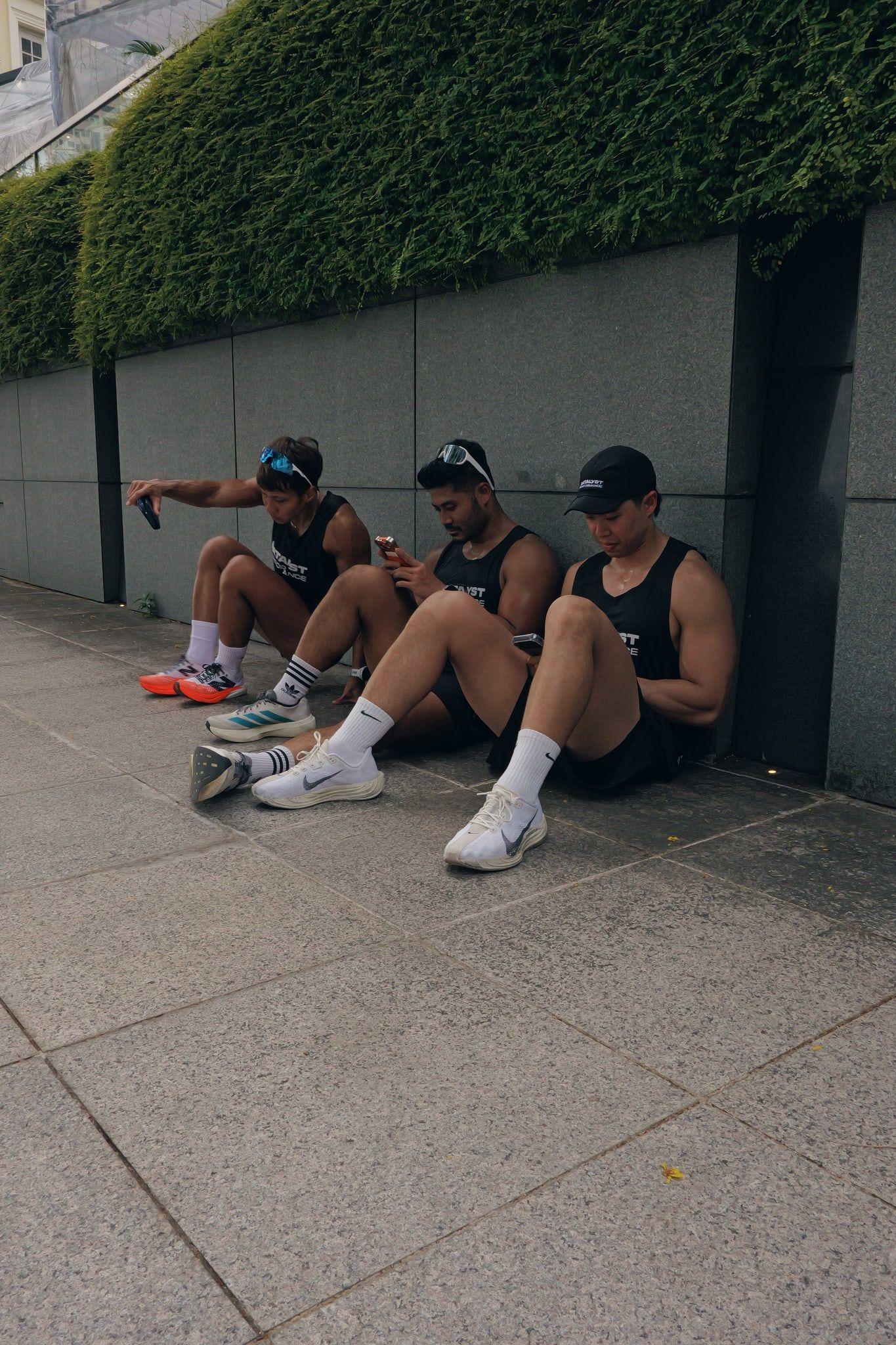
Is HYROX good for your health? For most healthy adults, yes: training for it builds aerobic fitness, leg strength and grip, three of the strongest measurable markers of a long, capable life. The race itself is hard, though, and the risk sits in how you prepare. This guide explains what the race asks of your body, who should get checked first, and how to enter it as a stop on a longer journey rather than the finish line. For dates, venue and entry details for the November race at Singapore Expo, see our HYROX Singapore race guide.
| Question | Short answer | What to do about it |
|---|---|---|
| Is the training good for you? | Yes, it builds aerobic fitness, strength and grip together | Train for 12 to 16 weeks, not 3 |
| Is the race risky? | Injuries are common in training, serious events are rare | Build load slowly and keep two easy days a week |
| Do I need a medical check? | Yes if you have symptoms, known heart disease or have been inactive | See your GP before you register |
| Which division suits a first race? | Doubles or Relay for most people with a modest base | Pick by your weakest area, not your ego |
| How long is recovery? | Most people feel normal within a week | Easy movement, sleep and protein first |
TL;DR
- HYROX training develops the three things that predict healthy ageing best: aerobic fitness, muscle strength and grip.
- A 2026 cohort study found about 30% of HYROX athletes reported a health problem in any given week.
- Get medical clearance first if you have chest symptoms, known heart, kidney or metabolic disease, or have not exercised regularly.
- Doubles and Relay give a first-timer the same race experience with a fraction of the load.
- Treat race day as a checkpoint: the fitness you build should outlast the medal by decades.
HYROX has grown fast in Singapore. The April 2026 race at the National Stadium drew more than 14,000 athletes from 58 countries, aged from 16 to 74, according to SportPlus. The second race of the year runs from 26 to 29 November 2026 at Singapore Expo, and the official event page lists Singles, Doubles and Relay divisions across four days. Our guide to the Singapore race keeps the dates and entry details current.
A lot of people sign up for the same reason: a friend did it, or a colleague posted a finisher photo, and it looked like a fitness goal you could actually train for. That instinct is sound. The harder question, and the one we hear in the studio before someone registers, is whether the race is good for them, or just hard. This guide answers it from a healthspan point of view. Healthspan is the number of years you stay strong, mobile and well, and it is the lens we use for everything at Catalyst Performance.
The ten sections below cover the benefits, the real risks, the checks worth doing before you register, and how to pick a division and recover afterwards. The methods are the same ones our coaches use with clients preparing for the race.
1. What the race asks of your body
Every HYROX race has the same structure in every city: a 1 km run, then a station, repeated eight times. The stations are the SkiErg, sled push, sled pull, burpee broad jumps, rowing, farmers carry, sandbag lunges and wall balls. That is 8 km of running broken up by about half an hour or more of loaded work, depending on your speed. Most first-timers take between 75 and 100 minutes.
That combination is what makes it unusual. A marathon is almost all aerobic work. A strength session is almost all muscular work. HYROX sits in between, asking the heart and lungs to keep working hard while the legs, back and grip carry, push and pull. You never get a long rest, and you run every kilometre on legs that have just done something heavy.
Sports scientists have started to measure it. In a 2026 study of 24 male Pro athletes racing an official event, Gutiérrez-Hellín and colleagues found an average race time of just under 70 minutes, and the runs were held at about 84% of the speed at the second ventilatory threshold, the point above which breathing climbs steeply. In plain terms, even the best racers spend the whole race close to their sustainable limit. For a recreational athlete the absolute speeds are lower, but the effort profile is similar: long, hard and continuous.
That profile explains both sides of this guide. Long, hard, continuous effort is a strong training stimulus, and it is also where people get hurt or unwell when they arrive underprepared.
2. The aerobic case: why the engine matters for health
Half of a HYROX race is running, and the stations keep your heart rate high between runs. Training for it is, first of all, aerobic training. That matters for health far beyond the race.
The clearest data come from the Cleveland Clinic. Mandsager and colleagues followed 122,007 adults who had done a treadmill exercise test, over a median of 8.4 years. People in the lowest fitness group had about five times the risk of death of people in the highest group, after adjusting for age and other factors. The relationship held across the range: every step up in fitness came with lower risk, and there was no point at which more fitness stopped helping. This is an observational study, so it shows association, not proof that fitness alone causes the difference, but the size and consistency of the effect are hard to ignore.
The practical point is that a HYROX build is one of the few training goals that makes busy adults do structured aerobic work for months. Zone 2 runs, threshold intervals and compromised running after stations all raise VO2 max, the measure of how much oxygen your body can use. If you want to know where you start, our guide to what counts as a good VO2 max and the VO2 max chart by age and sex give the reference ranges.
In our studio we measure cardiorespiratory fitness as one of the four pillars of the 4-Pillar Healthspan Assessment. Clients preparing for HYROX often see the biggest change here, because the race gives them a reason to run consistently for the first time in years. A bonus: aerobic fitness also shortens the time you need to recover between stations, so the health gain and the race gain are the same thing.
3. Strength and grip: the stations are the healthspan part
Most endurance events leave strength out. HYROX puts it in the middle of the race. Pushing and pulling a sled, carrying two heavy kettlebells for 200 metres and doing walking lunges with a sandbag all need leg strength, a strong trunk and a firm grip. Those happen to be the qualities that fade first with age.
Grip strength is a useful example. In the PURE study, Leong and colleagues measured grip in 139,691 adults across 17 countries and followed them for a median of four years. Each 5 kg drop in grip strength was linked with a 16% higher risk of death from any cause and a 17% higher risk of cardiovascular death. Grip is not magic; it reflects overall muscle strength. That is why the farmers carry, sled pull and wall balls are more than race stations. They are a weekly reason to keep the whole chain strong. You can check your own number with our grip strength test.
The wider evidence points the same way. A 2022 meta-analysis in the British Journal of Sports Medicine by Momma and colleagues pooled 16 cohort studies and found muscle-strengthening activity was associated with a 10% to 17% lower risk of death from any cause, with the largest benefit at about 30 to 60 minutes a week. A HYROX programme with two strength sessions a week sits right in that range.
This matters most after 40, when muscle loss speeds up if nothing stops it. Our guide to sarcopenia and muscle loss in Singapore explains the stakes. For a racer, the takeaway is to treat the strength sessions as non-negotiable, even in the weeks when running feels like the priority.
4. Why a date on the calendar helps
The biggest health benefit of signing up may not be physical at all. It is the date. A fixed race on the calendar turns "I should exercise more" into a plan with weeks, sessions and a reason to show up when work is busy.
We see this in clients every season. Someone who has trained on and off for years books a race four months out, and suddenly the Tuesday run happens because the plan says so. The race is the hook. The habit is the prize. Three or four sessions a week, kept up for 16 weeks, is long enough for the routine to feel normal, and that routine is what carries into the next year.
The trap is the opposite pattern: training hard for one event, then stopping the week after because the goal is gone. For healthspan, the race is a checkpoint on the way, not the destination. Before you register, it helps to decide what you will do in December and January, whether that is a second race, a strength block, or simply holding three sessions a week.
If time is the obstacle, our post on the minimum effective dose of about three hours a week shows how little you need to keep the gains once the race is over.
5. Injury risk: what the first HYROX data shows
Any honest answer to "is HYROX good for your health" has to include injuries. The first prospective data on HYROX athletes were published in 2026. Chittenden and colleagues followed 89 HYROX athletes, 56 of them women, for 12 weeks using weekly health questionnaires.
On average, about 30% of the athletes reported some health problem in any given week, which includes illness as well as injury. The injury rate was 14.4 per 1,000 hours of training, and 6.4 per 1,000 hours for injuries that caused time off. The study was small and relied on self-report, so the figures are a first look rather than a final answer. For context, a 2018 survey of 3,049 people doing CrossFit by Feito and colleagues found 30.5% reported an injury in the previous year. The two studies measured injury differently, so the rates cannot be compared directly, but both describe the same reality: mixed, high-intensity training carries a real injury load.
The common pattern in our experience is not a dramatic accident. It is too much running added too fast, or wall balls and lunges done to failure with tired legs, week after week. The lower back, knees, Achilles tendon and the front of the shin take the strain. Our guides to Achilles tendinopathy, shin splints and runner's knee cover the usual suspects.
Three rules reduce the risk. Increase weekly running distance gradually, keep at least two easy or rest days a week, and practise each station at race weight with good form before you practise it fast. A coach watching your lunges and wall balls in week three costs far less than a sore knee in week ten.
6. Your heart: who should get checked before racing
Serious cardiac events in mass-participation races are rare, but they happen, and they mostly happen to people who did not know they had a problem. The best data come from long-distance running. Kim and colleagues reviewed races in the United States from 2000 to 2010, covering 10.9 million runners. There were 59 cardiac arrests, a rate of 0.54 per 100,000 participants, and most occurred in men around middle age.
HYROX has no equivalent data yet, but the effort is similar in length and intensity to a hard half marathon, so the same caution applies. The American College of Sports Medicine screening approach, updated by Riebe and colleagues in 2015, is a sensible guide. It asks three questions: do you exercise regularly now, do you have known cardiovascular, metabolic or kidney disease, and do you have any symptoms that suggest it?
If you have symptoms such as chest pain or pressure on exertion, unusual breathlessness, palpitations, dizziness or fainting, see a doctor before you train hard, whatever your age. If you have known heart, kidney or metabolic disease such as diabetes, get medical clearance before you start vigorous training. If you have been inactive, build up gradually with moderate exercise first. An annual health screening that includes blood pressure, cholesterol and blood sugar is worth booking before a race block, especially after 40.
Our coaching team works under the medical review of Dr Luqman Haris, MBBS, but Catalyst is a training studio, not a medical provider. When a client mentions a symptom, we stop and refer them to a GP or specialist clinic before we go any further.
7. Training in Singapore heat
Most HYROX training in Singapore happens in heat and humidity, whether that is a run along East Coast Park or a sled session in a warm gym. Heat raises your heart rate at any given pace, makes you sweat more and slows recovery. It is not a reason to avoid training, but it changes how you should judge a session.
The international consensus on training in the heat, written by Racinais and colleagues in 2015, recommends that athletes acclimatise through repeated exercise in the heat over one to two weeks. In practice, that means your first hot runs will feel harder than they should, and that is normal. Slow down, judge effort by breathing and heart rate rather than pace, and drink to a plan rather than waiting for thirst.
For Singapore, the best training windows are early morning and after sunset. Our post on Zone 2 running in Singapore explains how to keep easy runs easy when the air is thick, and the heart rate zones calculator gives you numbers to work with.
Stop and cool down if you feel confused, stop sweating, feel faint or develop a headache during hot exercise. Heat illness can come on quickly, and it is one of the few training risks you can almost always avoid.
8. Choosing a division with your health in mind
The division you choose shapes how much load your body has to absorb, both on race day and in the months before it. Singles means you do all 8 km of running and every station yourself. Doubles means you both run every kilometre but split the station work. Relay means a team of four shares the race, so each person runs two kilometres and does two stations.
For a first race, most people with a modest training base are better served by Doubles or Relay. You get the atmosphere and the format with less total load, and you can train for it in fewer weeks. If you have a solid running base and regular strength training, Singles Open is a fair first goal. Singles Pro, with heavier weights, is for experienced racers.
Choose by your weakest area. If running is your limiter, Relay cuts your running to two kilometres while you learn the format. If strength is the limiter, Doubles halves the station work while you still run every kilometre. Our Singapore race guide lists the divisions and entry details, and our stations guide gives the weights for every division.
Doubles has one more advantage: a training partner. Two people who have agreed to race together tend to turn up for each other, which makes the habit in section 4 easier to keep.
9. The week after the race
The week after a race is where many people lose the health gain they spent months building, either by doing too much too soon or by stopping completely. The goal is to recover fully and then keep training.
For the first two or three days, keep moving gently: walking, an easy spin on a bike, light mobility. Muscle soreness usually peaks a day or two after the race, especially in the quads and glutes from the lunges and wall balls. Sleep more than usual, eat enough, and keep protein intake steady, since your muscles are repairing. Our protein intake calculator gives a sensible daily range.
By the end of the first week, most people can return to easy runs and light strength work. Hold off on hard intervals and heavy sessions until the soreness has gone and your resting heart rate is back to normal. Any pain that is sharp, localised or getting worse rather than better deserves an assessment rather than a test run. Our recovery services and sports massage can help you through the first week.
Then make the next plan. A short strength block after a race often brings the biggest improvement for the following season, because months of race-specific work tend to leave raw strength behind.
10. When the race is not the right goal
Sometimes the healthiest decision is to train for the race and not enter it yet, or to enter a later one. That applies if you are coming back from an injury, have pain that changes how you move, are managing a health condition that is not yet under control, or have less than six weeks and no base.
None of these rule you out for good. They mean the race is the wrong first step. A person returning from a back injury, for example, gets more from three months of progressive strength work than from rushing into lunges and sled pushes. Our post-injury personal training and rehab pages describe how we bridge that gap, and our personal training for over 50s covers the adjustments we make with age.
It also helps to be clear about why you are racing. If the race is the only thing keeping you training, that is fine, but plan what comes after. If you are racing to prove something to yourself, that is fine too, as long as the proof does not cost you a season of injury. The look and the medal come with the work. They are stops on the journey, not the reason for it.
Train for HYROX as if the race is one checkpoint in the next 30 years, because for your health, that is exactly what it is.
How to prepare if you are short on time
If you only do three things, do them in this order. First, check your health: if you have symptoms, known disease or have been inactive, see your GP before you start. Second, build your aerobic base with two or three easy runs a week, because running makes up half the race and most of the training risk. Third, keep two strength sessions a week with lunges, carries and pulls, so the stations do not ambush you on the day.
If you have more time, add one session of compromised running, where you run straight after a station, and practise each station at race weight. For a structured plan, our coach's guide to training for HYROX in Singapore sets out a 12-week framework, and our first-timer tips for busy people cover the race-day basics.
If you are not sure where your weak link is, measure it. The 4-Pillar Healthspan Assessment looks at body composition, cardiorespiratory fitness, stability and strength, which maps closely onto what the race will test.
Frequently asked questions
Q. Is HYROX good for your health?
For most healthy adults, yes. Training for it builds aerobic fitness, strength and grip together, all of which are linked with healthier ageing. The risks are mainly overuse injuries from building up too fast, so a gradual plan matters more than the race itself.
Q. Is HYROX bad for your joints?
Not for most people who train sensibly. The stations involve lunges, carries and sled work rather than repeated jumping on hard ground. Problems usually come from adding running too quickly or doing lunges and wall balls with poor form when tired.
Q. Do I need a medical check before HYROX?
See a doctor first if you have chest pain, unusual breathlessness, palpitations or fainting on exertion, known heart, kidney or metabolic disease, or if you have not exercised regularly. An annual health screening before a race block is sensible after 40.
Q. Can a beginner do HYROX?
Yes, with time to prepare. A beginner should allow 12 to 16 weeks and consider Doubles or Relay for a first race. Most first-timers finish in 75 to 100 minutes, and there is no need to race hard on your first attempt.
Q. How long does it take to recover from HYROX?
Most people feel close to normal within a week. Keep moving gently for two or three days, sleep well and eat enough protein, then return to easy training. Wait until soreness has gone before doing hard sessions again.
Q. Is HYROX safe for people over 50?
Yes for many people over 50, provided they are screened, have trained regularly and build up gradually. Racers at the April 2026 Singapore event were aged up to 74. Strength work matters even more with age, and Relay or Doubles is a sensible start.
HYROX is a good reason to get fit, and the fitness it builds, aerobic capacity, strength and grip, is exactly the kind that keeps you capable for decades. Prepare for it gradually, get checked if you need to, choose a division that suits your base and keep training after the medal. For dates and entry details, read our HYROX Singapore guide; for a coached plan, see HYROX training in Singapore.
Not sure if you are ready? Book the 4-Pillar Healthspan Assessment and we will measure your fitness, strength and stability, then tell you which division and timeline suit you. Prefer a conversation first? Book a 30-minute consultation; you can read what to expect.
HYROX is a registered trademark of its owner. Catalyst Performance is not affiliated with, endorsed by or sponsored by HYROX. Confirm race dates, divisions and entry details on the official HYROX website.
Citations
- Gutiérrez-Hellín J, Alonso-Domínguez S, Gil-Cabrera J, Arazola-López D, Sainz-Pérez M, Larnaudie-Faura C, et al. Relative running intensity and pacing during an official HYROX PRO MEN competition: the HYScience study. International Journal of Sports Physiology and Performance. 2026. doi:10.1123/ijspp.2026-0098. PMID 42697540. PubMed
- Chittenden E, Bell A, Forbes G, Tooth P, Porter R, Van Der Vliet R, et al. Prevalence, burden and risk markers of health problems in HYROX athletes: a 12-week prospective cohort study. Frontiers in Sports and Active Living. 2026;8:1937574. doi:10.3389/fspor.2026.1937574. PMID 42780891. PubMed
- Mandsager K, Harb S, Cremer P, Phelan D, Nissen SE, Jaber W. Association of cardiorespiratory fitness with long-term mortality among adults undergoing exercise treadmill testing. JAMA Network Open. 2018;1(6):e183605. doi:10.1001/jamanetworkopen.2018.3605. PMID 30646252. PubMed
- Leong DP, Teo KK, Rangarajan S, Lopez-Jaramillo P, Avezum A Jr, Orlandini A, et al. Prognostic value of grip strength: findings from the Prospective Urban Rural Epidemiology (PURE) study. The Lancet. 2015;386(9990):266-273. doi:10.1016/S0140-6736(14)62000-6. PMID 25982160. PubMed
- Momma H, Kawakami R, Honda T, Sawada SS. Muscle-strengthening activities are associated with lower risk and mortality in major non-communicable diseases: a systematic review and meta-analysis of cohort studies. British Journal of Sports Medicine. 2022;56(13):755-763. doi:10.1136/bjsports-2021-105061. PMID 35228201. PubMed
- Feito Y, Burrows EK, Tabb LP. A 4-year analysis of the incidence of injuries among CrossFit-trained participants. Orthopaedic Journal of Sports Medicine. 2018;6(10):2325967118803100. doi:10.1177/2325967118803100. PMID 30370310. PubMed
- Kim JH, Malhotra R, Chiampas G, d'Hemecourt P, Troyanos C, Cianca J, et al. Cardiac arrest during long-distance running races. New England Journal of Medicine. 2012;366(2):130-140. doi:10.1056/NEJMoa1106468. PMID 22236223. PubMed
- Riebe D, Franklin BA, Thompson PD, Garber CE, Whitfield GP, Magal M, et al. Updating ACSM's recommendations for exercise preparticipation health screening. Medicine and Science in Sports and Exercise. 2015;47(11):2473-2479. doi:10.1249/MSS.0000000000000664. PMID 26473759. PubMed
- Racinais S, Alonso JM, Coutts AJ, Flouris AD, Girard O, González-Alonso J, et al. Consensus recommendations on training and competing in the heat. British Journal of Sports Medicine. 2015;49(18):1164-1173. doi:10.1136/bjsports-2015-094915. PMID 26069301. PubMed
- HYROX. HYROX Singapore II, Season 26/27: event page. singapore.hyrox.com
- SportPlus. AIA HYROX Singapore 2026: first-ever 3-day HYROX race set for Singapore National Stadium. sportplus.sg