The Edit · Founder Insights
Serratus Muscle: What the Three Serratus Muscles Do and How to Train Them
The serratus anterior holds your shoulder blade on the ribs. Learn what all three serratus muscles do and the exercises research supports.
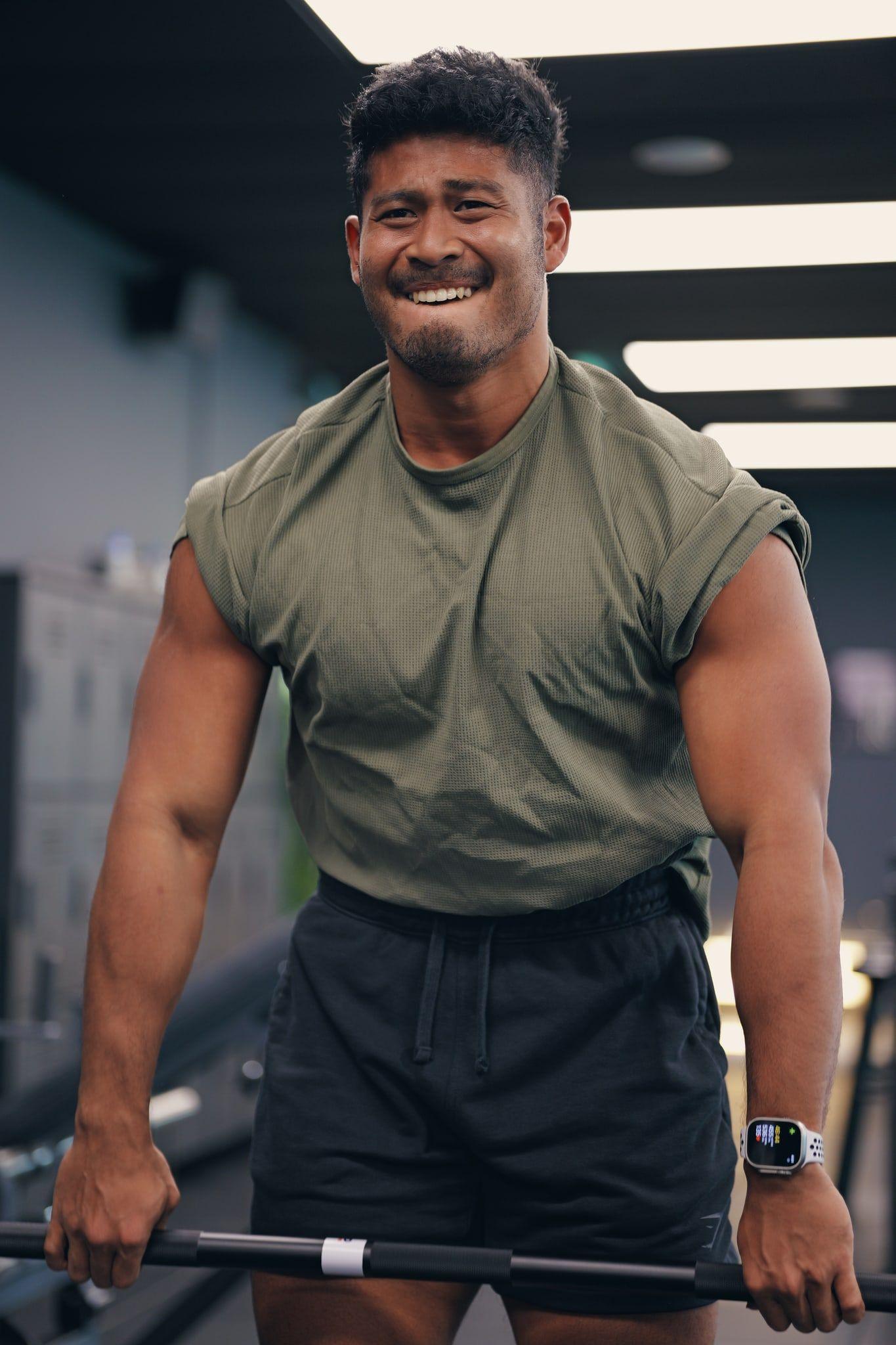
The serratus muscle most people mean is the serratus anterior, the saw-toothed muscle on the side of your ribcage that holds the shoulder blade against the ribs and swings it forward and up when you push or reach overhead. There are two smaller serratus muscles at the back, the serratus posterior superior and inferior, which sit under the upper and lower back muscles and seem to help with posture sense. This guide covers all three, what goes wrong when the serratus anterior is weak, and the exercises research links to it.
| Muscle | Where it sits | Main job | Nerve |
|---|---|---|---|
| Serratus anterior | Side of the ribcage, from the upper eight or nine ribs to the inner edge of the shoulder blade | Pulls the shoulder blade forward around the ribs and rotates it upward | Long thoracic nerve (C5 to C7) |
| Serratus posterior superior | Upper back, from the lower neck and upper thoracic spine to ribs 2 to 5 | Traditionally said to lift the ribs; may mainly provide position sense | Intercostal nerves |
| Serratus posterior inferior | Lower back, from the lower thoracic and upper lumbar spine to ribs 9 to 12 | Traditionally said to pull the lower ribs down; may mainly provide position sense | Lower intercostal nerves |
TL;DR
- "Serratus muscle" usually means the serratus anterior, which keeps the shoulder blade flat on the ribs and helps lift the arm overhead.
- A weak or paralysed serratus anterior lets the shoulder blade lift off the ribs, which is called a winged scapula.
- In laboratory studies the push-up plus, the serratus punch, the dynamic hug and the wall slide activated the serratus anterior most.
- Pressing with the shoulder blades pinned back, as in a standard bench press, leaves the serratus anterior with little to do.
- Pair serratus work with middle and lower trapezius work: the two muscles share the job of rotating the shoulder blade.
Run your fingers down the side of your chest, just below the armpit, and you will feel a series of ridges over the ribs. In a lean person they look like the teeth of a saw, which is where the name comes from: serratus is Latin for saw-toothed. That is the serratus anterior, and it is one of the most important muscles in the shoulder that most people never train on purpose.
The muscle matters because the shoulder blade is the base your arm works from. Every push, reach, throw and press starts with the shoulder blade moving and staying steady on the ribcage. The serratus anterior is the main muscle that does both. When it is weak, the arm works from an unstable base, and the neck and the top of the shoulder often end up doing extra work.
This guide explains each serratus muscle, then the exercises that laboratory studies have measured, and finishes with how to train the serratus anterior for the long term. At Catalyst Performance healthspan comes first, so the goal is shoulders that keep working well for decades, not a single hard session. If you have read our guide to the trapezius muscle, this is its partner: the two muscles share the job of moving the shoulder blade.
1. The three serratus muscles
Anatomy books list three muscles with serratus in the name. The serratus anterior is the large one on the side of the chest. The serratus posterior superior sits on the upper back, under the rhomboids. The serratus posterior inferior sits on the lower back, under the latissimus dorsi. All three attach to the ribs by finger-like slips, which gives them their saw-toothed look.
Despite the shared name, they do very different jobs. The serratus anterior moves the shoulder blade and is a powerful, working muscle. The two posterior muscles are thin sheets that attach the spine to the ribs and have no direct link to the shoulder blade at all. They are small enough that many training guides ignore them completely.
When people search for the serratus muscle, they are almost always asking about the anterior one: why it hurts, why their shoulder blade sticks out, or how to make it visible. Most of this guide therefore covers the serratus anterior, with one section on the two posterior muscles so you know what they are and why they rarely need special attention.
A quick way to tell them apart: if the muscle you are thinking about helps you push a door open or reach for a high shelf, it is the serratus anterior. If it is buried in your back between the spine and the ribs, it is one of the posterior pair.
2. Serratus anterior anatomy
The serratus anterior starts on the outer surface of the upper ribs, usually the first eight or nine, by a series of slips. From there it wraps backward around the ribcage, passes under the shoulder blade and attaches along the whole length of its inner edge, the medial border, on the side that faces the ribs. Picture the shoulder blade sitting on a sling made of this muscle.
Anatomists often describe three parts. The upper part runs from the first two ribs to the top corner of the shoulder blade. The middle part fans out along the inner edge. The lower part, the largest and strongest, runs from the lower ribs to the bottom corner of the shoulder blade. It is this lower part that does most of the work when the arm goes overhead, because it pulls the bottom corner of the shoulder blade forward and around the ribs.
The serratus anterior is supplied by the long thoracic nerve, which comes from the fifth, sixth and seventh cervical nerve roots in the neck. The nerve runs a long way down the side of the chest wall, on the surface of the muscle, which leaves it exposed to injury from a blow, heavy straps on the shoulder or surgery near the armpit. A 2019 ultrasound review by Chang and colleagues describes winging of the shoulder blade as the main sign that this nerve has been damaged.
Neumann and Camargo, in a 2019 review of how to target the serratus anterior, stress that because the muscle wraps around a curved ribcage and attaches along the whole shoulder blade, it can move the blade in several directions at once. That is why one exercise is rarely enough to train all of it.
3. What the serratus anterior does
The serratus anterior has three main jobs. First, it protracts the shoulder blade, sliding it forward and around the ribcage. You use this when you push something away from you or punch. Second, it rotates the shoulder blade upward, tilting the shoulder socket towards the ceiling so the arm can rise above shoulder height without the bones of the shoulder pinching. Third, it holds the inner edge of the shoulder blade flat against the ribs, so the blade does not tip or lift off as the arm moves.
Upward rotation is the job that matters most for everyday life. Ekstrom and colleagues measured the trapezius and the serratus anterior in 30 healthy people across 10 exercises and found the serratus anterior was most active in exercises that needed a large amount of upward rotation of the shoulder blade. In other words, the higher you raise your arm, the harder the serratus anterior works.
It does not do this alone. The upper and lower trapezius pull on the top of the shoulder blade while the serratus anterior pulls the bottom corner forward, and together they rotate it like a pair of hands turning a wheel. When one side of that partnership is weak, the other has to work harder, which is why a tight upper trapezius and a weak serratus anterior often appear together.
The serratus anterior also has a minor role in breathing. When the shoulder blade is held still, it can lift the ribs a little, helping the chest expand. That is why people who are very short of breath sometimes lean forward on their hands: it fixes the shoulder blades and lets these muscles help. It is a backup role, not a reason to train the muscle for breathing.
4. Serratus posterior superior and inferior
The serratus posterior superior runs from the lower neck and upper thoracic spine down and outward to the upper ribs. The serratus posterior inferior runs from the lower thoracic and upper lumbar spine up and outward to the lowest ribs. Both are thin and sit deep to the larger back muscles, so you cannot see or feel them separately.
Textbooks have long described them as breathing muscles: the upper one lifting the ribs to help breathe in, the lower one pulling the lower ribs down. The evidence for this is weak. In a 2001 review in Clinical Anatomy, Vilensky and colleagues examined the anatomy and the limited research and concluded that the serratus posterior muscles probably function mainly in proprioception, the body's sense of its own position, rather than as significant breathing muscles. They also noted that the upper muscle has been proposed as a source of upper back pain, though the evidence is limited.
For training, the practical message is simple. You do not need special exercises for the posterior serratus muscles. Rowing, carrying, breathing well and keeping the upper back mobile all involve the area. If you have pain deep between the shoulder blades, it is more useful to have someone assess how your upper back and shoulder blades move than to hunt for one small muscle.
Our guide to lower back pain from desk work covers the wider pattern of stiffness and bracing that tends to affect the whole back in people who sit for long hours.
5. Winged scapula and the long thoracic nerve
When the serratus anterior stops working, the inner edge of the shoulder blade lifts off the ribcage and sticks out, especially when you push against a wall or raise your arm forward. This is called a winged scapula. It can be subtle, visible only when you do a push-up, or obvious at rest.
The most common cause of true winging from the serratus anterior is an injury to the long thoracic nerve. Martin and Fish, in a 2008 review, list causes including direct blows to the side of the chest, repeated or heavy loads on the shoulder, surgery near the armpit and inflammation of the nerve, sometimes with no clear trigger. Their review reports that most cases of serratus anterior paralysis recover on their own within 24 months, although some need further treatment.
Winging can also come from the trapezius or from simple weakness and poor control, without any nerve injury. Mild, symmetrical prominence of the shoulder blades during a push-up is common and usually trains well. Sudden winging on one side, winging with pain or weakness lifting the arm, or winging after an injury or surgery is different, and needs a medical assessment before you load it.
At Catalyst, when we see one shoulder blade lift off clearly more than the other during a push-up or an overhead reach, we pause the loaded work and ask the client to see a doctor. Our rehab service then works alongside the medical plan. A coach is not the right person to diagnose a nerve problem, but is often the first to notice one.
6. The serratus anterior and shoulder pain
Shoulder pain when you lift your arm often has a shoulder blade component. Ludewig and Cook studied 52 construction workers who did regular overhead work, half with symptoms of shoulder impingement. The group with symptoms had less upward rotation of the shoulder blade, more forward tipping, more activity in the upper and lower trapezius and less activity in the serratus anterior. The serratus anterior was doing less, and the shoulder blade was moving less well.
Altered movement of the shoulder blade is called scapular dyskinesis. The 2013 consensus statement from the Scapular Summit, led by Kibler, concluded that scapular dyskinesis is present in a high percentage of shoulder injuries and is best seen as a possible impairment to shoulder function rather than a diagnosis in itself. That is a helpful way to think about it: a shoulder blade that moves poorly is a clue, not the whole answer.
For a person with shoulder pain, this means serratus anterior training is often part of the plan, but rarely the only part. The rotator cuff, the trapezius, thoracic spine mobility and how you load the shoulder in daily life all matter. A study done at one time point in one group of workers cannot prove that strengthening the serratus fixes impingement, but it does explain why clinicians so often include it.
If you have a painful arc when you lift your arm out to the side, pain at night when lying on the shoulder, or weakness lifting the arm, get it assessed before you start an exercise programme. Our post-injury personal training picks up once a clinician has ruled out anything that needs medical care.
Most people train the muscles that pull the shoulder blade back and forget the one that holds it on the ribs. The serratus anterior is that muscle.
7. Push-up plus
The push-up plus is a normal push-up with one addition: at the top, once your arms are straight, you push the floor further away so the shoulder blades slide apart and your upper back rounds slightly. That extra few centimetres is the plus, and it is the part that trains the serratus anterior.
It is the most studied serratus exercise. Ludewig and colleagues measured 30 people doing push-up variations and found the standard push-up plus produced the highest serratus anterior activation, up to 123% of a maximal test contraction, along with the lowest ratio of upper trapezius to serratus activity during the plus phase. They called it an optimal exercise for the serratus anterior. Decker and colleagues, testing eight exercises in 20 healthy people, also found the push-up plus among the two exercises with the greatest serratus anterior activity.
How to do it well: start in a push-up position with hands under the shoulders. Lower with control, press up, then at the top push the floor away until the shoulder blades spread, hold for a second, and let them settle back before the next repetition. Keep the neck long and do not shrug. If a full push-up is too hard, do the same movement against a wall or a bench, or on your knees. Decker found the knee push-up plus also activated the serratus anterior well.
Our coaches often start a client with the plus phase alone: holding a plank on straight arms and moving only the shoulder blades, together and apart, for 10 to 12 slow repetitions. Once that feels natural, the full push-up plus follows. The common mistake is to sag through the lower back, so keep the body in one straight line.
8. Serratus punch and dynamic hug
The serratus punch and the dynamic hug both train the serratus anterior by reaching forward against resistance, the protraction movement that defines the muscle.
Decker and colleagues tested both. The serratus anterior punch, scaption (raising the arm in the plane of the shoulder blade), the dynamic hug, the knee push-up plus and the push-up plus all produced serratus anterior activity above 20% of a maximal contraction. The push-up plus and the dynamic hug produced the greatest activity overall. The study was done in 20 healthy people with surface electrodes, so it shows which muscle works, not how much it grows.
To do a serratus punch, lie on your back holding a light dumbbell straight up over your shoulder. Without bending the elbow, push the weight towards the ceiling so your shoulder blade lifts off the floor, then lower it slowly. Standing versions use a cable or band anchored behind you, punching forward and reaching at the end. For the dynamic hug, stand with a band around your back and hands in front, elbows slightly bent, and move your hands forward and together as if hugging a large tree, finishing with the shoulder blades spread.
These are ideal finishers after an upper-body session or easy warm-up exercises before pressing. Start with 2 sets of 12 to 15 repetitions with a light load and focus on the reach at the end. A useful cue: imagine trying to touch something a few centimetres beyond where your arm naturally finishes.
9. Wall slide and overhead reach
Because the serratus anterior works hardest when the arm is high, overhead exercises are a natural way to train it, as long as the shoulder blade is free to move.
Hardwick and colleagues compared the wall slide with the plus phase of a wall push-up and with raising the arm in the plane of the shoulder blade in 20 healthy people. They concluded that the wall slide is an effective exercise to activate the serratus anterior at and above 90 degrees of arm elevation. This fits the Ekstrom finding that the muscle is most active when the shoulder blade has to rotate upward a long way.
To do a wall slide, stand facing a wall with your forearms on it, elbows at shoulder height and a little in front of you. Press lightly into the wall and slide your forearms up until your arms are nearly straight, letting the shoulder blades travel forward and up. Slide back down with control. A foam roller between your forearms and the wall makes the movement smoother. Keep the shoulders away from the ears throughout.
Other overhead options include a landmine press, which lets the shoulder blade move freely, and a bottoms-up kettlebell carry overhead once the shoulder is ready. If overhead work is painful, stop and get the shoulder checked; the answer is usually to work in a smaller range first, not to push through.
10. Why the bench press leaves the serratus out
The serratus anterior is sometimes called the boxer's muscle, because a punch is pure protraction: the shoulder blade drives forward behind the fist. Boxers and swimmers often have a well-developed serratus anterior for this reason. Many gym-goers, by contrast, train it very little, even if they press heavy weights.
The reason is setup. On a flat bench press, lifters are taught to pinch the shoulder blades together and keep them pinned to the bench. That is a safe, stable position for heavy pressing, but it means the shoulder blades barely move, so the serratus anterior has little to do. Machines with a fixed back pad and most chest flies work the same way.
The fix is not to abandon the bench press. It is to add pressing in which the shoulder blades can move. Push-ups, landmine presses and single-arm cable presses all let the shoulder blade glide forward at the end of the movement. A simple rule: for every two or three sets of bench press or machine pressing, add a set of push-ups or a serratus punch.
This matters more if you also sit at a desk for most of the day. A programme that is heavy on pinned pressing and light on free shoulder blade movement can leave the serratus anterior undertrained, which feeds into the upper trapezius tightness we discuss next. Our guide to the triceps muscle covers the other half of pressing.
11. Serratus anterior for desk workers
Long hours at a laptop place the arms in front of the body with very little load. The shoulder blades drift forward and often tip, the upper trapezius stays switched on at a low level, and the serratus anterior has little to do. Many office workers in Singapore know the result: a tight, sore band between the neck and the shoulder by the end of the day.
In our trapezius guide we explain why the middle and lower trapezius are usually the parts that need more work in desk workers. The serratus anterior is the other half of that story. The study by Cools and colleagues on scapular muscle balance found that none of the 12 common scapular exercises they tested met their criteria for balancing the upper trapezius against the serratus anterior. The practical reading is that the serratus needs its own exercises, such as the push-up plus or the punch, alongside rowing and prone work for the trapezius.
A good desk-worker plan therefore has three parts: rows and prone raises for the middle and lower trapezius, one serratus exercise, and changes to the workstation so the screen sits near eye level and you stand up every 30 to 45 minutes. Our desk job mobility programme and executive personal training are built around this pattern.
If you have only five minutes, do one set of 10 wall slides and one set of 10 push-ups with the plus at the top during the working day. Small, frequent doses suit a muscle that mainly needs to remember its job.
12. Can you see the serratus?
A visible serratus anterior, the row of ridges under the armpit, is a popular physique goal. It shows up on lean people with a well-trained muscle, and on very few others. You can build the muscle with the exercises in this guide, but whether you can see it depends mostly on body fat.
The ridges usually only appear at a fairly low body-fat level, which is not a sensible long-term target for many people. Our body fat percentage calculator and guide to sustainable fat loss explain healthy ranges. Chasing a very low number for the sake of a few visible ridges can cost sleep, energy and muscle, which runs against everything healthspan training aims for.
We are not against the look. It comes with the work, and many people enjoy seeing it. It is a stop on the journey, though, not the destination. A strong serratus anterior that keeps your shoulder working well into your sixties and seventies is worth more than one you can see for a summer.
If appearance is your goal, the pullover, the push-up plus and the serratus punch will build the muscle. Combine them with steady fat loss through strength training and protein, not crash dieting. Our guide to muscle loss when dieting explains why.
13. Serratus strength and healthspan
No longevity study has measured the serratus anterior on its own, and we will not pretend one exists. What we can say is that the jobs it does, pushing, reaching overhead and holding the shoulder steady, are the jobs that make daily life easy or hard as you age: lifting a bag into an overhead compartment, pushing yourself up from the floor, reaching for a high shelf, catching yourself on a handrail.
The wider evidence on strength and ageing is firm. The National Strength and Conditioning Association position statement on resistance training for older adults, by Fragala and colleagues, states that resistance training is a powerful way to combat the loss of muscle strength and mass that comes with age, with benefits for function and independence. The Asian Working Group for Sarcopenia uses handgrip below 28 kg for men and below 18 kg for women as its cut-off for low muscle strength, a sign of how seriously strength is treated as a health measure in Asia. Our guide to grip strength explains why.
Getting down to the floor and back up is a good example of the serratus anterior at work. Pushing up from your hands and knees needs a stable shoulder blade. Older adults who lose that ability often lose confidence in getting down at all. The push-up plus and the plank are simple ways to keep it.
In the 4-Pillar Healthspan Assessment we measure stability and strength alongside body composition and cardiorespiratory fitness. Shoulder blade control is part of the stability picture. For readers over 50, our personal training for over 50s and guide to strength training after 50 show how we build this into a full programme.
14. A simple weekly serratus plan
You do not need a long routine. Two short blocks a week, added to the end of an upper-body session or done at home, cover the serratus anterior well.
Session one: push-up plus, 3 sets of 8 to 12 (on a bench or the wall if needed); serratus punch lying on your back, 2 sets of 12 to 15 per arm with a light dumbbell; wall slide, 2 sets of 10. Session two: dynamic hug with a band, 2 sets of 15; landmine press, 3 sets of 8 to 10 per arm; plank with shoulder blade protraction, 2 sets of 10 slow repetitions.
Progress by adding repetitions before load, then by moving to harder versions: wall push-up plus to bench to floor, band hug to cable hug. Keep the neck relaxed and the shoulders away from the ears. If the neck tightens first, the exercise is too hard or the range is too big. Give it six to eight weeks before judging the change; shoulder blade control improves slowly and is often felt before it is seen.
Pair these with your trapezius work from our trapezius guide and a pulling exercise such as a row. If you train with us, a coach will check how your shoulder blade moves in the first session and adjust the plan from there. If you cannot reach the studio, our online coaching covers the same programme remotely.
How to pick which to apply first
If you only add one exercise, make it the push-up plus. It is the most studied serratus exercise, needs no equipment and scales from the wall to the floor. If you add a second, choose the wall slide, because it trains the muscle with the arm overhead, where it matters most for daily reaching.
If your shoulder blades wing clearly on one side, if you have pain lifting your arm or if you have numbness or weakness in the arm, get assessed before you start. If you sit for most of the day, combine the serratus work with rows and prone trapezius exercises and change your workstation. And if you are not sure where your shoulder stands, a coach can watch you push and reach and tell you in a few minutes.
The 4-Pillar Healthspan Assessment is the structured version of that check, measuring strength and stability alongside body composition and fitness.
Frequently asked questions
Q. What is the serratus muscle?
Usually it means the serratus anterior, a saw-toothed muscle on the side of the ribcage that holds the shoulder blade flat and moves it forward and up. There are also two small serratus posterior muscles in the upper and lower back.
Q. What does the serratus anterior do?
It slides the shoulder blade forward around the ribcage, rotates it upward so the arm can go overhead, and holds its inner edge flat against the ribs. It also helps lift the ribs slightly during heavy breathing when the shoulder blade is fixed.
Q. Where is the serratus anterior located?
It runs from the outer surface of the upper eight or nine ribs, wraps backward under the shoulder blade and attaches along the shoulder blade's inner edge. You can feel it on the side of the chest below the armpit.
Q. What causes serratus anterior pain?
Common causes include overuse from pushing, throwing or swimming, a strain from heavy lifting, and a long cough. Pain on the side of the chest can also come from the ribs, the lungs or the heart, so new, severe or breath-related chest pain needs a doctor.
Q. What is the best exercise for the serratus anterior?
In laboratory studies, the push-up plus produced the highest serratus anterior activity with low upper trapezius activity. The serratus punch, dynamic hug and wall slide also activated it well. One or two of these, twice a week, is enough for most people.
Q. What nerve supplies the serratus anterior?
The long thoracic nerve, from the fifth, sixth and seventh cervical nerve roots. Injury to this nerve can cause a winged scapula, where the shoulder blade lifts off the ribcage.
Q. What do the serratus posterior muscles do?
They are traditionally described as breathing muscles that lift or lower the ribs, but a review in Clinical Anatomy suggests their main role is probably position sense. They rarely need specific training.
The serratus anterior is the muscle that holds the shoulder blade on the ribs and turns it upward when you reach, and it is one most training programmes leave out. Give it two short blocks a week, let your shoulder blades move when you press, and pair it with trapezius work, and your shoulders will thank you for decades. Start with our trapezius muscle guide for the other half of the picture.
Want a coach to look at how your shoulders move? Book the 4-Pillar Healthspan Assessment or a 30-minute consultation, and we will build a plan around what we see. Here is what to expect at your first visit.
Citations
- Neumann DA, Camargo PR. Kinesiologic considerations for targeting activation of scapulothoracic muscles, part 1: serratus anterior. Brazilian Journal of Physical Therapy. 2019;23(6):459-466. doi:10.1016/j.bjpt.2019.01.008. PMID 30737019. PubMed
- Chang KV, Wu WT, Mezian K, Naňka O, Özçakar L. Sonoanatomy revisited: the long thoracic nerve. Medical Ultrasonography. 2019;21(3):349-352. doi:10.11152/mu-1952. PMID 31476216. PubMed
- Ekstrom RA, Donatelli RA, Soderberg GL. Surface electromyographic analysis of exercises for the trapezius and serratus anterior muscles. Journal of Orthopaedic and Sports Physical Therapy. 2003;33(5):247-258. doi:10.2519/jospt.2003.33.5.247. PMID 12774999. PubMed
- Vilensky JA, Baltes M, Weikel L, Fortin JD, Fourie LJ. Serratus posterior muscles: anatomy, clinical relevance, and function. Clinical Anatomy. 2001;14(4):237-241. doi:10.1002/ca.1039. PMID 11424195. PubMed
- Martin RM, Fish DE. Scapular winging: anatomical review, diagnosis, and treatments. Current Reviews in Musculoskeletal Medicine. 2008;1(1):1-11. doi:10.1007/s12178-007-9000-5. PMID 19468892. PubMed
- Ludewig PM, Cook TM. Alterations in shoulder kinematics and associated muscle activity in people with symptoms of shoulder impingement. Physical Therapy. 2000;80(3):276-291. PMID 10696154. PubMed
- Kibler WB, Ludewig PM, McClure PW, Michener LA, Bak K, Sciascia AD. Clinical implications of scapular dyskinesis in shoulder injury: the 2013 consensus statement from the 'Scapular Summit'. British Journal of Sports Medicine. 2013;47(14):877-885. doi:10.1136/bjsports-2013-092425. PMID 23580420. PubMed
- Ludewig PM, Hoff MS, Osowski EE, Meschke SA, Rundquist PJ. Relative balance of serratus anterior and upper trapezius muscle activity during push-up exercises. American Journal of Sports Medicine. 2004;32(2):484-493. doi:10.1177/0363546503258911. PMID 14977678. PubMed
- Decker MJ, Hintermeister RA, Faber KJ, Hawkins RJ. Serratus anterior muscle activity during selected rehabilitation exercises. American Journal of Sports Medicine. 1999;27(6):784-791. doi:10.1177/03635465990270061601. PMID 10569366. PubMed
- Hardwick DH, Beebe JA, McDonnell MK, Lang CE. A comparison of serratus anterior muscle activation during a wall slide exercise and other traditional exercises. Journal of Orthopaedic and Sports Physical Therapy. 2006;36(12):903-910. doi:10.2519/jospt.2006.2306. PMID 17193867. PubMed
- Cools AM, Dewitte V, Lanszweert F, Notebaert D, Roets A, Soetens B, Cagnie B, Witvrouw EE. Rehabilitation of scapular muscle balance: which exercises to prescribe? American Journal of Sports Medicine. 2007;35(10):1744-1751. doi:10.1177/0363546507303560. PMID 17606671. PubMed
- Fragala MS, Cadore EL, Dorgo S, Izquierdo M, Kraemer WJ, Peterson MD, Ryan ED. Resistance training for older adults: position statement from the National Strength and Conditioning Association. Journal of Strength and Conditioning Research. 2019;33(8):2019-2052. doi:10.1519/JSC.0000000000003230. PMID 31343601. PubMed
- Chen LK, Woo J, Assantachai P, Auyeung TW, Chou MY, Iijima K, et al. Asian Working Group for Sarcopenia: 2019 consensus update on sarcopenia diagnosis and treatment. Journal of the American Medical Directors Association. 2020;21(3):300-307.e2. doi:10.1016/j.jamda.2019.12.012. PMID 32033882. PubMed